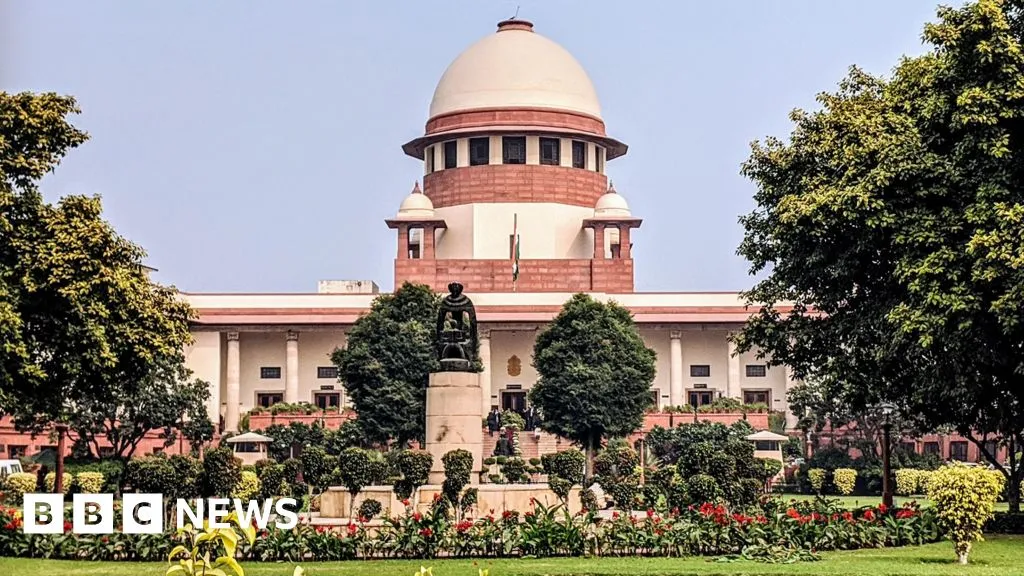
26 minutes agoAnahita SachdevGetty ImagesThe use of AI in legal settings remains mostly unregulated in IndiaIndia's Supreme Court has threatened legal consequences after a judge was found to have adjudicated on a property dispute using fake judgements generated by Artificial Intelligence.The top court, which was responding to an appeal by the defendants, will now examine the ruling given by the lower court in the southern state of Andhra Pradesh.The Supreme Court called the case a matter of "institutional concern" and said fake AI-generated judgements had "a direct bearing on integrity of adjudicatory process".The incident has made headlines, becoming the latest in a series of instances where AI has disrupted court proceedings in India and elsewhere in the worldThe problems in the case in Andhra Pradesh arose in August last year when a junior civil judge in the trial court in Vijaywada city passed an order in a case about a disputed property. The court had previously assigned an official to survey the property and file a report, which the defendants in the case objected to. The judge dismissed their objection, citing four past legal judgements - all of which were later found to be AI-generated.AI programmes have vastly simplified tasks in the workplace but generative AI systems are known for their ability to "hallucinate" and assert falsehoods as fact, even sometimes inventing sources for the inaccurate information.The defendants challenged the order in the state's high court, pointing out that the cited orders were fake. The high court acknowledged this, but accepted that the junior civil judge had made the error in "good faith" and went on to agree with the trial court's decision anyway.In its order, the high court said that "the citations may be non-existent, but if the learned trial court has considered the correct principles of law and its application to the facts of the case is also correct, mere mentioning of incorrect or non-existent rulings/citations in the order cannot be a ground to set aside the order".The high court had also sought a report from the junior judge who had used the AI-generated rulings. She told the court that this was her first time using an AI tool and she had believed the citations to be "genuine". She had no intention to misquote or misrepresent the rulings and that "the mistake occurred solely due to the reliance on an automatic source", the high court wrote.The high court also advocated for the "exercise of actual intelligence over Artificial Intelligence".Following this, the defendants appealed again, taking the matter to the Supreme Court, which was less forgiving about the impact of AI.Coming down sternly against the fake judgements, the top court last Friday stayed the lower court's order on the property dispute. It said the use of AI while making judgements was not simply "an error in decision making" but an act of "misconduct"."This case assumes considerable institutional concern, not because of the decision that was taken on the merits of the case, but about the process of adjudication and determination," the top court said.The court said it would examine the case in more detail and issued notices to the country's Attorney and Solicitor General, as well as the Bar Council of India.In another case last month, the Supreme Court raised concerns over the trend of lawyers using AI tools to draft petitions. "It is absolutely uncalled for," legal news website LiveLaw quoted the court as saying.India is not alone in reckoning with the effects of AI in courts.In October, two federal judges in the US were called out for the use of AI tools which led to errors in their rulings. In June 2025, the High Court of England and Wales warned lawyers not to use AI-generated case material after a series of cases cited fictitious or partially made up rulings.India's legal institutions are grappling alongside others around the world with how to regulate and monitor the use of AI in the courtroom.Last year, the Supreme Court published a white paper on AI in India's judiciary, in which it listed best practices as well as guidelines for AI use by judicial institutions, lawyers and clerks.The court stressed the need for human oversight and the importance of keeping institutional safeguards "firmly in place".
SRCBBC News - World
LANGEN
LEANCenter
WORDS703
ENT4
TUE · 2026-03-03 · 11:34 GMTBRIEF NSR-2026-0303-20957
NSR-2026-0303-20957News Report·EN·Legal & Judicial
India's top court angry after junior judge cites fake AI-generated orders
India's Supreme Court has threatened legal consequences after a junior judge cited fake AI-generated orders in a property dispute case in Andhra Pradesh. The incident occurred in August last year when a junior civil judge passed an order based on four alleged past judgements that were later found to be AI-generated.
BBC News - WorldFiled 2026-03-03 · 11:34 GMTLean · CenterRead · 3 min
BBC News - WorldFIG 01
Reading time
3min
Word count
703words
Sources cited
0cited
Entities identified
4entities
Quality score
100%
§ 01
Briefing Summary
AI-generatedNEWSAR · AI
India's Supreme Court has threatened legal consequences after a junior judge cited fake AI-generated orders in a property dispute case in Andhra Pradesh. The incident occurred in August last year when a junior civil judge passed an order based on four alleged past judgements that were later found to be AI-generated. The defendants challenged the decision, pointing out the fabricated citations. The high court acknowledged the error but accepted the trial court's decision, citing the principle of good faith. The junior judge had used an AI tool for the first time and believed the citations to be genuine. The Supreme Court has taken notice, calling it a matter of "institutional concern" and examining the ruling given by the lower court.
Confidence 0.90Claims 5Entities 4
§ 02
Article analysis
Model · rule-basedFraming
Legal & Judicial
Technology
Tone
Measured
AI-assessed
CalmNeutralAlarmist
Factuality
0.80 / 1.00
Factual
LowHigh
Sources cited
0
No named sources
FewMany
§ 03
Key claims
5 extracted01
The Supreme Court called the case a matter of 'institutional concern'.
quoteSupreme Court
Confidence
1.00
02
The junior judge said it was her first time using an AI tool and she believed the citations to be 'genuine'.
quotejunior judge
Confidence
1.00
03
The high court accepted that the junior civil judge had made the error in 'good faith'.
factual
Confidence
1.00
04
The Supreme Court stayed the lower court's order on the property dispute.
factual
Confidence
1.00
05
A judge adjudicated a property dispute using fake judgements generated by artificial intelligence.
factual
Confidence
1.00
§ 04
Full report
3 min read · 703 words§ 05
Entities
4 identifiedKey playerOppositionContextPositiveNeutralNegative
Organizations1
§ 06
Keywords & salience
10 termsartificial intelligence
1.00
ai-generated orders
0.90
fake judgements
0.80
legal settings
0.70
supreme court
0.70
court proceedings
0.60
integrity of adjudicatory process
0.60
junior judge
0.60
legal consequences
0.50
property dispute
0.50
§ 07
Topic connections
Interactive graph Network visualization showing 51 related topics
View Full Graph Person Organization Location Event|Click node to navigate|Edge numbers = shared articles