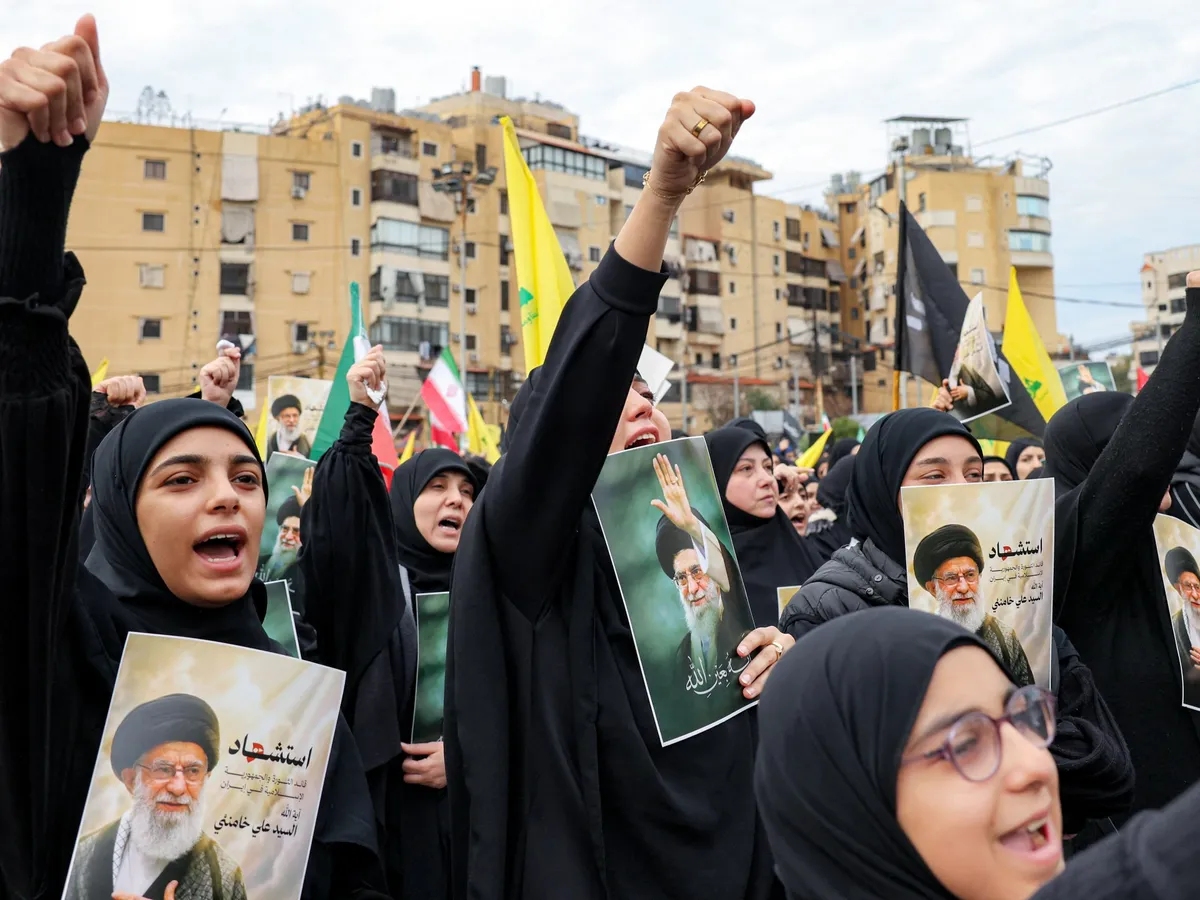
Mourners chant slogans during a memorial rally held by supporters of Lebanon’s Shia Muslim Hezbollah movement a day after Iran’s supreme leader was assassinated during a US and Israeli offensive on Tehran, in Beirut’s southern suburbs on March 1, 2026 [AFP]Published On 3 Mar 2026Beirut, Lebanon – Hezbollah raised the stakes for the Lebanese government on Tuesday, when it launched an attack on Israel’s Ramat Airbase and a barrage of rockets another military facility in the Israeli-occupied Golan Heights, a day after Prime Minister Nawaf Salam’s cabinet announced a ban on Hezbollah’s military and security activities.Analysts said that the Lebanese government’s decision, while difficult to implement, might have a decisive impact on the future of Lebanon. Some say it was a necessary step to bring decisions related to security and defence under the central government’s control, while others argue it raises the spectre of internal strife.Imad Salamey, a political scientist at the Lebanese American University, said that implementation of the government’s decision to disarm Hezbollah was “more plausible today than in previous years because the decision reflects unusually broad national backing, including from within the Shia political sphere”.“Amal’s vote in favour signals that support for consolidating arms under state authority is no longer framed purely as a sectarian or anti-resistance demand, but increasingly as a state-stabilisation necessity – especially amid economic collapse and regional escalation,” he said, referring to the other Lebanese Shia Muslim group headed by Parliament Speaker Nabih Berri.But Michael Young, a Lebanon expert at the Carnegie Middle East Center, said the decision was easier said than done.“Implementation is going to he much more complicated. The army is not enthusiastic to enter into a fight with Hezbollah,” Young told Al Jazeera.“It’s good that the state has taken this decision, but it is not good that the army seems very reluctant to implement this decision,” he added.The Iran-backed Hezbollah effectively joined the war that the United States and Israel started against Iran on Saturday when it launched a barrage of rockets and drones towards northern Israel on Monday, saying it was acting to avenge the killing of Iran’s Supreme Leader Ayatollah Ali Khamenei in Tehran and Israel’s near-daily attacks on Lebanon.Israel responded by hitting Beirut’s southern suburbs with loud attacks that woke many of the city’s residents up, and issued evacuation warnings for more than 50 towns, displacing tens of thousands of people from their homes.Hezbollah’s military actions bannedAs this unfolded, Salam’s cabinet met and debated the events before the prime minister called an emergency news conference.“We announce a ban on Hezbollah’s military activities and restrict its role to the political sphere,” Salam said in a news conference on Monday after the meeting.“We declare our rejection of any military or security operations launched from Lebanese territory outside the framework of legitimate institutions.”Lebanese Prime Minister Nawaf Salam speaks to journalists at the government headquarters in Beirut, Lebanon, December 3, 2025 [Mohamed Azakir/Reuters]He added that all of Hezbollah’s military or security activities are “illegal” and said security forces would “prevent any attacks originating from Lebanese territory” against Israel or other states.“We declare our commitment to the cessation of hostilities and the resumption of negotiations,” he said.The statement was the strongest stance against Hezbollah to date and even gained the support of Parliament Speaker, and longtime staunch Hezbollah ally, Nabih Berri, who leads the Amal Movement.Justice Minister Adel Nassar, meanwhile, ordered the arrest of the people who ordered the attack.A ‘landmark’ decisionHezbollah has been Lebanon’s strongest political and military force for decades. But the 2023-2024 war with Israel devastated the group. Hezbollah lost the majority of its military leadership, including longtime Secretary-General Hassan Nasrallah.Since the end of that war, a debate over Hezbollah’s weapons and role has ensued. Salam’s government has promised to disarm Hezbollah, while the group itself only accepted giving up its arms south of the Litani River that cuts across southern Lebanon.Despite a November 2024 ceasefire agreement, Israel continued to attack south and east Lebanon almost daily. But since Hezbollah’s retaliation, Israel has started bombing Beirut’s suburbs again. On Monday alone, Israel killed more than 52 people, wounded more than 150 others, struck targets all over Lebanon, and gave evacuation orders for more than 50 Lebanese towns.While Hezbollah’s first attack on Israel in over a year took many by surprise, Israel’s violent response did not.Critics of Hezbollah pointed out that the group had acted recklessly and gave Israel an excuse to unleash its fury on Lebanon. Israel has also spoken about a potential ground invasion.For analysts, the Lebanese government’s decision was a clear indication of how far the group has fallen since 2024.“The government’s decision to officially ban all Hezbollah activities represents a landmark shift in the position of the government toward disarming Hezbollah,” Dania Arayssi, a senior analyst at New Lines Institute for Strategy and Policy, told Al Jazeera. “This is a further reaffirmation that Hezbollah has lost a lot, if not all, its political power and influence in the Lebanese government.”Arayssi said Hezbollah’s diminished status since 2024 also meant that the likelihood of a clash between the group and the Lebanese Armed Forces (LAF) was minimal.“I don’t think there is a possibility of this leading to internal strife,” she said.Hezbollah challenges Salam’s governmentHezbollah did not welcome the announcement.The head of Hezbollah’s Parliamentary Bloc, Mohammad Raad, dispelled rumours of his assassination on Monday evening when he released a statement dismissing the government’s decision.“We see no justification for Prime Minister Salam and his government to take bombastic decisions against Lebanese citizens who reject the occupation and accuse them of violating the peace that the enemy itself has denied and refused to uphold for a year and four months,” Raad said in a statement. “[Israel] has imposed a state of daily war on the Lebanese people.”“The Lebanese were expecting a decision to ban aggression, but instead they are faced with a decision to ban the rejection of aggression,” Raad added.Jawad Salhab, a political researcher and analyst, called the government’s move “a grave betrayal of the Lebanese people and a grave betrayal of the Lebanese state, whose sovereignty has been violated for 15 months.”“Fifteen months of strategic patience have cost us more than 500 martyrs, while this Zionist enemy has persisted in its aggression against Lebanon and its sovereignty by air, land, and sea,” he said.Overnight on Monday, leading into Tuesday, Israel struck targets around Lebanon, including the southern suburbs of the capital Beirut. In one strike, Israel targeted al-Manar, Hezbollah’s television station.Then, on Tuesday morning, Hezbollah attacked Israel again, in what will be interpreted as a clear challenge to Salam’s announcement.The Lebanese army had been tasked with an earlier government decision to disarm Hezbollah and said in January that it completed the first phase south of the Litani River. But Hezbollah has refused to move along with phase two, set to take place between the Litani and the Awali River, which is near the city of Sidon.Nicholas Blanford, a nonresident senior fellow with the US-based Atlantic Council, told Al Jazeera that the government’s move was a “bold step” but one that might be difficult to enforce.
SRCAl Jazeera
LANGEN
LEANCenter
WORDS1 176
ENT11
TUE · 2026-03-03 · 14:27 GMTBRIEF NSR-2026-0303-20988
NSR-2026-0303-20988News Report·EN·National Security
Lebanon’s ban on Hezbollah ‘activities’: bold but difficult to implement
In March 2026, the Lebanese government, led by Prime Minister Nawaf Salam, announced a ban on Hezbollah's military and security activities. This decision followed Hezbollah's attack on Israel's Ramat Airbase and military facilities in the Golan Heights, which the group claimed was retaliation for the assassination of Iran's Supreme Leader and Israeli attacks on Lebanon.
Justin SalhaniAl JazeeraFiled 2026-03-03 · 14:27 GMTLean · CenterRead · 5 min
Al JazeeraFIG 01
Reading time
5min
Word count
1 176words
Sources cited
2cited
Entities identified
11entities
Quality score
100%
§ 01
Briefing Summary
AI-generatedNEWSAR · AI
In March 2026, the Lebanese government, led by Prime Minister Nawaf Salam, announced a ban on Hezbollah's military and security activities. This decision followed Hezbollah's attack on Israel's Ramat Airbase and military facilities in the Golan Heights, which the group claimed was retaliation for the assassination of Iran's Supreme Leader and Israeli attacks on Lebanon. Analysts suggest the ban, while difficult to enforce, could significantly impact Lebanon's future, potentially consolidating security under government control. While some Shia groups support the decision as a means of stabilizing the state, experts express concern about the army's reluctance to confront Hezbollah and the potential for internal conflict. The ban occurs against the backdrop of escalating regional tensions, including a US and Israeli offensive against Iran.
Confidence 0.90Sources 2Claims 5Entities 11
§ 02
Article analysis
Model · rule-basedFraming
National Security
Political Strategy
Tone
Mixed Tone
AI-assessed
CalmNeutralAlarmist
Factuality
0.70 / 1.00
Factual
LowHigh
Sources cited
2
Limited
FewMany
§ 03
Key claims
5 extracted01
Hezbollah launched a barrage of rockets and drones towards northern Israel.
factualarticle
Confidence
1.00
02
Hezbollah launched an attack on Israel’s Ramat Airbase and a barrage of rockets on the Golan Heights.
factualarticle
Confidence
1.00
03
Lebanon's government announced a ban on Hezbollah's military and security activities.
factualarticle
Confidence
1.00
04
Implementation of the government’s decision to disarm Hezbollah was “more plausible today than in previous years”.
quoteImad Salamey
Confidence
0.90
05
The army is not enthusiastic to enter into a fight with Hezbollah.
quoteMichael Young
Confidence
0.80
§ 04
Full report
5 min read · 1 176 words§ 05
Entities
11 identifiedKey playerOppositionContextPositiveNeutralNegative
People4
§ 06
Keywords & salience
10 termshezbollah
1.00
lebanon
0.90
ban on activities
0.80
israeli attacks
0.70
internal strife
0.60
security
0.60
economic collapse
0.50
iran
0.50
political sphere
0.50
military facility
0.40
§ 07
Topic connections
Interactive graph Network visualization showing 51 related topics
View Full Graph Person Organization Location Event|Click node to navigate|Edge numbers = shared articles