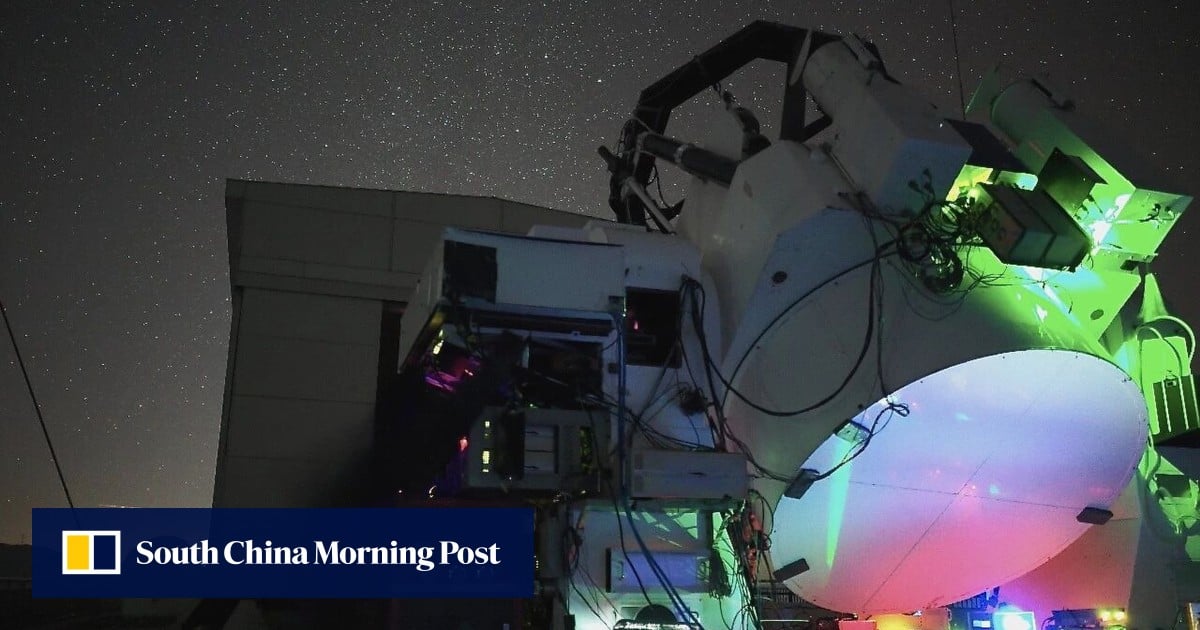
Chinese scientists have reported a milestone in space laser communications, sustaining a high-speed, hours-long laser link with a satellite more than 40,000km (25,000 miles) above the Earth. The capability is seen as critical to future deep-space networks.According to the Chinese Academy of Sciences’ Institute of Optics and Electronics, which led the project, researchers used a 1.8-metre (6-foot) aperture telescope in Yunnan province to lock onto a geostationary satellite within four seconds.During the experiment, which lasted more than three hours, the laser link sustained uninterrupted data transmission at 1 gigabit per second (Gbps) in both directions, the Sichuan Observer reported on Tuesday.The research team described the result as a “leading breakthrough” in long-duration, real-time communication in high orbit, where the tiniest of pointing errors or shifts in the atmosphere can break the beam.Lead researcher Liu Chao said high-orbit satellite-ground communication was often unstable and brief, sometimes lasting only minutes. And while data travels quickly from satellites, signals from Earth are much slower, making real-time interaction difficult.“It’s like sending someone 10 messages and getting only one reply,” Liu told the Sichuan Observer. “It’s hard to have an efficient conversation that way.”11:05Space race elevates Asia in new world order Space race elevates Asia in new world order
SRCSouth China Morning Post
LANGEN
LEANCenter-Right
WORDS204
ENT5
WED · 2026-03-04 · 13:30 GMTBRIEF NSR-2026-0304-21339
NSR-2026-0304-21339News Report·EN·Technology
China team’s space laser breakthrough takes communication speeds to high orbit
Chinese scientists have achieved a breakthrough in space laser communication, establishing a sustained, high-speed link with a satellite in geostationary orbit over 40,000km away. Researchers from the Chinese Academy of Sciences' Institute of Optics and Electronics used a telescope in Yunnan province to lock onto the satellite within seconds.
Ling XinSouth China Morning PostFiled 2026-03-04 · 13:30 GMTLean · Center-RightRead · 1 min
South China Morning PostFIG 01
Reading time
1min
Word count
204words
Sources cited
2cited
Entities identified
5entities
Quality score
100%
§ 01
Briefing Summary
AI-generatedNEWSAR · AI
Chinese scientists have achieved a breakthrough in space laser communication, establishing a sustained, high-speed link with a satellite in geostationary orbit over 40,000km away. Researchers from the Chinese Academy of Sciences' Institute of Optics and Electronics used a telescope in Yunnan province to lock onto the satellite within seconds. The experiment, lasting over three hours, maintained uninterrupted data transmission at 1 Gbps in both directions. This advancement is considered a significant step towards enabling long-duration, real-time communication in high orbit, which is crucial for future deep-space networks. The technology addresses the challenges of unstable and brief communication links, improving the efficiency of data exchange between Earth and satellites.
Confidence 0.90Sources 2Claims 5Entities 5
§ 02
Article analysis
Model · rule-basedFraming
Technology
National Security
Tone
Measured
AI-assessed
CalmNeutralAlarmist
Factuality
0.80 / 1.00
Factual
LowHigh
Sources cited
2
Limited
FewMany
§ 03
Key claims
5 extracted01
The research team described the result as a “leading breakthrough” in long-duration, real-time communication in high orbit.
quotenull
Confidence
1.00
02
High-orbit satellite-ground communication was often unstable and brief, sometimes lasting only minutes.
quoteLiu Chao
Confidence
1.00
03
The laser link sustained uninterrupted data transmission at 1 gigabit per second (Gbps) in both directions.
factualSichuan Observer
Confidence
1.00
04
Researchers used a 1.8-metre aperture telescope in Yunnan province to lock onto a geostationary satellite within four seconds.
factualChinese Academy of Sciences’ Institute of Optics and Electronics
Confidence
1.00
05
Chinese scientists sustained a high-speed laser link with a satellite more than 40,000km above the Earth.
factualnull
Confidence
1.00
§ 04
Full report
1 min read · 204 words§ 05
Entities
5 identifiedKey playerOppositionContextPositiveNeutralNegative
Organizations1
§ 06
Keywords & salience
8 termsspace laser communication
1.00
high orbit
0.80
satellite communication
0.70
data transmission
0.60
deep-space networks
0.50
1 gbps
0.50
telescope
0.40
china
0.40
§ 07
Topic connections
Interactive graph Network visualization showing 51 related topics
View Full Graph Person Organization Location Event|Click node to navigate|Edge numbers = shared articles