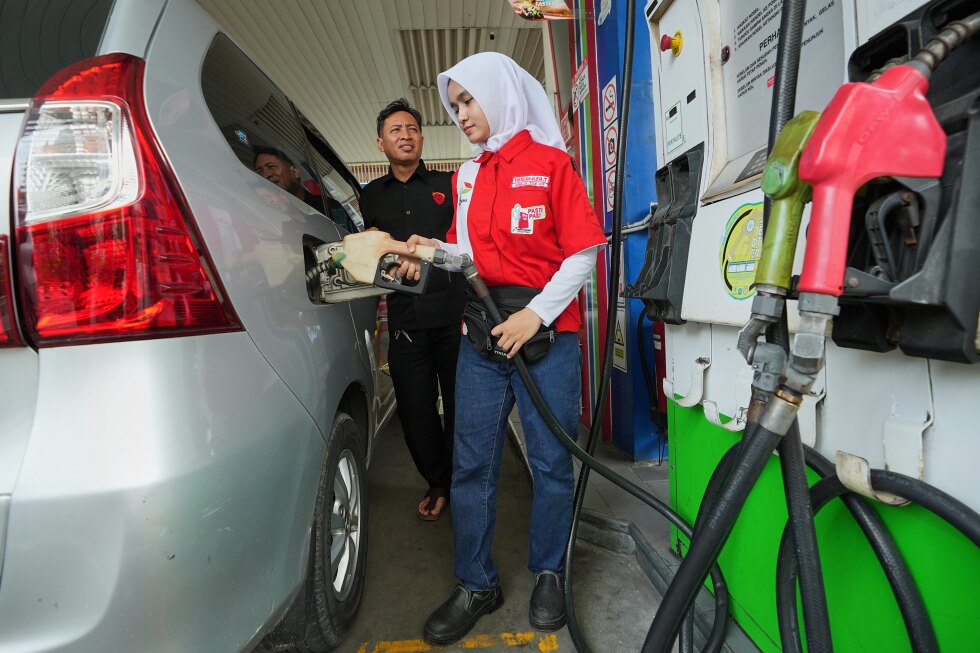
War with Iran chokes flows of oil and natural gas, highlighting energy security risks for Asia 1 of 3 | An employee fills up the fuel tank of a car at a gas station in Jakarta, Indonesia, Tuesday, March 3, 2026. (AP Photo/Achmad Ibrahim) 2 of 3 | A line of vehicles wait to fill fuel at a gas station Tuesday, March 3, 2026, in Yangon, Myanmar. (AP Photo) 3 of 3 | Hanging fuel nozzles are seen at a gasoline station in Manila, Philippines on Tuesday, March 3, 2026. (AP Photo/Aaron Favila) 1 of 3 An employee fills up the fuel tank of a car at a gas station in Jakarta, Indonesia, Tuesday, March 3, 2026. (AP Photo/Achmad Ibrahim) Add AP News on Google Add AP News as your preferred source to see more of our stories on Google. 2 of 3 A line of vehicles wait to fill fuel at a gas station Tuesday, March 3, 2026, in Yangon, Myanmar. (AP Photo) Add AP News on Google Add AP News as your preferred source to see more of our stories on Google. 3 of 3 Hanging fuel nozzles are seen at a gasoline station in Manila, Philippines on Tuesday, March 3, 2026. (AP Photo/Aaron Favila) Add AP News on Google Add AP News as your preferred source to see more of our stories on Google. Updated [hour]:[minute] [AMPM] [timezone], [monthFull] [day], [year] BANGKOK (AP) — Global energy trade is in turmoil as war around the Persian Gulf chokes off oil and natural gas shipments, causing prices to soar. Asia is the most exposed since it relies heavily on imported fuel, much of it shipped through the Strait of Hormuz, the narrow passageway that carries a fifth of global trade in crude oil and liquified natural gas, or LNG.About 13 million barrels of oil per day moved through the corridor in 2025, according to energy consultancy Kpler. That’s about a third of all seaborne crude, the unrefined petroleum that is processed into fuels such as gasoline and diesel.Roughly a fifth of the world’s LNG, natural gas cooled into liquid form for easier storage and transport, also flows through the straits. More than 80% of the LNG shipped through the strait in 2024 went to Asia, according to the U.S. Energy Information Administration. Since the Iran war began, the price of Brent crude, the international standard, has jumped 15% to about $84 per barrel, the highest level since July 2024. U.S. President Donald Trump said Tuesday the U.S. will offer risk insurance to shippers and may deploy its navy to protect vessels if needed. But the disruptions are cascading beyond the region. When supply tightens, richer nations outbid poorer ones for scarce cargoes, leaving more vulnerable economies short of fuel. This was seen during past energy shocks caused by Russia’s invasion of Ukraine in 2022.“The crisis, with the closure of the Hormuz Strait as the latest development, would not only raise oil and gas prices but also grind global economic activity to a halt,” said Zulfikar Yurnaidi, with the Association of Southeast Asian Nations ’ Centre for Energy. China and India potentially face big risksFor Asia’s two most populous countries, their huge scale magnifies the risks.China is the world’s largest crude oil importer and India comes in third. Sustained spikes in oil prices would ripple through their broader economies, straining transport, industry and households.China is the biggest buyer of Iranian oil, but Beijing has prioritized energy security and has alternatives, including major use of renewables. It imported about 1.4 million barrels per day from Iran last year, roughly 13% of its total seaborne crude imports, according to Kpler. Most of those shipments are already at sea and will cover another four to five months of demand, Kpler estimates. China also has substantial strategic petroleum reserves, though the exact amount is a state secret. It can buy more from Russia: China’s independent refiners – also known in the industry as ‘teapots’ – have been the key buyers for Iranian, Russian and Venezuelan oil, often at big discounts due to risks associated with Western sanctions. Despite war-related disruptions, global supplies are sufficient overall.“It is therefore unlikely that China would struggle to source enough crude to power its economy or meet domestic demand,” said Muyu Xu, a senior crude oil analyst at Kpler. “The real question is at what price.”India might resume purchases of Russian crude oil, despite pressure from Trump not to. It has enough crude reserves to last less than a month. The next two weeks will be critical and the situation could could deteriorate quickly, driving up fuel costs and broader inflation if the conflict drags on, according to energy analyst Vibhuti Garg with the Institute for Energy Economics and Financial Analysis, or IEEFA, in Delhi.“It is a very, very volatile situation,” Garg said.The main risk is higher prices for perishable foods vulnerable to supply shocks. At the same time, a weaker rupee and higher borrowing costs could slow the economy, she said.Japan, South Korea and Taiwan are most exposedFew regions are as exposed to Middle East energy flow disruptions as East Asia.Japan imported 2.34 million barrels of crude per day in January, about 95% of its total imports that month, according to its Ministry of Economy, Trade and Industry. Japan is often ranked as the world’s second-largest LNG importer.South Korea relies nearly entirely on energy imports. The Korea International Trade Association says it gets around 70% of its crude oil and 20% of its LNG from the Middle East. Taiwan also imports nearly all of its LNG. It has been trying to reduce its reliance on the Middle East but still sources about one-third from Qatar, which halted LNG production after attacks on its facilities.Japan and South Korea have large energy supply stockpiles. While Taiwan announced that it has enough supplies for March and contingency plans for the future.But analysts say reserves are temporary buffers and energy-intensive industries, like Taiwan’s semiconductor industry, remain vulnerable.Governments are in “hope for the best, prepare for the worst” mode, said Grant Hauber, with IEEFA, warning some may regret not diversifying sooner into renewables, a “natural hedge” against disruption.Fossil fuels dominate the energy mix in all three East Asian economies. Renewables provide under 10% of power in South Korea and Taiwan and about 22% in Japan, according to the International Energy Agency. Southeast Asia braces for energy issuesDeveloping, energy-hungry countries in Southeast Asia face the risk of being outbid by richer nations as supplies tighten.In Singapore, officials have warned businesses and households to brace for higher energy bills.In Manila, authorities banned non-essential travel and personal use of government cars to cut fuel use.In Thailand, officials have urged the public to save energy, as motorists lined up at filling stations as prices climbed.Full-time delivery riders and drivers — essential to keeping goods and people moving through Thailand’s congested urban centers — depend on fuel to earn a living. In the northern city of Chiang Rai, 64-year-old taxi driver Sommit Sutar said he can’t see how to conserve fuel and still work.“Gasoline was already expensive. This war will make the problem even worse,” Sutar said.The government has suspended petroleum exports to shore up domestic reserves, which it says can last up to 61 days while ramping up natural gas production from the Gulf of Thailand and Myanmar.Thailand relies heavily on spot-market LNG, leaving it “highly exposed to price and geopolitical volatility,” said Amy Kong, with the Brussels-registered research group Zero Carbon Analytics. That makes it vulnerable to bidding wars with wealthier nations.___Ghosal reported from Hanoi, Vietnam. Associated Press business writer Chan Ho-him in Hong Kong contributed to this report.___The Associated Press’ climate and environmental coverage receives financial support from multiple private foundations. The AP is solely responsible for all content. Find AP’s standards for working with philanthropies, a list of supporters and funded coverage areas at AP.org. Delgado covers climate and energy stories across Southeast Asia for The Associated Press. Ghosal covers the intersection of business and climate change in southeast Asia for The Associated Press. He is based out of Hanoi in Vietnam.
SRCAssociated Press (AP)
LANGEN
LEANCenter
WORDS1 348
ENT12
THU · 2026-03-05 · 07:23 GMTBRIEF NSR-2026-0305-21606
NSR-2026-0305-21606News Report·EN·Economic Impact
War with Iran chokes flows of oil and natural gas, highlighting energy security risks for Asia
A war with Iran has disrupted global energy trade, particularly impacting Asia due to its reliance on imported oil and natural gas shipped through the Strait of Hormuz. The Strait is a critical passageway for a fifth of global crude oil and liquified natural gas (LNG) trade.
By
ANTON L. DELGADO and ANIRUDDHA GHOSALAssociated Press (AP)Filed 2026-03-05 · 07:23 GMTLean · CenterRead · 6 min
Associated Press (AP)FIG 01
Reading time
6min
Word count
1 348words
Sources cited
4cited
Entities identified
12entities
Quality score
100%
§ 01
Briefing Summary
AI-generatedNEWSAR · AI
A war with Iran has disrupted global energy trade, particularly impacting Asia due to its reliance on imported oil and natural gas shipped through the Strait of Hormuz. The Strait is a critical passageway for a fifth of global crude oil and liquified natural gas (LNG) trade. In 2025, 13 million barrels of oil per day moved through the corridor. Since the war began, the price of Brent crude has risen 15% to $84 per barrel. The U.S. President has stated the U.S. will offer risk insurance to shippers and may deploy its navy to protect vessels.
Confidence 0.90Sources 4Claims 5Entities 12
§ 02
Article analysis
Model · rule-basedFraming
Economic Impact
National Security
Tone
Mixed Tone
AI-assessed
CalmNeutralAlarmist
Factuality
0.80 / 1.00
Factual
LowHigh
Sources cited
4
Well sourced
FewMany
§ 03
Key claims
5 extracted01
More than 80% of the LNG shipped through the strait in 2024 went to Asia.
statisticU.S. Energy Information Administration
Confidence
1.00
02
About 13 million barrels of oil per day moved through the Strait of Hormuz in 2025.
statisticenergy consultancy Kpler
Confidence
1.00
03
Since the Iran war began, the price of Brent crude has jumped 15% to about $84 per barrel.
factual
Confidence
0.90
04
Asia is the most exposed since it relies heavily on imported fuel.
factual
Confidence
0.90
05
War with Iran chokes off oil and natural gas shipments, causing prices to soar.
factual
Confidence
0.90
§ 04
Full report
6 min read · 1 348 words§ 05
Entities
12 identifiedKey playerOppositionContextPositiveNeutralNegative
People1
Organizations1
§ 06
Keywords & salience
10 termsenergy security
0.90
oil and natural gas
0.80
strait of hormuz
0.70
iran war
0.70
asia
0.70
crude oil
0.60
lng
0.60
supply disruptions
0.50
energy trade
0.50
persian gulf
0.40
§ 07
Topic connections
Interactive graph Network visualization showing 51 related topics
View Full Graph Person Organization Location Event|Click node to navigate|Edge numbers = shared articles