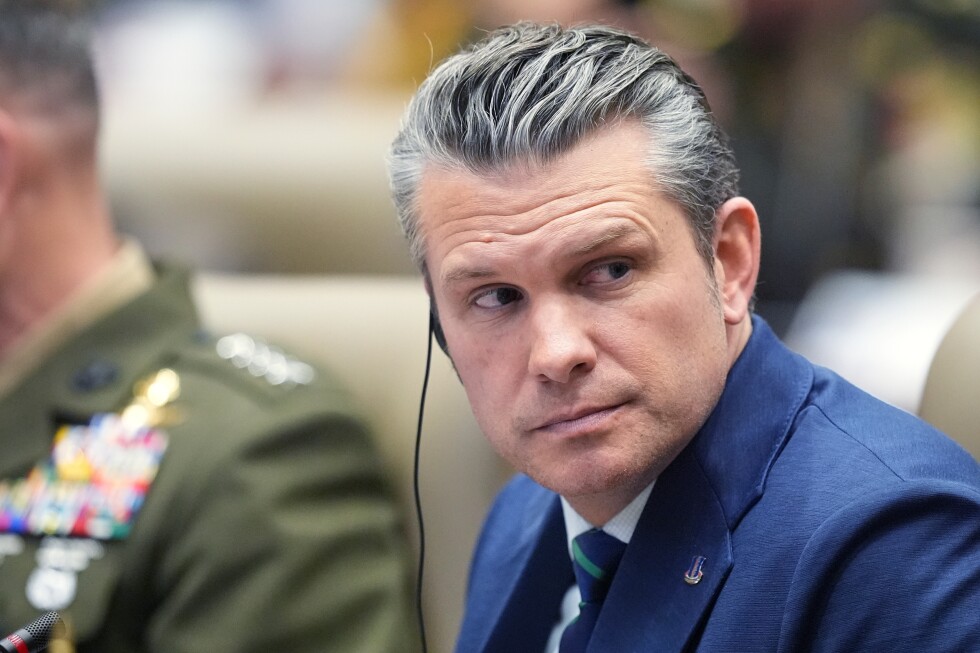
Hegseth urges Latin American allies to go on offense against drug cartels 1 of 5 | Defense Secretary Pete Hegseth listens during the inaugural Americas Counter Cartel Conference at U.S. Southern Command in Doral, Fla., Thursday, March 5, 2026. (AP Photo/Rebecca Blackwell) 2 of 5 | White House deputy chief of staff Stephen Miller listens during the inaugural Americas Counter Cartel Conference at U.S. Southern Command in Doral, Fla., Thursday, March 5, 2026. (AP Photo/Rebecca Blackwell) 3 of 5 | White House deputy chief of staff Stephen Miller, left, and Defense Secretary Pete Hegseth arrive at the inaugural Americas Counter Cartel Conference at U.S. Southern Command in Doral, Fla., Thursday, March 5, 2026. (AP Photo/Rebecca Blackwell) 4 of 5 | Defense Secretary Pete Hegseth speaks at the inaugural Americas Counter Cartel Conference at U.S. Southern Command in Doral, Fla., Thursday, March 5, 2026. (AP Photo/Rebecca Blackwell) 5 of 5 | From left, White House deputy chief of staff Stephen Miller, Defense Secretary Pete Hegseth and Gen. Francis L. Donovan, Commander of the Southern Command, arrive at the inaugural Americas Counter Cartel Conference at U.S. Southern Command in Doral, Fla., Thursday, March 5, 2026. (AP Photo/Rebecca Blackwell) 1 of 5 Defense Secretary Pete Hegseth listens during the inaugural Americas Counter Cartel Conference at U.S. Southern Command in Doral, Fla., Thursday, March 5, 2026. (AP Photo/Rebecca Blackwell) Add AP News on Google Add AP News as your preferred source to see more of our stories on Google. 2 of 5 White House deputy chief of staff Stephen Miller listens during the inaugural Americas Counter Cartel Conference at U.S. Southern Command in Doral, Fla., Thursday, March 5, 2026. (AP Photo/Rebecca Blackwell) Add AP News on Google Add AP News as your preferred source to see more of our stories on Google. 3 of 5 White House deputy chief of staff Stephen Miller, left, and Defense Secretary Pete Hegseth arrive at the inaugural Americas Counter Cartel Conference at U.S. Southern Command in Doral, Fla., Thursday, March 5, 2026. (AP Photo/Rebecca Blackwell) Add AP News on Google Add AP News as your preferred source to see more of our stories on Google. 4 of 5 Defense Secretary Pete Hegseth speaks at the inaugural Americas Counter Cartel Conference at U.S. Southern Command in Doral, Fla., Thursday, March 5, 2026. (AP Photo/Rebecca Blackwell) Add AP News on Google Add AP News as your preferred source to see more of our stories on Google. 5 of 5 From left, White House deputy chief of staff Stephen Miller, Defense Secretary Pete Hegseth and Gen. Francis L. Donovan, Commander of the Southern Command, arrive at the inaugural Americas Counter Cartel Conference at U.S. Southern Command in Doral, Fla., Thursday, March 5, 2026. (AP Photo/Rebecca Blackwell) Add AP News on Google Add AP News as your preferred source to see more of our stories on Google. Updated [hour]:[minute] [AMPM] [timezone], [monthFull] [day], [year] MIAMI (AP) — Defense Secretary Pete Hegseth on Thursday urged Latin American countries to take a more aggressive approach against drug cartels, warning that the Trump administration would be forced to act by itself if governments fail to effectively combat criminal organizations that directly threaten the United States and border security.“America is prepared to take on these threats and go on the offense alone if necessary,” Hegseth said in a speech at U.S. Southern Command in Miami with defense officials from allied governments around the region.Hegseth spoke at what the Pentagon billed as the first “Americas Counter Cartel Conference,” with representatives from Argentina, Honduras and the Dominican Republic among more than a dozen conservative governments closely aligned with President Donald Trump. Most of the military leaders came to Florida with their presidents, who on Saturday are scheduled to attend a summit with Trump at his nearby golf club. The defense secretary said the U.S. and Latin America had a shared Christian heritage and that it was at stake as a result of decades of inaction and a purely law enforcement approach to fighting organized crime and terrorist networks in the Western Hemisphere. “Business as usual will not stand,” he said, pledging U.S. support to combat cartels, restore deterrence and “make the Americas great again.”His comments were echoed by Stephen Miller, the deputy White House chief of staff who is a key architect of Trump’s aggressive stance in the region. “Cartels that operate in this hemisphere are the ISIS (Islamic State group) and al-Qaida of this hemisphere and must be treated just as ruthlessly,” Miller said, adding that “hard power” and lethal force — not criminal justice — must be used to repel the groups.“The human rights that we are going to protect are not those of the savages that rape, torture and murder but those of the average citizens,” he said. The meetings come as the Republican administration seeks to leverage military assets to restore dominance in the hemisphere while now also fighting a war in Iran.When Trump took office in January 2025, he pledged a renewed focus on Latin American, a strategic pivot that his national security strategy describes as the “Trump Corollary” to the 19th-century Monroe Doctrine, which sought to ban European incursions in the Americas. Key to that objective is a greater reliance on the U.S. military to neutralize drug cartels long blamed for soaring crime and murder rates that hold back Latin America’s economic potential and fuel migration to the United States.“For too long, leaders in Washington abandoned the simple wisdom of the Monroe Doctrine,” Hegseth said, referring to Trump’s focus on the region’s security as the “Donroe Doctrine.”Trump early on designated cartels from Mexico and Venezuela as foreign terrorist organizations. Later, he declared that Washington was in “armed conflict” with those groups.The extraordinary assertion of presidential power to combat drug trafficking is at the heart of the White House’s legal rationale for dozens of strikes on suspected drug smugglers in the Caribbean Sea and Eastern Pacific Ocean — so far, 44 boat strikes that have resulted in at least 150 deaths. A massive naval deployment, unseen in Latin America since the end of the Cold War, also paved the way for the U.S. military operation in early January that captured Venezuela’s then-president, Nicolas Maduro. He is now facing drug charges in New York.Trump’s approach has won support among conservatives in the region such as El Salvador’s Nayib Bukele, who rode to power on promises to use a “mano dura” — iron fist — against criminal groups. Just this week, Ecuador for the first time carried out joint operations with U.S. military forces against organized crime groups.But relying on the military to supplant the role traditionally performed by civilian law enforcement entails risks in a region where military institutions and oversight are weaker, armed forces have a legacy of human rights abuses and corruption is a perennial challenge. “Without strong rule-of-law institutions and civilian oversight, militarizing the fight against cartels can weaken the very institutions needed to defeat them,” said Rebecca Bill Chavez, president of the Inter-American Dialogue and a former deputy assistant defense secretary for Western Hemisphere affairs. Goodman is a Miami-based investigative reporter who writes about the intersection of crime, corruption, drug trafficking and politics in Latin America. He previously spent two decades reporting from South America.
SRCAssociated Press (AP)
LANGEN
LEANCenter
WORDS1 205
ENT7
THU · 2026-03-05 · 16:23 GMTBRIEF NSR-2026-0305-21790
NSR-2026-0305-21790News Report·EN·National Security
Hegseth urges Latin American allies to go on offense against drug cartels
On March 5, 2026, Defense Secretary Pete Hegseth attended the inaugural Americas Counter Cartel Conference at U.S. Southern Command in Doral, Florida.
By
JOSHUA GOODMANAssociated Press (AP)Filed 2026-03-05 · 16:23 GMTLean · CenterRead · 5 min
Associated Press (AP)FIG 01
Reading time
5min
Word count
1 205words
Sources cited
0cited
Entities identified
7entities
Quality score
100%
§ 01
Briefing Summary
AI-generatedNEWSAR · AI
On March 5, 2026, Defense Secretary Pete Hegseth attended the inaugural Americas Counter Cartel Conference at U.S. Southern Command in Doral, Florida. The conference brought together Latin American allies to discuss strategies for combating drug cartels. Hegseth urged these allies to take a more offensive approach against the cartels. White House Deputy Chief of Staff Stephen Miller also attended the conference. The event aimed to strengthen cooperation and coordination in the fight against drug trafficking in the Americas.
Confidence 0.90Claims 3Entities 7
§ 02
Article analysis
Model · rule-basedFraming
National Security
Political Strategy
Tone
Measured
AI-assessed
CalmNeutralAlarmist
Factuality
0.70 / 1.00
Factual
LowHigh
Sources cited
0
No named sources
FewMany
§ 03
Key claims
3 extracted01
Stephen Miller and Pete Hegseth attended the Americas Counter Cartel Conference.
factualAP News
Confidence
1.00
02
The Americas Counter Cartel Conference took place at U.S. Southern Command in Doral, Fla., Thursday, March 5, 2026.
factualAP News
Confidence
1.00
03
Pete Hegseth urges Latin American allies to go on offense against drug cartels.
factualArticle Title
Confidence
1.00
§ 04
Full report
5 min read · 1 205 words§ 05
Entities
7 identifiedKey playerOppositionContextPositiveNeutralNegative
People3
Organizations1
§ 06
Keywords & salience
6 termsdrug cartels
1.00
latin american allies
0.80
offense
0.70
americas counter cartel conference
0.60
u.s. southern command
0.50
pete hegseth
0.50
§ 07
Topic connections
Interactive graph Network visualization showing 51 related topics
View Full Graph Person Organization Location Event|Click node to navigate|Edge numbers = shared articles