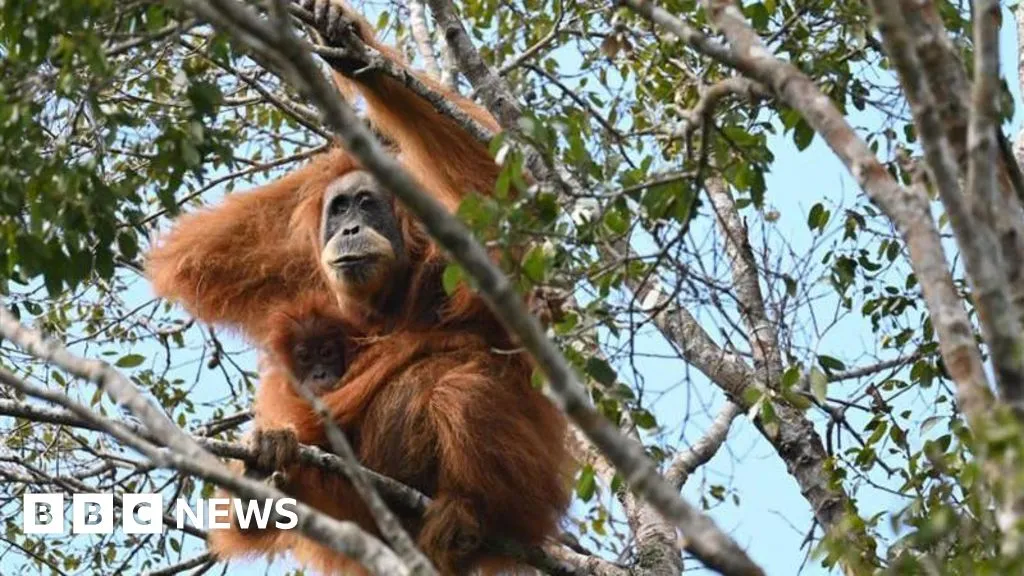
5 hours agoNavin Singh KhadkaEnvironment correspondent, BBC World ServiceOrangutan Information CentreThe Tapanuli orangutan was only discovered by scientists to be a separate species in 2017 – distinct from the Sumatran and Bornean apesAn unusual silence in the forests of north Sumatra in Indonesia is worrying wildlife experts and conservationists. Here, in the mountainous forests of Batang Toru, is where they had always seen and heard the world's rarest ape, the Tapanuli orangutans.But ever since Cyclone Senyar devastated Sumatra on 25 November, the critically endangered primates have not been seen in the area, conservation workers say.Their absence has fuelled speculation as to whether the great apes were swept away by floods and landslides. And while some believe the animals may have travelled to a safer location, a carcass found in the area, said to be that of an orangutan, is fuelling conservationists' fears.Fewer than 800 Tapanuli orangutans remain and any loss would have a serious impact on the species, conservationists say.Humanitarian workers told the BBC they found the dead animal semi-buried in the debris of mud and logs in Pulo Pakkat village in central Tapanuli district earlier this week."When I first saw it I was not sure what it was, because it was kind of defaced, perhaps because it was buried underneath by the sludge and logs," said Deckey Chandra, who has been working with a humanitarian team in the area. He previously worked in the conservation of the Tapanuli orangutans."I have seen several dead bodies of humans in the past few days but this was the first dead wildlife," he said. "They used to come to this place to eat fruits. But now it seems to have become their graveyard."Getty ImagesCyclone Senyar swept across Sumatra in late November, devastating the Indonesian islandMr Chandra shared with the BBC pictures he took of the carcass, some of which show him with the dead animal.Conservationists working in the region believe it is of the Tapanuli orangutan, a species that was only discovered in 2017. The other two species are Bornean and Sumatran orangutans.More than 900 people have died as a result of heavy rain, floods and landslides since Cyclone Senyar ravaged parts of Indonesia in late November. Hundreds are still missing, with many villages in Sumatra completely destroyed as the storm swept across the island.Professor Erik Meijaard, managing director of Borneo Futures in Brunei, is now studying the disasters' impact on the orangutans with the help of satellite images.He said 4,800 hectares (11,860 acres) of forest on the mountain slopes can be seen as destroyed by landslides - but since part of the satellite image is cloud covered, he's extrapolated the destruction figure to 7,200 hectares in his preliminary observation."The destroyed areas would have contained some 35 orangutans, and considering the violence of the destruction it wouldn't surprise us if they are all dead. That's a major blow to the population," he told the BBC."These areas show as bare soil on satellite imagery where two weeks ago it was primary forest. Complete destruction. Many patches of several hectares completely denuded. It must have been hellish in the forest at the time."Prof Mejjard said he too has seen the picture of the dead orangutan shared by Chandra."What struck me is that all the flesh had been ripped off the face," he said. "If a few hectares of forest comes down in massive landslides, even powerful orangutans are helpless and just get mangled."Panut Hadisiswoyo, founder of Orangutan Information Centre which works for the conservation of the primates in the region, said the carcass meant it was highly possible some Tapanuli orangutans were unable to escape as rushing waters and landslides swept through their habitat.Getty ImagesExperts suggest that as much as 7,200 hectares of forest was destroyed in the recent cyclonePictures showing the carcass of a Sumatran elephant, another critically endangered species, being swept away by floods in Aceh in northern Sumatra went viral on social media last week.The island hosts a range of endangered species like Sumatran tigers, elephants and rhinos.But conservation workers say there are particular concerns for orangutans and other primates, like gibbons, because huge parts of the mountainous forest in the Tapanuli district saw massive landslides due to Cyclone Senyar's extreme rainfall.Some locals say the primates must have escaped before the disaster struck, as they can sense danger beforehand. But some primate experts say that may not have been the case."During heavy rains orangutans either just sit in a tree or gather branches and leaves to use as an umbrella and then wait for the rain to stop," said Serge Wich, professor of primate biology at Liverpool John Moores University, who has conducted research on Tapanuli orangutans."But this time, by the time the rain stopped it was too late: parts of their habitat - the slopes of valleys - were wiped out by landslides, which means there must have been consequences for them."The recent floods have also damaged a number of orangutan research centres in Sumatra - including at Ketambe, the world's first orangutan research centre, in Aceh.Dr Ian Singleton, scientific director for the Sumatran Orangutan Conservation Programme, said the Ketambe centre is now almost completely destroyed. "It needs to be rebuilt as soon as possible so it can continue to play that role in protecting the forests in that area and its orangutans."
SRCBBC News - World
LANGEN
LEANCenter
WORDS882
ENT5
FRI · 2025-12-12 · 00:08 GMTBRIEF NSR-2025-1212-2197
NSR-2025-1212-2197News Report·EN·Environmental
Fears grow that world's rarest apes were swept away in Sumatran floods
Wildlife experts are concerned about the critically endangered Tapanuli orangutans in North Sumatra, Indonesia, after Cyclone Senyar struck in late November. The apes, only identified as a distinct species in 2017, have not been seen or heard in their usual habitat in the Batang Toru forests since the cyclone caused devastating floods and landslides.
BBC News - WorldFiled 2025-12-12 · 00:08 GMTLean · CenterRead · 4 min
BBC News - WorldFIG 01
Reading time
4min
Word count
882words
Sources cited
4cited
Entities identified
5entities
Quality score
100%
§ 01
Briefing Summary
AI-generatedNEWSAR · AI
Wildlife experts are concerned about the critically endangered Tapanuli orangutans in North Sumatra, Indonesia, after Cyclone Senyar struck in late November. The apes, only identified as a distinct species in 2017, have not been seen or heard in their usual habitat in the Batang Toru forests since the cyclone caused devastating floods and landslides. Conservationists fear the orangutans may have been swept away, a concern heightened by the discovery of a carcass believed to be that of a Tapanuli orangutan. With fewer than 800 individuals remaining, any loss would severely impact the species. Over 900 people have died in Indonesia due to the cyclone, and the impact on the orangutan population is being studied.
Confidence 0.90Sources 4Claims 5Entities 5
§ 02
Article analysis
Model · rule-basedFraming
Environmental
Human Interest
Tone
Mixed Tone
AI-assessed
CalmNeutralAlarmist
Factuality
0.80 / 1.00
Factual
LowHigh
Sources cited
4
Well sourced
FewMany
§ 03
Key claims
5 extracted01
More than 900 people have died as a result of heavy rain, floods and landslides since Cyclone Senyar ravaged parts of Indonesia.
statisticnull
Confidence
1.00
02
Humanitarian workers found a dead animal semi-buried in the debris of mud and logs in Pulo Pakkat village.
factualHumanitarian workers
Confidence
1.00
03
Fewer than 800 Tapanuli orangutans remain.
statisticconservationists
Confidence
1.00
04
Tapanuli orangutans have not been seen in the Batang Toru forests since Cyclone Senyar devastated Sumatra on 25 November.
factualconservation workers
Confidence
0.90
05
The destroyed areas would have contained some 35 orangutans, and considering the violence of the destruction it wouldn't surprise us if they are all dead.
predictionProfessor Erik Meijaard
Confidence
0.60
§ 04
Full report
4 min read · 882 words§ 05
Entities
5 identifiedKey playerOppositionContextPositiveNeutralNegative
§ 06
Keywords & salience
8 termstapanuli orangutan
1.00
sumatra floods
0.90
endangered species
0.80
cyclone senyar
0.70
conservation
0.60
landslides
0.50
wildlife
0.40
great apes
0.40
§ 07
Topic connections
Interactive graph No topic relationship data available yet. This graph will appear once topic relationships have been computed.