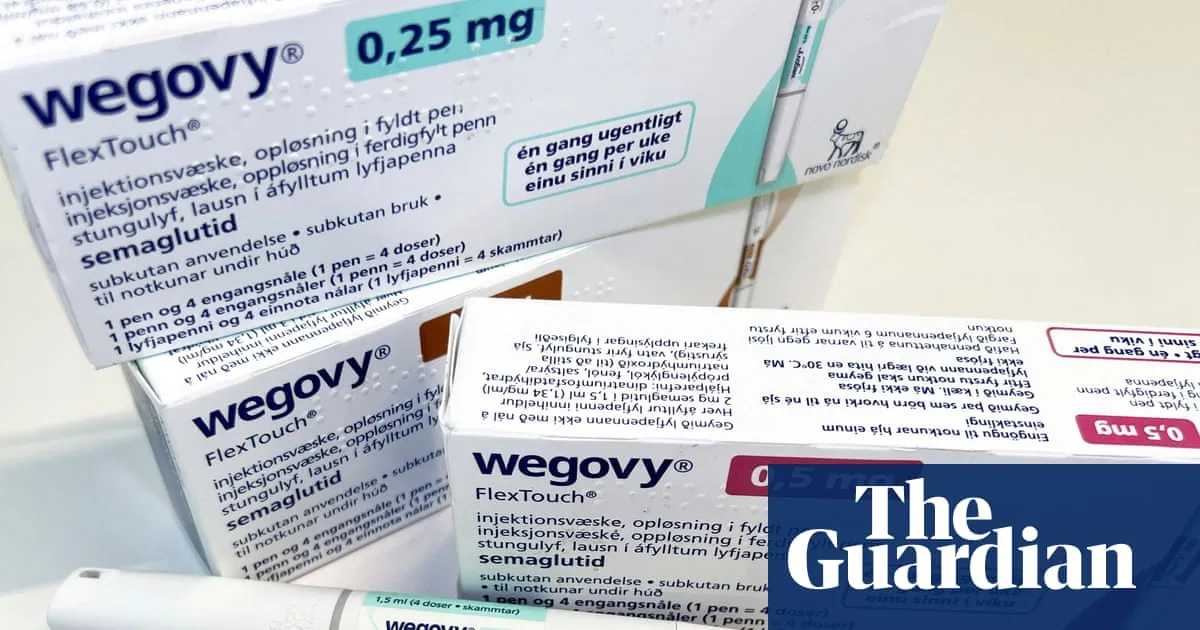
Weight-loss drugs cannot rescue the UK from its deepening obesity crisis and produce unpleasant side-effects for many users, the government’s chief medical adviser has said.Prof Chris Whitty delivered a wide-ranging critique of the drugs during a speech in London on Thursday evening.“Just relying on the drugs seems to me the wrong answer,” he said.Prof Chris Whitty, Photograph: Kirsty O’Connor/PAHis scepticism about drugs such as Mounjaro and Wegovy, known as GLP-1 agonists, contrasted with the health secretary, Wes Streeting, who has hailed them as a “real gamechanger” in tackling obesity.Giving the annual Medical Journalists’ Association lecture, Whitty cautioned against relying too much on the drugs to treat obesity. Tougher action to curb junk food advertising and make food healthier to prevent obesity occurring would be a better course of action to take, he said.“Does anyone in this group believe that the correct answer is to allow obesity to rise because of pretty aggressive marketing of obesogenic foods to children and them stick them on GLP-1 agonists at the age of 18? I think it is shocking if that is where we end up.“Really, is our answer to say ‘give up on public health’, which we know will work, in children and then just rely on drugs to get us out of a hole? I do not think this is a socially acceptable answer. Actually, I do not think that’s a medically acceptable answer, because these drugs are not benign,” Whitty said.“GLP-1s, they are very good drugs. [But] we know that if you stop them, the weight comes on again. Some people have very bad reactions to them. It’s very small numbers, but they do. And a large number of people have unpleasant side-effects, largely gastrointestinal,” he added.GLP-1s, sometimes called “fat jabs”, have been shown to increase the risk of complications such as severe acute pancreatitis, sudden sight loss and unexpected pregnancy among women using contraception.With weight regain common after coming off GLP-1s, they could also mean that people end up in older age with less muscle mass and more fat than before they began taking them, he added.Decades of policy in the UK to halt the rise in obesity has failed, in contrast to the success of other countries at doing so, but their achievements show it can be done, Whitty said. He added he was “really worried” that obesity was worsening, unlike campaigns to prevent smoking and air pollution.“In obesity, things are going the wrong way. They don’t have to. In France, for example, levels of obesity are pretty well the same now as they were in 1990. No one can claim the French don’t like their food,” he said.Asked if ministers should encourage or force food firms to make their products healthier, Whitty said that “reformulation definitely has a part to play in this” and urged them to put less sugar and fat in their products.Industries that would face tough action to improve public health use “very strong lobbyists” to persuade the media to run stories that then deter ministers from taking the bold steps needed, he added. The media then depict policies which would be beneficial as “nanny state”, even though most voters want action taken.Obesity experts welcomed Whitty’s remarks.Sonia Pombo, the head of research and impact at Action on Salt and Sugar, said: “Weight-loss drugs are not, and must never be treated as, a substitute for a strong, effective food policy. Depending on GLP-1s to counter the harms of an unhealthy food environment is simply putting a plaster on a system that continues to generate ill health.”Katharine Jenner, the director of the Obesity Health Alliance, said: “It is not a commonsense approach for the government to continue to let children grow up in environments flooded with unhealthy options, only to rely on medicines later in life to address the harm. We should not accept a system where the food industry drives obesity and the pharmaceutical industry is left to pick up the pieces.“Childhood obesity is preventable. Stronger action, from reformulating food and restricting junk food advertising aimed at children to setting targets for companies to reduce sales of unhealthy processed products, can help create healthier environments and better outcomes. The UK should be guided by the evidence and act far more boldly to prevent obesity before it starts.”
SRCThe Guardian - World News
LANGEN
LEANCenter-Left
WORDS711
ENT7
FRI · 2026-03-06 · 15:00 GMTBRIEF NSR-2026-0306-22091
NSR-2026-0306-22091News Report·EN·Public Health
Weight-loss drugs alone will not solve UK’s obesity crisis, says Chris Whitty
Professor Chris Whitty, the UK's chief medical adviser, has expressed concerns that relying solely on weight-loss drugs to tackle the country's obesity crisis is not a viable solution. In a speech, he stated that these medications are not a "benign" option and can have unpleasant side effects for many users.
Denis Campbell Health policy editorThe Guardian - World NewsFiled 2026-03-06 · 15:00 GMTLean · Center-LeftRead · 3 min
The Guardian - World NewsFIG 01
Reading time
3min
Word count
711words
Sources cited
1cited
Entities identified
7entities
Quality score
100%
§ 01
Briefing Summary
AI-generatedNEWSAR · AI
Professor Chris Whitty, the UK's chief medical adviser, has expressed concerns that relying solely on weight-loss drugs to tackle the country's obesity crisis is not a viable solution. In a speech, he stated that these medications are not a "benign" option and can have unpleasant side effects for many users. Whitty also highlighted the risk of weight regain after stopping the medication and potential long-term health consequences. He argued that tougher action to curb junk food advertising and make food healthier is needed to prevent obesity from occurring in the first place. The UK's approach to addressing obesity has been criticized as failing, with other countries achieving success through similar measures. Whitty emphasized the need for a comprehensive strategy to combat obesity, rather than relying on medication alone.
Confidence 0.90Sources 1Claims 5Entities 7
§ 02
Article analysis
Model · rule-basedFraming
Public Health
Political Strategy
Tone
Measured
AI-assessed
CalmNeutralAlarmist
Factuality
0.70 / 1.00
Factual
LowHigh
Sources cited
1
Limited
FewMany
§ 03
Key claims
5 extracted01
Wes Streeting has hailed weight-loss drugs as a “real gamechanger” in tackling obesity.
factualnull
Confidence
1.00
02
Weight-loss drugs cannot rescue the UK from its deepening obesity crisis.
quoteChris Whitty
Confidence
0.90
03
GLP-1s have been shown to increase the risk of complications such as severe acute pancreatitis.
factualnull
Confidence
0.80
04
GLP-1s, if stopped, lead to weight regain.
factualChris Whitty
Confidence
0.80
05
Some people have very bad reactions to GLP-1 drugs.
factualChris Whitty
Confidence
0.70
§ 04
Full report
3 min read · 711 words§ 05
Entities
7 identifiedKey playerOppositionContextPositiveNeutralNegative
Organizations2
§ 06
Keywords & salience
10 termsweight-loss drugs
1.00
chris whitty
0.90
obesity crisis
0.90
glp-1 agonists
0.80
public health
0.70
uk
0.70
junk food advertising
0.60
side-effects
0.60
weight regain
0.50
obesogenic foods
0.50
§ 07
Topic connections
Interactive graph No topic relationship data available yet. This graph will appear once topic relationships have been computed.