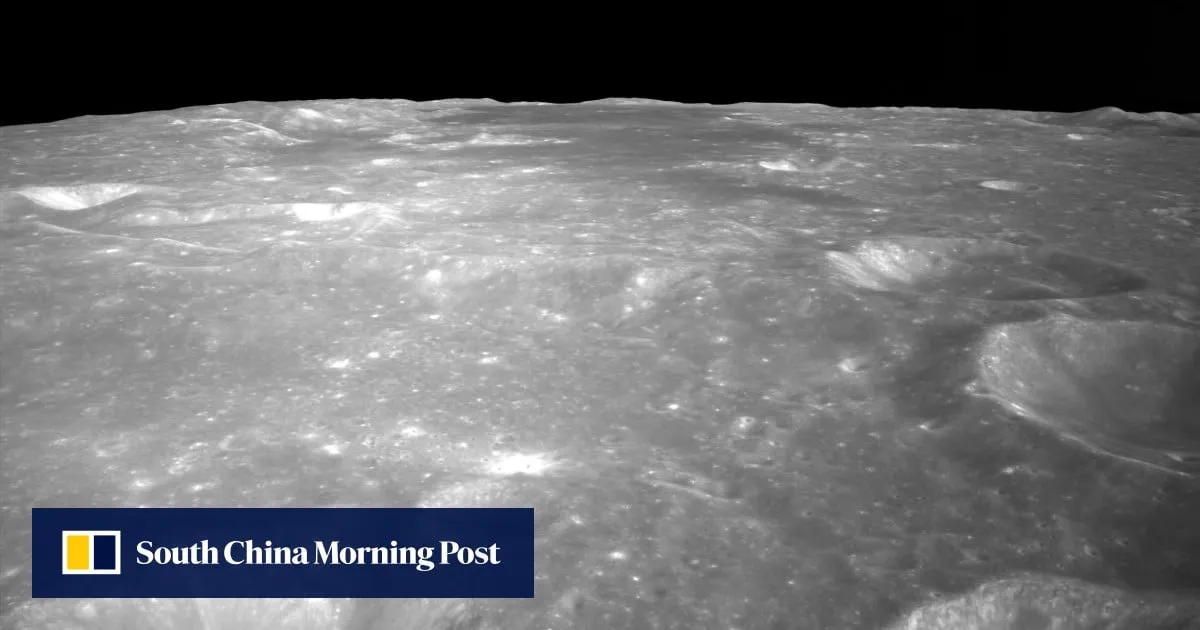
Chinese scientists have used AI to determine the chemical make-up of the Moon’s far side, offering new insights into one of lunar science’s enduring mysteries.Nearly half the Moon’s surface – the far side which permanently faces away from the Earth – had long remained chemically unmapped.But samples from China’s Chang’e-6 mission, combined with advanced technologies, have enabled a team led by the Shanghai Institute of Technical Physics (SITP) to crack the lunar chemical code.Researchers from SITP, an affiliate of the Chinese Academy of Sciences, teamed up with peers from Tongji University in Shanghai and several other Chinese institutes for the study.It enabled the creation of the first high-precision global distribution map of major oxides on the Moon, according to findings published last month in the peer-reviewed journal Nature Sensors.“The study revealed the exposure characteristics of deep materials in the South Pole-Aitken basin and the compositional patterns of far-side lunar terrains,” SITP said in a statement this week.
SRCSouth China Morning Post
LANGEN
LEANCenter-Right
WORDS157
ENT5
SAT · 2026-03-07 · 13:00 GMTBRIEF NSR-2026-0307-22356
NSR-2026-0307-22356News Report·EN·Technology
Chinese scientists use AI model to crack mystery of moon’s far side
Chinese scientists have utilized artificial intelligence to analyze data from the Chang'e-6 mission and other sources, successfully mapping the chemical composition of the moon's far side. This achievement addresses a long-standing challenge in lunar science, as nearly half of the moon's surface had remained chemically unmapped.
Dannie PengSouth China Morning PostFiled 2026-03-07 · 13:00 GMTLean · Center-RightRead · 1 min
South China Morning PostFIG 01
Reading time
1min
Word count
157words
Sources cited
1cited
Entities identified
5entities
Quality score
100%
§ 01
Briefing Summary
AI-generatedNEWSAR · AI
Chinese scientists have utilized artificial intelligence to analyze data from the Chang'e-6 mission and other sources, successfully mapping the chemical composition of the moon's far side. This achievement addresses a long-standing challenge in lunar science, as nearly half of the moon's surface had remained chemically unmapped. The research team, led by the Shanghai Institute of Technical Physics (SITP), collaborated with other Chinese institutions to create a high-precision global distribution map of major oxides on the moon. Published in Nature Sensors, the findings reveal insights into the South Pole-Aitken basin and the compositional patterns of the lunar far side. This new map provides valuable data for understanding the moon's formation and evolution.
Confidence 0.90Sources 1Claims 4Entities 5
§ 02
Article analysis
Model · rule-basedFraming
Technology
Tone
Measured
AI-assessed
CalmNeutralAlarmist
Factuality
0.80 / 1.00
Factual
LowHigh
Sources cited
1
Limited
FewMany
§ 03
Key claims
4 extracted01
The study revealed the exposure characteristics of deep materials in the South Pole-Aitken basin and the compositional patterns of far-side lunar terrains.
quoteSITP
Confidence
1.00
02
Samples from China’s Chang’e-6 mission, combined with advanced technologies, have enabled a team to crack the lunar chemical code.
factual
Confidence
1.00
03
Nearly half the moon’s surface – the far side which permanently faces away from the Earth – had long remained chemically unmapped.
factual
Confidence
1.00
04
Chinese scientists have used AI to determine the chemical make-up of the moon’s far side.
factual
Confidence
1.00
§ 04
Full report
1 min read · 157 words§ 05
Entities
5 identifiedKey playerOppositionContextPositiveNeutralNegative
Organizations1
Events1
§ 06
Keywords & salience
9 termsmoon's far side
1.00
ai model
0.80
lunar science
0.80
chemical make-up
0.70
major oxides
0.60
chang'e-6 mission
0.60
chinese scientists
0.50
south pole-aitken basin
0.50
lunar terrains
0.40
§ 07
Topic connections
Interactive graph Network visualization showing 9 related topics
View Full Graph Person Organization Location Event|Click node to navigate|Edge numbers = shared articles