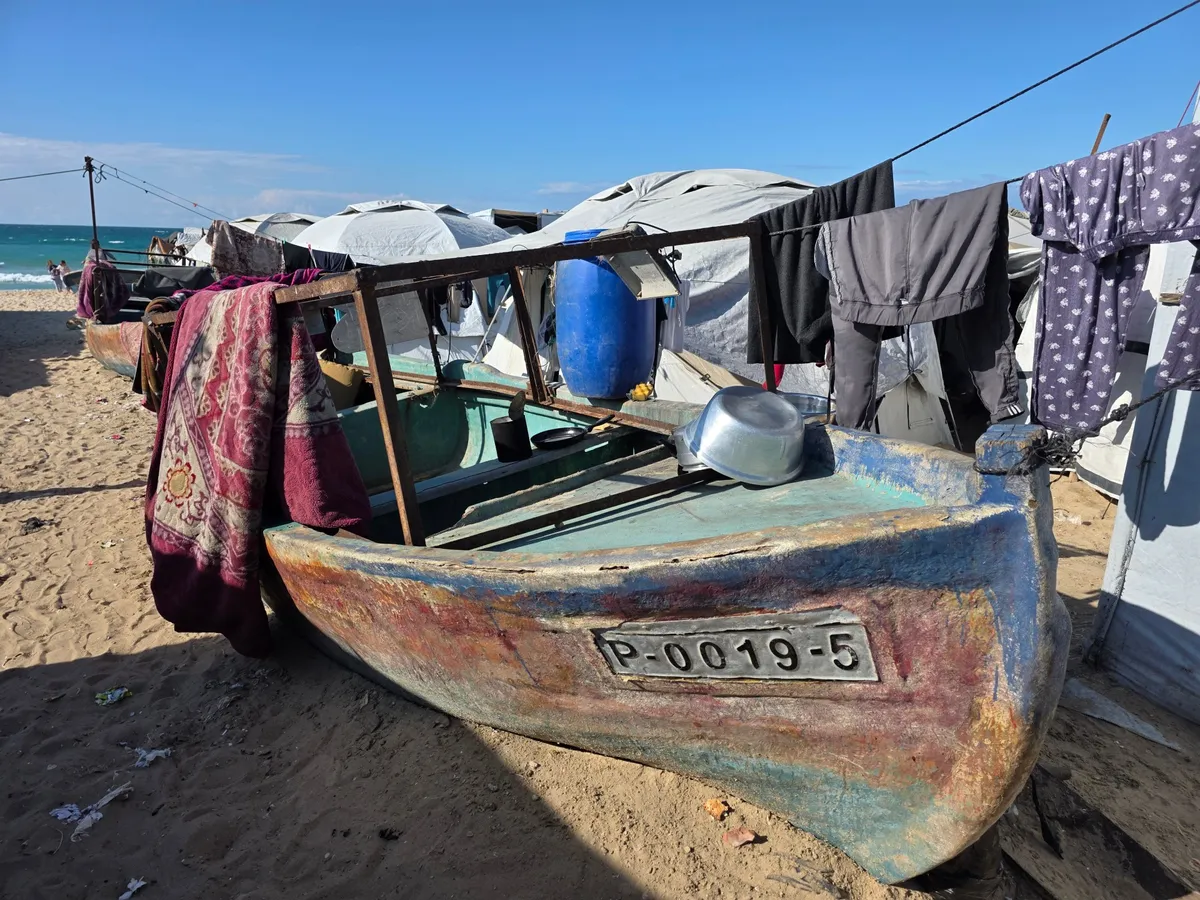
Gaza’s fishing industry collapses under Israeli blockade, leaving fishermen risking their lives for minimal catches.Fishing boats destroyed by Israeli forces, now used as tents supports [Ahmed Al-Najjar/Al Jazeera]Published On 8 Mar 2026Khan Younis, Gaza Strip – On the blue, wavy surface off the Khan Younis seaport, two Palestinian fishermen paddled their small, battered boat nearly 200 metres (656 feet) into the sea. On the shore, Dawood Sehwail, a 72-year-old Palestinian fisherman, stood inspecting a torn net, his eyes fixed on the waves as if reading a language only he understands.Displaced from Rafah, further to the south, in May 2024 as a result of Israel’s genocidal war on Gaza, Sehwail now comes daily to the water’s edge, not just to fish, but to have an escape, to study the sea, and to remember.Recommended Stories list of 3 itemslist 1 of 3100,000 pray at Al-Aqsa amid Israeli restrictions on 2nd Friday of Ramadanlist 2 of 3US citizens’ support for Israel at historic low over Gaza genocide: Polllist 3 of 3Green Party wins UK by-election in blow to Labour, PM Starmerend of list“The feeling never gets old,” he said, with a sparkle in his eye that defies his age. “You come to see what wonders the sea might still have for you.”“We were always shackled [by Israel],” Sehwail said quietly. “But one period was less harsh than another.”Even before October 2023, when Israel started its genocidal war on Gaza, the Palestinian enclave’s fishermen operated under heavy restrictions imposed by Israel. Fishing zones were repeatedly reduced. Maritime boundaries outlined in agreements since the 1993 Oslo Accords were rarely implemented on the water. The distances fishermen were permitted to travel in the sea constantly shifted, often shrinking without warning.“After every Israeli aggression, the consequences fell on us,” Sehwail explained. “We were supposed to [be allowed to] go further into the sea, but the occupation kept pushing us back.”Fisherman Adnan Sehwail risks his life every time he gets on a boat in Gaza [Ahmed Al-Najjar/Al Jazeera]Controlling the seaFor a coastal territory, the sea should have been a source of wealth, stability, and fresh food. Instead, under Israel’s blockade that controls Gaza’s land, air, and sea since 2007, it has become another mechanism of control and persecution.Sehwail once owned a stone distribution business, but was forced to shut it down after the Israeli blockade on Gaza tightened in 2007. He eventually turned to fishing, a skill he had learned as a child, and which he once thought he had abandoned.“Our profession is day by day,” he said. “It used to be that, if you work, and are lucky, you can sell your catch and feed your family. If you’re very lucky, you save a little for the future of your children.”But within a few days of Israel’s genocidal war, everything changed. Gaza’s seaport was destroyed by Israeli air strikes. Israel also bombed fishing installations from north to south. Boats were burned or sunk. The sector collapsed almost instantly.“The Rafah fishermen had six fishing trawlers,” Sehwail recalled. “All of them were bombed and burned. I tried to keep my own small boat and nets for as long as I could, but they were destroyed by the occupation just days before we were displaced in May 2024.”At Khan Younis port, the aftermath is no different. The harbour has turned into a crowded displacement site. Broken or burned boats are no longer vessels but tent supports, tied with ropes to hold fragile shelters in place.A rusted metal skeleton of a trawler protrudes from the sand where displaced children now play around. But even in ruin, fishermen improvise.“What we do now is try not to die,” Sehwail said. “We borrow tools. Some even turn refrigerator parts into floating boards. We have no motors, only paddles. We use whatever is left.”Originally from the coastal village of Jourat Asqalan, depopulated of its Palestinian residents during the 1948 Nakba and the formation of Israel, Sehwail’s bond with the sea runs generations deep. “The connection is powerful,” he said. “My home in Rafah was also near the beach. Even in displacement, the sea keeps me company. But now my children and their families are scattered across displacement camps.”No safetyMaterial destruction has been only part of the toll for Gaza’s fishermen. According to the Gaza Fishermen’s Syndicate, at least 238 fishermen have been killed by Israel since October 2023, whether at sea or on land, among more than 72,000 Palestinians.The sector once consisted of more than 5,000 fishermen providing for more than 50,000 family members, who depended on fishing as a primary source of income. And Israeli violations have continued since the “ceasefire” began in October, with more than 20 fishermen reported to have been killed or detained.“The sea is practically closed,” said Zakaria Baker, the head of Gaza’s Fishermen Syndicate, in a recent interview with Al Jazeera.Baker explained that some fishermen do not risk venturing more than 800 metres (2,625 feet) offshore in small boats, as there is still uncertainty over how far they can go into the sea.Standing on the shore, Sehwail pointed toward an Israeli naval boat.“They are always there,” he said. “There is no official clearance for us. We enter at our own risk. The farthest we can go is about 800 metres, and even that depends on their mood.”He described sudden chases by the Israeli navy: boats shot at or sunk, fishermen detained.“They can see clearly what we are doing,” he said. “But it depends on the soldier’s mood whether he lets you fish or decides to shoot you dead.”“Israel ‘executed’ fishing in Gaza,” Sehwail said, repeating the phrase in pain. “What we do now is not real fishing. It’s risking your life for the hope of bringing back one or two fish to your tent.”Critical source of foodBefore the genocide, Gaza’s fisheries sector played a vital role in food security and poverty alleviation. According to the United Nations, by the end of 2024, the sector was operating at less than 7.3 percent of its pre-October 2023 production capacity. The UN also estimated that 72 percent of Gaza’s fishing fleet had been damaged or destroyed.The collapse has severely affected food availability, income generation, and community resilience. The reduction of fishing access to less than a nautical mile (1.85km) has drastically limited both quantity and species variety.“The further west we used to go, the more variety [of fish] we could find,” Sehwail explained. “But now in shallow waters, you find only small quantities and mostly juvenile sardines that should be left to grow. But people needed whatever they could find.”Months of Israeli starvation have turned fresh protein into a rarity; thus, fish is a special luxury.Even now, with the relative relief brought by the “ceasefire”, fish seen in Gaza’s markets are largely frozen imports, often more expensive than fresh local fish was before the genocide. Catastrophic economic collapse means many families cannot afford them.Baker emphasised that rehabilitation and recovery require more than ceasefire declarations. “No materials or compensation have been allowed in so far,” he said, “Israeli restrictions continue to block the entry of equipment. Fishermen need stable and safe conditions to return to work without fear of Israeli bullets.”“The fishermen are simple, poor people,” Sehwail said. “We only want to live with dignity and provide for our families. Across Gaza from north to south, we’re all in need of support to finally fish as we actually deserve.”
SRCAl Jazeera
LANGEN
LEANCenter
WORDS1 226
ENT6
SUN · 2026-03-08 · 06:13 GMTBRIEF NSR-2026-0308-22477
NSR-2026-0308-22477News Report·EN·Human Rights
Palestinians risk life and limb to fish in Gaza’s Israeli-controlled sea
Since 2007, the Israeli blockade of Gaza has devastated the Palestinian fishing industry. Fishermen like Dawood Sehwail, displaced from Rafah, face severe restrictions imposed by Israel, including reduced fishing zones and constantly shifting maritime boundaries.
Ahmed Al-NajjarAl JazeeraFiled 2026-03-08 · 06:13 GMTLean · CenterRead · 5 min
Al JazeeraFIG 01
Reading time
5min
Word count
1 226words
Sources cited
1cited
Entities identified
6entities
Quality score
100%
§ 01
Briefing Summary
AI-generatedNEWSAR · AI
Since 2007, the Israeli blockade of Gaza has devastated the Palestinian fishing industry. Fishermen like Dawood Sehwail, displaced from Rafah, face severe restrictions imposed by Israel, including reduced fishing zones and constantly shifting maritime boundaries. These restrictions, intensified after each Israeli aggression, limit catches and endanger lives. The sea, once a source of livelihood and stability, has become another means of control, forcing many, like Adnan Sehwail, to risk their lives for minimal returns. The situation has forced some fishermen to repurpose destroyed boats for shelter.
Confidence 0.90Sources 1Claims 5Entities 6
§ 02
Article analysis
Model · rule-basedFraming
Human Rights
Economic Impact
Tone
Mixed Tone
AI-assessed
CalmNeutralAlarmist
Factuality
0.60 / 1.00
Mixed
LowHigh
Sources cited
1
Limited
FewMany
§ 03
Key claims
5 extracted01
Israel’s blockade controls Gaza’s land, air, and sea since 2007.
factual
Confidence
0.90
02
After every Israeli aggression, the consequences fell on us.
quoteDawood Sehwail
Confidence
0.90
03
Fishing boats destroyed by Israeli forces are now used as tents.
factual
Confidence
0.90
04
Gaza’s fishing industry collapses under Israeli blockade.
factual
Confidence
0.80
05
Israel started its genocidal war on Gaza in October 2023.
factual
Confidence
0.70
§ 04
Full report
5 min read · 1 226 words§ 05
Entities
6 identifiedKey playerOppositionContextPositiveNeutralNegative
Locations5
§ 06
Keywords & salience
8 termsgaza
1.00
israeli blockade
0.90
fishing industry
0.90
palestinian fishermen
0.80
fishing zones
0.60
maritime boundaries
0.60
israeli aggression
0.50
oslo accords
0.40
§ 07
Topic connections
Interactive graph Network visualization showing 51 related topics
View Full Graph Person Organization Location Event|Click node to navigate|Edge numbers = shared articles