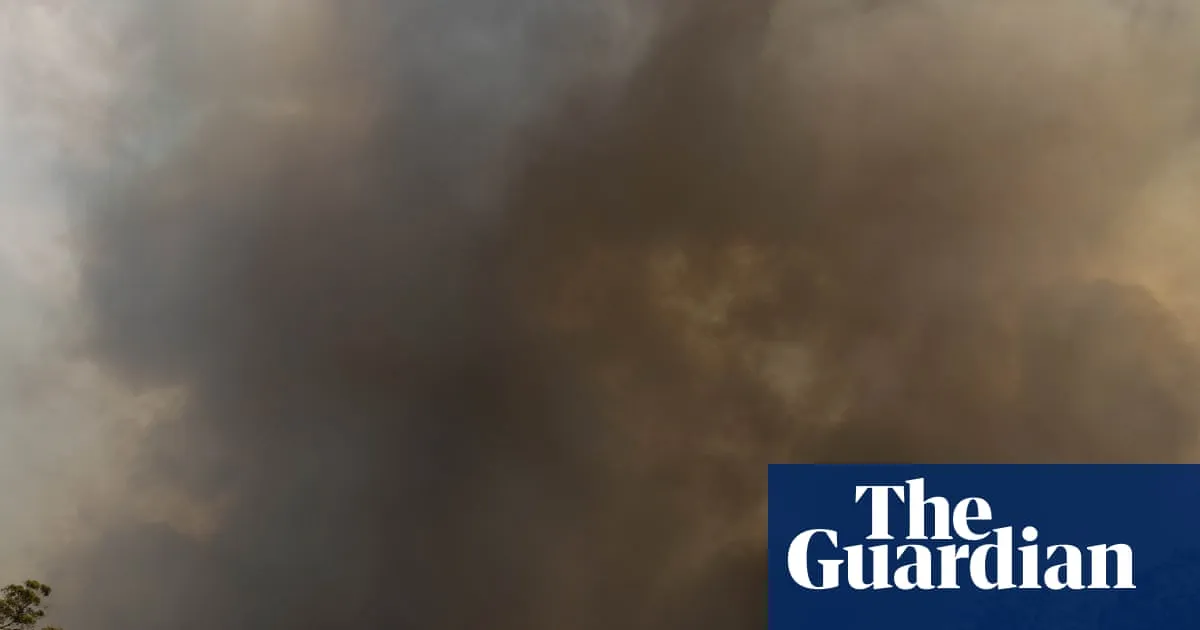
Bushfires have been ravaging Australia, with more than 50 burning throughout New South Wales, destroying homes and causing at least one death. Nine blazes remained out of control on Monday as flames ripped through homes and critical infrastructure. Scorching temperatures – peaking at 41C in Koolewong – combined with fierce, erratic winds to spread the fires rapidly and made them harder to control.On Sunday night an Australian firefighter was killed after a tree fell on him while he worked on a fire near Bulahdelah, about 150 miles (250km) north of Sydney. The blaze scorched 3,500 hectares (8,600 acres) and destroyed four homes over the weekend. NSW, one of Australia’s most fire-prone regions, is particularly vulnerable because of its hot, dry climate and vast eucalyptus forests, which shed oils that become highly flammable.Farther south, Tasmania faced its own emergency, with a fast-moving 700-hectare fire at Dolphin Sands destroying 19 homes and damaging at least 40 more, leaving coastal communities reeling.Authorities warn the heightened bushfire threat is being fuelled by rising temperatures and a dangerous build-up of vegetation. Previous years of La Niña weather systems had unusually wet summers, resulting in dense growth across forests and grasslands. However, recent months of below-average rainfall have rapidly dried that vegetation, turning it into abundant, volatile fuel. With the season already labelled as “high risk”, many fear this could be Australia’s most dangerous summer since the “black summer” fires of 2019-20.Meanwhile, the US state of Washington is bracing for dangerous flooding as an atmospheric river continues to drench the Pacific north-west. Authorities issued immediate evacuation orders for about 100,000 residents on Thursday as relentless rain pummelled the region for another day.In just 24 hours, north-west Washington has been hit with 120-205mm of rainfall, with flooding from the Cascade Foothills to Puget Sound expected to worsen through Friday. Rivers across the state are surging towards their most severe flood classifications, with several threatening to break historic records. The Skagit River, one of Washington’s largest, is forecast to crest 6ft above its previous peak.Elsewhere in the US, hurricane-force winds topping 80mph left thousands without power in Alaska’s Matanuska-Susitna borough over the weekend, closing schools and businesses and damaging homes. The strong gusts were caused by a clash of weather systems; a cold, dense high-pressure mass over the Copper River basin collided with a warmer low-pressure system moving in from the Gulf of Alaska. The contrast created a siphon-like effect, funnelling frigid air down the mountain valleys and driving it into what is known as a katabatic wind.
SRCThe Guardian - World News
LANGEN
LEANCenter-Left
WORDS420
ENT6
FRI · 2025-12-12 · 10:00 GMTBRIEF NSR-2025-1212-2252
NSR-2025-1212-2252News Report·EN·Environmental
Weather tracker: Australia bushfires could be most dangerous since ‘black summer’
Bushfires are raging across Australia, particularly in New South Wales and Tasmania, prompting fears of a season as dangerous as the 2019-20 "black summer." Over 50 fires are burning in NSW, destroying homes, infrastructure, and causing at least one death. Hot temperatures, high winds, and abundant dry vegetation are fueling the blazes.
Ishani MistryThe Guardian - World NewsFiled 2025-12-12 · 10:00 GMTLean · Center-LeftRead · 2 min
The Guardian - World NewsFIG 01
Reading time
2min
Word count
420words
Sources cited
0cited
Entities identified
6entities
Quality score
100%
§ 01
Briefing Summary
AI-generatedNEWSAR · AI
Bushfires are raging across Australia, particularly in New South Wales and Tasmania, prompting fears of a season as dangerous as the 2019-20 "black summer." Over 50 fires are burning in NSW, destroying homes, infrastructure, and causing at least one death. Hot temperatures, high winds, and abundant dry vegetation are fueling the blazes. In Tasmania, a fast-moving fire destroyed 19 homes and damaged at least 40 others. Meanwhile, in the US, Washington state is experiencing severe flooding due to an atmospheric river, leading to evacuation orders for approximately 100,000 residents. Record-breaking rainfall has caused rivers to surge, threatening historic flood levels. In Alaska, hurricane-force winds left thousands without power and damaged homes.
Confidence 0.90Claims 5Entities 6
§ 02
Article analysis
Model · rule-basedFraming
Environmental
Human Interest
Tone
Mixed Tone
AI-assessed
CalmNeutralAlarmist
Factuality
0.80 / 1.00
Factual
LowHigh
Sources cited
0
No named sources
FewMany
§ 03
Key claims
5 extracted01
A fast-moving 700-hectare fire at Dolphin Sands destroyed 19 homes and damaged at least 40 more in Tasmania.
factual
Confidence
1.00
02
An Australian firefighter was killed after a tree fell on him while he worked on a fire near Bulahdelah.
factual
Confidence
1.00
03
Bushfires have been ravaging Australia, with more than 50 burning throughout New South Wales.
factual
Confidence
1.00
04
The heightened bushfire threat is being fuelled by rising temperatures and a dangerous build-up of vegetation.
factualAuthorities
Confidence
0.90
05
Many fear this could be Australia’s most dangerous summer since the “black summer” fires of 2019-20.
prediction
Confidence
0.70
§ 04
Full report
2 min read · 420 words§ 05
Entities
6 identifiedKey playerOppositionContextPositiveNeutralNegative
§ 06
Keywords & salience
9 termsbushfires
1.00
australia
0.90
extreme weather
0.80
flooding
0.70
rising temperatures
0.60
new south wales
0.60
atmospheric river
0.50
vegetation
0.50
hurricane-force winds
0.40
§ 07
Topic connections
Interactive graph Network visualization showing 51 related topics
View Full Graph Person Organization Location Event|Click node to navigate|Edge numbers = shared articles