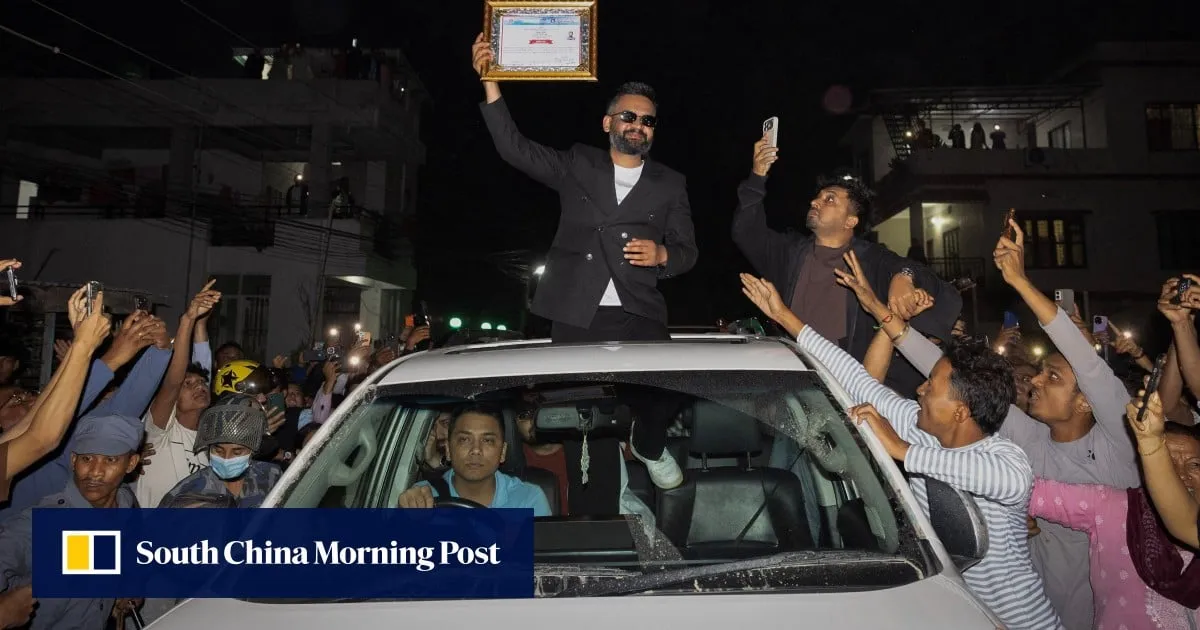
A Nepali political party led by an ex-rapper is set for a landslide victory in the country’s first parliamentary election since Gen Z protests ousted the old leadership that has ruled the Himalayan nation for decades.The Rastriya Swatantra, or the National Independent Party (RSP), formed only four years ago, had already won 117 of 165 directly elected seats and led in eight other constituencies in the results published on Sunday morning by Nepal’s Election Commission.Other political parties and independent candidates had won 36 seats in total so far. Officials were still counting the votes on Sunday, and final results were expected later in the week.The party’s prime ministerial candidate is rapper-turned-politician Balendra Shah, who won the 2022 Kathmandu mayoral race. He emerged as a leading figure in the 2025 uprising that ousted former Prime Minister Khadga Prasad Oli.In Nepal, voters directly elect 165 members to the House of Representatives, the lower chamber of Parliament. The remaining 110 seats in the 275-member body are allocated through a proportional representation system, under which political parties are assigned seats based on their share of the vote. On Sunday, RSP was also leading, with about 51 per cent of the 110 seats.The relatively new RSP has unseated the two long-dominant parties: the Nepali Congress and the Communist Party of Nepal (Unified Marxist–Leninist), who have taken turns ruling the country.Local papers called the sweeping win a historic moment. “RSP set for a landslide victory,” said the popular Himalayan Times. “People’s ballot revolt; shift in political paradigm,” said Annapurna Post.
SRCSouth China Morning Post
LANGEN
LEANCenter-Right
WORDS254
ENT5
SUN · 2026-03-08 · 11:00 GMTBRIEF NSR-2026-0308-22538
NSR-2026-0308-22538News Report·EN·Political Strategy
Nepali ex-rapper will form government after landslide election win
In Nepal's first parliamentary election since Gen Z protests, the Rastriya Swatantra Party (RSP), led by ex-rapper Balendra Shah, is poised for a landslide victory. Formed just four years ago, the RSP has already secured 117 of 165 directly elected seats, unseating the long-dominant Nepali Congress and Communist Party of Nepal.
Associated PressSouth China Morning PostFiled 2026-03-08 · 11:00 GMTLean · Center-RightRead · 2 min
South China Morning PostFIG 01
Reading time
2min
Word count
254words
Sources cited
1cited
Entities identified
5entities
Quality score
100%
§ 01
Briefing Summary
AI-generatedNEWSAR · AI
In Nepal's first parliamentary election since Gen Z protests, the Rastriya Swatantra Party (RSP), led by ex-rapper Balendra Shah, is poised for a landslide victory. Formed just four years ago, the RSP has already secured 117 of 165 directly elected seats, unseating the long-dominant Nepali Congress and Communist Party of Nepal. Shah, who also won the 2022 Kathmandu mayoral race and was a key figure in the 2025 uprising, is the party's prime ministerial candidate. The RSP is also leading in proportional representation, potentially securing over half of the 110 seats allocated through this system. Final results are expected later in the week, marking a significant shift in Nepal's political landscape.
Confidence 0.90Sources 1Claims 5Entities 5
§ 02
Article analysis
Model · rule-basedFraming
Political Strategy
Human Interest
Tone
Measured
AI-assessed
CalmNeutralAlarmist
Factuality
0.80 / 1.00
Factual
LowHigh
Sources cited
1
Limited
FewMany
§ 03
Key claims
5 extracted01
RSP set for a landslide victory.
quoteHimalayan Times
Confidence
1.00
02
Balendra Shah, a rapper-turned-politician, is the party’s prime ministerial candidate.
factual
Confidence
1.00
03
The Rastriya Swatantra Party (RSP) had won 117 of 165 directly elected seats.
statistic
Confidence
1.00
04
RSP was also leading, with about 51 per cent of the 110 seats.
statistic
Confidence
0.90
05
A Nepali political party led by an ex-rapper is set for a landslide victory.
factual
Confidence
0.90
§ 04
Full report
2 min read · 254 words§ 05
Entities
5 identifiedKey playerOppositionContextPositiveNeutralNegative
Organizations1
§ 06
Keywords & salience
9 termsnepali election
1.00
political party
0.80
landslide victory
0.70
rastriya swatantra party
0.70
political paradigm shift
0.60
balendra shah
0.60
proportional representation
0.50
gen z protests
0.50
rapper-turned-politician
0.40
§ 07
Topic connections
Interactive graph Network visualization showing 51 related topics
View Full Graph Person Organization Location Event|Click node to navigate|Edge numbers = shared articles