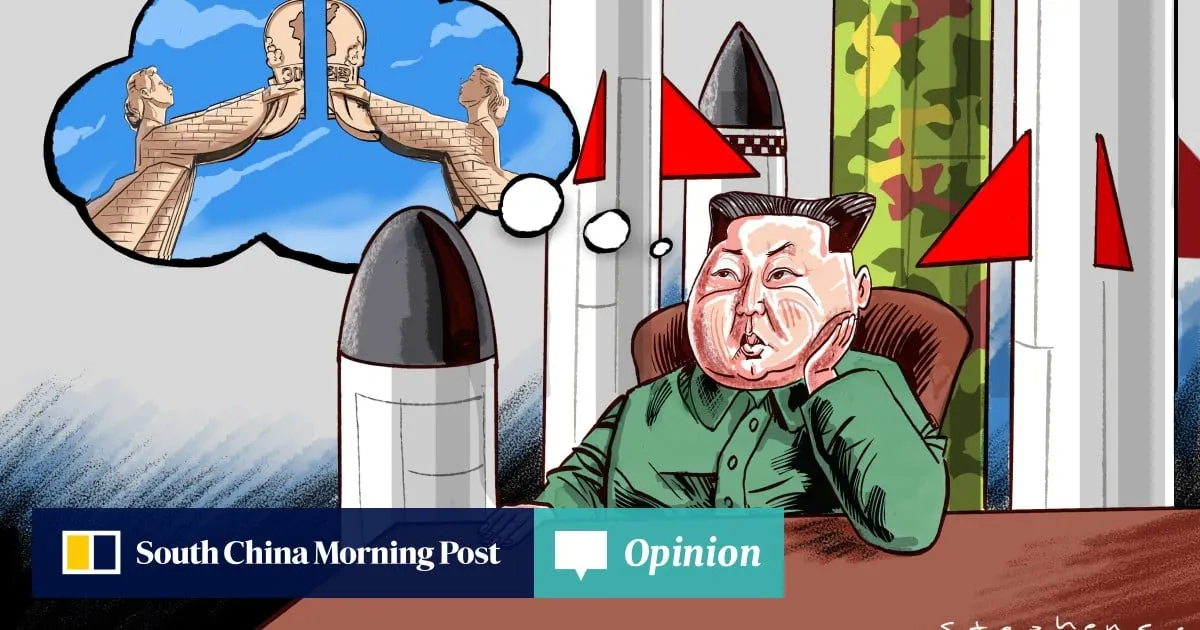
The North Korea that leaves the ninth Workers’ party congress is a different country from the one that left the eighth congress in 2021. Five years ago, the centrepiece of the eighth party congress was an ambitious weapons development programme unveiled by North Korean leader Kim Jong-un and accompanied by belligerent rhetoric against the United States, both of which indicated the North Korean leadership’s concerns about their vulnerability.Now, Kim’s regime has an improved and resilient nuclear arsenal, a strong military alliance with Russia tested on the battlefields of Ukraine and an economy that has recovered from the Covid-19 pandemic. Simultaneously, Kim emphasised that South Korea was a “most hostile” nation, even as he signalled openness to cooperation with the US. This has reanimated security concerns on the Korean peninsula, as there appears to be no pathway for inter-Korean diplomacy while the North designates Seoul as a hostile state.While South Korean and US officials should take Pyongyang’s rhetoric seriously, it would be a mistake to assume that Kim’s statements were only meant for foreign audiences. The rhetoric and policy changes under Kim represent a remarkable shift in North Korea’s political stance towards coexistence.Although Kim is a totalitarian dictator, he still has to maintain his own legitimacy among party elites. Declaring South Korea to be a hostile and therefore separate state indicates a careful middle ground that is a fundamental reorientation of how the North has defined its identity for nearly 80 years.For decades, North Korea had to balance two competing frameworks that defined its government’s legitimacy and purpose: first, that all Koreans, North and South, were meant to be reunified into a cohesive entity, as Korea had been for centuries. Second, that North Korea was the only legitimate force of independence on the peninsula, and its righteous decolonisation campaign was only upended because of the machinations of American imperialists during the Korean war. In many ways, North Korea’s essential political purpose has been built on the notion that it must liberate the peninsula, and that peace can never be fully achieved until liberation is accomplished.06:55Why have South Korean moves to make amends been ignored by the North?Why have South Korean moves to make amends been ignored by the North?This has produced an entangling effect of North Korea’s own making and repeatedly throttled attempts at negotiation. Part of the challenge comes down to the way that events such as the Korean war are remembered. While much of the world calls the conflict “the Korean war”, the North refers to the “Fatherland Liberation War” and a narrative of American imperialists, supported by hirelings such as Syngman Rhee, attacking the Korean people in an unprovoked invasion.
SRCSouth China Morning Post
LANGEN
LEANCenter-Right
WORDS442
ENT9
SUN · 2026-03-08 · 12:30 GMTBRIEF NSR-2026-0308-22561
NSR-2026-0308-22561Analysis·EN·Political Strategy
Nuclear-armed North Korea is pivoting from reunification to coexistence
Following the ninth Workers’ Party Congress, North Korea, under Kim Jong-un, appears to be shifting its political stance from reunification with South Korea to coexistence. This shift is marked by designating South Korea as a "most hostile" nation while signaling openness to cooperation with the US.
Syrus Solo JinSouth China Morning PostFiled 2026-03-08 · 12:30 GMTLean · Center-RightRead · 2 min
South China Morning PostFIG 01
Reading time
2min
Word count
442words
Sources cited
0cited
Entities identified
9entities
Quality score
100%
§ 01
Briefing Summary
AI-generatedNEWSAR · AI
Following the ninth Workers’ Party Congress, North Korea, under Kim Jong-un, appears to be shifting its political stance from reunification with South Korea to coexistence. This shift is marked by designating South Korea as a "most hostile" nation while signaling openness to cooperation with the US. This change comes after North Korea has strengthened its nuclear arsenal, solidified its military alliance with Russia, and recovered economically from the COVID-19 pandemic. The shift represents a reorientation of North Korea's identity, moving away from the long-held goal of liberating and reunifying the Korean peninsula. This new approach aims to solidify Kim's legitimacy among party elites by acknowledging South Korea as a separate state. The change has raised security concerns as it removes the possibility of inter-Korean diplomacy.
Confidence 0.90Claims 5Entities 9
§ 02
Article analysis
Model · rule-basedFraming
Political Strategy
National Security
Tone
Measured
AI-assessed
CalmNeutralAlarmist
Factuality
0.60 / 1.00
Mixed
LowHigh
Sources cited
0
No named sources
FewMany
§ 03
Key claims
5 extracted01
Kim emphasized that South Korea was a “most hostile” nation.
quoteKim Jong-un
Confidence
1.00
02
North Korea has an improved and resilient nuclear arsenal.
factualnull
Confidence
0.80
03
North Korea has a strong military alliance with Russia tested on the battlefields of Ukraine.
factualnull
Confidence
0.70
04
North Korea's economy has recovered from the Covid-19 pandemic.
factualnull
Confidence
0.60
05
North Korea is pivoting from reunification to coexistence.
predictionnull
Confidence
0.60
§ 04
Full report
2 min read · 442 words§ 05
Entities
9 identifiedKey playerOppositionContextPositiveNeutralNegative
Locations7
§ 06
Keywords & salience
9 termsnorth korea
1.00
coexistence
0.80
reunification
0.80
kim jong-un
0.70
south korea
0.60
nuclear arsenal
0.60
inter-korean diplomacy
0.50
political stance
0.50
hostile state
0.40
§ 07
Topic connections
Interactive graph Network visualization showing 51 related topics
View Full Graph Person Organization Location Event|Click node to navigate|Edge numbers = shared articles