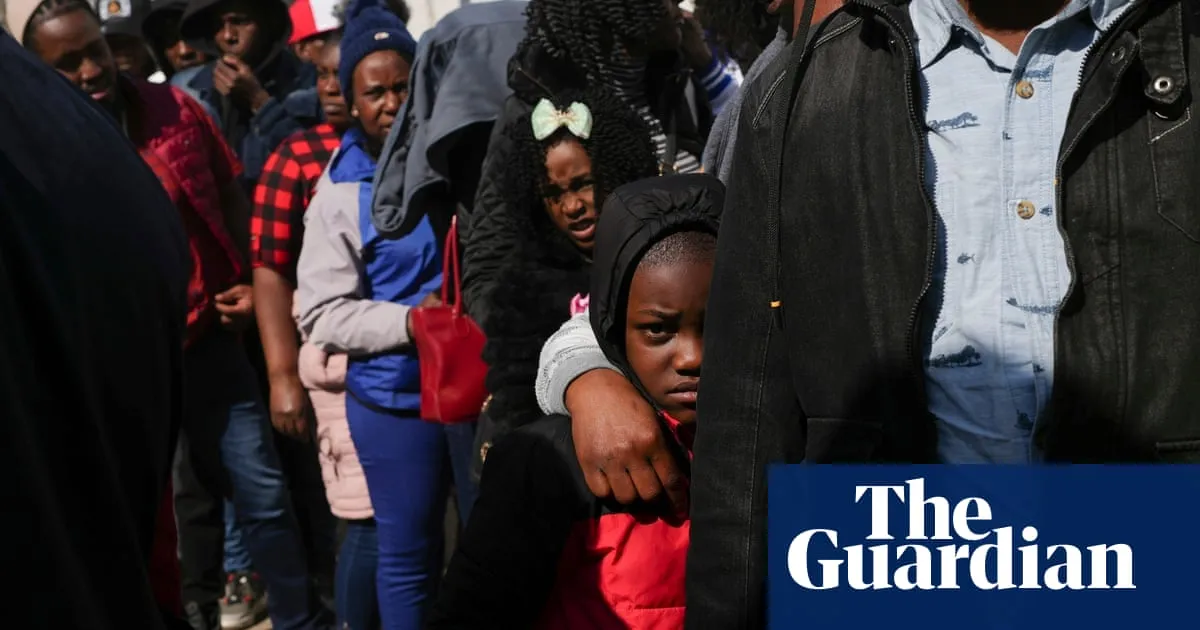
A year ago, when Jean Baptiste Gensley stepped off a bus in Tapachula, Mexico’s southern city on the border with Guatemala, he carried a small backpack and the hope that his journey was finally over.In his native Haiti, Gensley, 37, worked as a radio journalist and social worker, analyzing the effects of gang violence in some of Port-au-Prince’s most dangerous neighborhoods. With time, as his research led to police intervention, he caught the attention of the city’s gangs.In November 2024, during a period of escalating violence in the Haitian capital, gang members entered the compound where Gensley lived.“They burned the radio station, my home and many other things in the area,” he said in an interview in Tapachula. They even killed his dog.It was time to get out. After escaping Haiti and leaving his wife and 11-year-old son in the neighboring Dominican Republic for safety, Gensley continued by himself, fleeing on rural back roads deep into the countryside. He paid a local agency to take him to Punta Cana, a resort town on the eastern shores of the island. From Punta Cana, he flew to Quito, Ecuador’s capital – then took a plane to El Salvador.On buses, in cars and on the back of motorcycle taxis, Gensley made his way hundreds of miles north. Finally, he crossed into Mexico.He said: “I had no money left. All my funds were spent during the journey.”Gensley had the US in his sights but decided it was more feasible to choose Mexico as his final destination.Like many fleeing Haiti in recent years, he had initially thought the US should be his goal, with better prospects. But a hardening of attitudes and restrictions under Joe Biden and an extreme crackdown on immigration and asylum by Donald Trump ultimately convinced him that Mexico would be a much safer bet.Four days after his arrival in Tapachula, Gensley checked in at the Mexican commission for refugee assistance (Comar), where the agency told him he could get a work permit and right of residence. He was encouraged, but, in fact, months slipped by without any further news from Comar, leaving the Haitian journalist in a restless limbo. Days blended into one another and a settled future felt painfully out of reach.An asylum-seeking migrant from Haiti who did not give her name out of fear, cleans a kitchen at a shelter for migrants in Tijuana, Mexico. Photograph: Gregory Bull/APAs thousands of other Haitians continued to arrive in Tapachula, the main entry point for migrants traveling north through Central America, many have found themselves trapped in a tangle of hostile or dysfunctional immigration systems involving Mexico, the US and the UN. There are few smooth paths forward, whether they are aiming to settle there or head for central or northern Mexico, or the US.Trump has repeatedly expressed hostility towards Haiti, while also defunding international programs, including some that affect Mexico, and shutting out asylum seekers, refugees and migrants at the US-Mexico border.Since 2010, Haitians in the US had been eligible for temporary protected status (TPS) after the devastating 2010 earthquake and, later, escalating violence and instability, including the 2021 assassination of the Haitian president Jovenel Moïse that prompted multiple extensions of the program. But the Trump administration is trying to terminate TPS for Haitians.In early February, a lawsuit temporarily blocked the administration’s attempt to end Haitians’ eligibility for TPS, which would have left up to 350,000 Haitians stranded without legal status. Even so, ongoing uncertainty, including a drastic cut to the numbers of people accepted as refugees each year, has made it increasingly difficult for Haitians to reach or stay in the US.Mexico is increasingly becoming a destination for many fleeing war, oppression, crushing poverty, gang violence or combinations of those problems. However, as a relative newcomer like Gensley quickly found out, Mexico’s immigration system is shaped by US pressure.Since returning to office, Trump has used the threat of tariffs to challenge Mexico’s immigration and border policies – including the announcement of a 25% tariff in February 2025 that was reversed weeks later. Last month, Trump again announced a 10% global tariff on most imported goods. Mexican products categorized as compliant with the three-country trade agreement called USMCA are now excluded from the tariff.At the same time, cuts to US funding for international aid organizations have further strained Mexico’s asylum infrastructure. In 2025, as part of the administration’s dismantling of USAID, funding to the UN was slashed, forcing the UN high commissioner for refugees (UNHCR) to suspend its financial support for Mexico’s Comar.Until then, the US had provided more than 86% of the funding for UNHCR’s work in Mexico, according to a 2024 UNHCR funding report. In the aftermath of the severe cuts, Comar, which itself relies on the UN for roughly 60% of its budget, has struggled to process asylum applications, bringing the system to a near-standstill.Gang violence racking Haiti has reverberated among millions who left the country for Brazil, Chile, Mexico and the US. Photograph: Gregory Bull/APIn Tapachula, a patchwork of migration-focused organizations now does what it can to fill the gaps. For years, UNHCR played a central role, supporting housing for hundreds of migrants in shelters across Mexico. After the funding cuts, several shelters were forced to close.According to UNHCR, about 11 million people worldwide are losing such support because of the cuts, leaving many asylum seekers in dreary conditions, poverty and prolonged instability. The UN ranks Mexico among the top five countries for receiving the highest numbers of new asylum seekers.“Before President Trump, UNHCR gave help, not for everyone, but they helped,” Gensley said. “Now, with President Trump, UNHCR helps almost nobody.”Melanie Gallant, UNHCR spokesperson for Latin America and the Caribbean, wrote in a statement: “Despite a funding cut of more than 50%, UNHCR continues to prioritize essential support: helping Comar keep asylum procedures running, providing interpretation when possible, offering legal information and orientation, and assisting people with heightened protection needs.”UNCHR’s cuts to services in Tapachula, Gallant added, reflect global budget pressures – “not a shift in UNHCR’s commitment to supporting Mexico”.Meanwhile, Mexican immigration authorities do not allow asylum seekers to leave the city where they begin their asylum process, and they must report for check-ins every two weeks. Most asylum seekers there said they were unable to find work, and when they did, it was typically in low-paid jobs off the books.Jesús Zamarrón, an immigration lawyer in Tapachula who works closely with asylum seekers, said Mexican authorities were enforcing US immigration priorities under pressure from the threat of tariffs. By keeping migrants far from US territory, cities like Tapachula function as an extension, or externalization, of the US border, he said.Zamarrón added that Mexico had increasingly relied on its own southern border with Guatemala as a sort of “containment zone” to stem northward migration.Zamarrón said: “As a law firm, we have experienced delays in the immigration regularization processes for Haitian and Cuban populations. Especially with the Haitian population, due to a lack of interpreters.”Some Haitian immigrants arrive with a basic level of Spanish after living in the Dominican Republic or Central and South America before traveling to Mexico – but most do not. Haitians generally speak Creole, French or both languages.As a result, they require interpreters to complete their asylum interviews with officials from Comar.But throughout 2025, Comar had to let go of many of its workers, including interpreters for asylum interviews, because of the funding cuts. This has lengthened the asylum process significantly – particularly for Haitians, who make up the largest group of non-Spanish speakers entering Mexico.A Mexican immigration official speaks to migrants as they line up for their appointment with US immigration officials to apply for asylum. Photograph: Gregory Bull/APAccording to Mexican law, the asylum process should take about 45 days and can be extended to 90. But almost a dozen Haitian asylum seekers in Tapachula said their cases had extended past 90 days. Some, like Gensley, have had their process extended for more than nine months, leaving them unable to obtain the work permit that is a standard element of the asylum process.Finally, Gensley received a date for his asylum interview and completed it last October.“I saw it as a gift from God,” he said.In late November, after nine months of waiting, Gensley received the news that his asylum application had been approved. Now, he is trying to earn enough money to move to Tijuana, where job prospects are better and there is a more established Haitian community.He hopes to reunite with his family as soon as possible – but does not know when that will be.As gang violence in Haiti continued to rise and more Haitians fled to Mexico, their asylum applications are rarely successful. In a 2024 report, a coalition of human rights organizations noted that between 2021 and 2023, only 4.6% of Haitians’ asylum applications were approved by Comar.Christelle, an elementary school teacher from Haiti who requested that her last name not be shared in order not to risk her asylum case, says she has spent 10 months in Tapachula without being called in for an interview with Comar.“When we come here, everything happens step by step, and we have to wait,” she said. “I am trying to live, but life is very hard here.”Since 2024, Comar has applied the Cartagena declaration, a UN agreement that expanded the definition of “refugee” to applicants from Haiti. When used correctly, the declaration should also entail the faster processing of asylum claims.But if Haitians continue to wait months in limbo, the question arises if Cartagena is being fairly applied to them.“If the ability to even access the procedures and the process isn’t there, then that is a big challenge,” said Gabrielle Apollon, director of the Haitian Immigrant Rights Project at the New York University School of Law’s Global Justice Clinic and coordinator of the Hemispheric Network for Haitian Migrants’ Rights.Comar did not respond to a request for comment on access to the system.On a typical weekday, hundreds of Haitians gather around Tapachula’s Bicentennial Park and the street markets that spread around the city center. Some sell bottles of water or Haitian fried fish with pressed plantains that they have cooked in crowded apartments. Others look after the stalls of Mexican merchants.Newcomers have found comfort in the Haitian community as their cases undergo the same delays.Every few days, David Corrielan, a TikToker from Haiti who spent years living in the Dominican Republic, posts a new video on his channel, El Haitiano Mexicano. In interviews and video guides, he shares a view of life in Tapachula for Haitians, and Mexicans curious about their new neighbors.“This account is to help my Haitian siblings live well in Mexico, and here in Tapachula,” Corrielan said. “I want to share Haitian culture and the Haitian language with Mexicans.”Two and a half thousand miles north is an example of how things could look for the Haitian diaspora stuck in Tapachula. Tijuana, on Mexico’s northern border with San Diego, California, has a substantial Haitian community that stems from earlier waves of migration north.Since at least 2016, Tijuana has been a stopping point for thousands of Haitians trying to reach the US. In 2021, Haitian migrants were greeted with brute force by American border officials. Fearing deportation back to Haiti, many asylum seekers waited in migrant camps and crowded shelters across sprawling Tijuana.Vivianne Petit Frére, of Haiti, sits at a table in the Haitian restaurant she runs in downtown Tijuana, Mexico. Photograph: Gregory Bull/APOver time, many of them settled in the city, building a community there. Some, like Vivianne Petit Frére, learned Spanish and obtained citizenship after they had children born in Mexico. Like many other Haitians, Petit Frére came to Tijuana in 2021 fleeing violence in the aftermath of Moïse’s assassination.At the time, Petit Frére hoped to reach the US – seeking the “American Dream”, she said. But as American authorities deported Haitian asylum seekers directly to the country they had fled, she decided it was safer to stay in Tijuana.“When I arrived in Tijuana, I found opportunity – and I woke up from the ‘American dream’. Now, I’m living my [version of the] American dream,” Petit Frére said.Petit Frére bustled around the dining room of her restaurant, Lakou Lakay, near downtown Tijuana, serving a long table of researchers from the nearby university, Colegio de la Frontera Norte, who have stopped by for Haitian fried fish, meat, and rice and beans.They sat under a row of brightly colored placards. One described the four principles of Vodou, and another declared the restaurant as a space “where Haitian identity proudly blossoms on Mexican soil”.Through her business, and work with the Haitian community – she is finishing her social work degree – Petit Frére has become a go-to source of information and resources for Haitians living in Tijuana, looking for information on navigating visa issues, money transfers or just a bite of food.“It’s that voice that’s saying, ‘I’m here, I’m a part of this, I belong,’” she said. “That’s when I started to put down roots.” The obstacles are many, but Mexico can still be the answer.Migrants at a house funded by the Catholic Church in the neighborhood of Iztapalapa in Mexico City. Photograph: Raquel Cunha/ReutersPetit Frère said: “What they’re looking for isn’t [necessarily] the United States. It’s stability, whether economic or moral – whatever makes them feel good.”Back in Tapachula, Gensley and other Haitians who have fled the violence of their home country wait, day after day, for a piece of that stability.Gensley holds on to the hope that he will reunite with his family – but for now, until he can establish himself more solidly, it’s not possible.“I don’t know if things will get better now that I have my documents,” he said. “I have to remain patient. That’s it.” This article was reported with support from the non-profit news site PassBlue
SRCThe Guardian - World News
LANGEN
LEANCenter-Left
WORDS2 301
ENT9
SUN · 2026-03-08 · 12:00 GMTBRIEF NSR-2026-0308-22579
NSR-2026-0308-22579News Report·EN·Human Interest
‘I am trying to live’: Haitians in Mexico seek community despite broken immigration systems
Haitian journalist Jean Baptiste Gensley fled Haiti in November 2024 after gang violence escalated, targeting him for his work. He traveled through the Dominican Republic, Ecuador, and El Salvador, eventually reaching Tapachula, Mexico.
Anna Oakes and Mariana Hernández Ampudia in Tapachula and Tijuana, MexicoThe Guardian - World NewsFiled 2026-03-08 · 12:00 GMTLean · Center-LeftRead · 10 min
The Guardian - World NewsFIG 01
Reading time
10min
Word count
2 301words
Sources cited
2cited
Entities identified
9entities
Quality score
100%
§ 01
Briefing Summary
AI-generatedNEWSAR · AI
Haitian journalist Jean Baptiste Gensley fled Haiti in November 2024 after gang violence escalated, targeting him for his work. He traveled through the Dominican Republic, Ecuador, and El Salvador, eventually reaching Tapachula, Mexico. Gensley initially aimed for the U.S. but chose Mexico due to stricter U.S. immigration policies. In Tapachula, he applied for asylum with the Mexican commission for refugee assistance (Comar), hoping for a work permit and residency. However, like many other Haitians arriving in Tapachula, he has faced delays and uncertainty in the Mexican immigration system, leaving him in limbo.
Confidence 0.90Sources 2Claims 5Entities 9
§ 02
Article analysis
Model · rule-basedFraming
Human Interest
Human Rights
Tone
Measured
AI-assessed
CalmNeutralAlarmist
Factuality
0.70 / 1.00
Factual
LowHigh
Sources cited
2
Limited
FewMany
§ 03
Key claims
5 extracted01
Thousands of Haitians have arrived in Tapachula, Mexico, seeking asylum.
factualArticle
Confidence
1.00
02
Gensley left his wife and son in the Dominican Republic for safety.
factualArticle
Confidence
1.00
03
Jean Baptiste Gensley, a Haitian radio journalist and social worker, fled Haiti after gang members burned his radio station and home.
factualArticle
Confidence
1.00
04
Trump has repeatedly expressed hostility towards Haiti and defunded international programs.
factualArticle
Confidence
0.90
05
Gensley decided to seek asylum in Mexico due to hardening US immigration policies.
factualArticle
Confidence
0.90
§ 04
Full report
10 min read · 2 301 words§ 05
Entities
9 identifiedKey playerOppositionContextPositiveNeutralNegative
§ 06
Keywords & salience
10 termshaitian migrants
0.90
mexico
0.80
immigration
0.80
tapachula
0.70
asylum seekers
0.70
refugee assistance
0.60
gang violence
0.60
work permit
0.50
joe biden
0.40
donald trump
0.40
§ 07
Topic connections
Interactive graph Network visualization showing 51 related topics
View Full Graph Person Organization Location Event|Click node to navigate|Edge numbers = shared articles