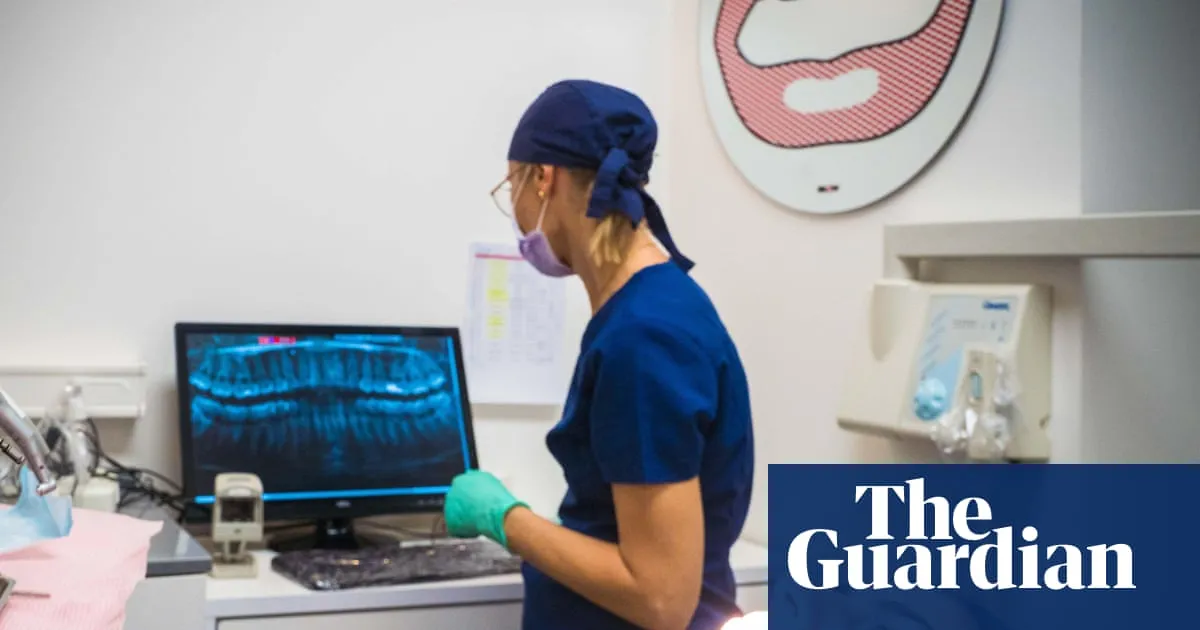
Almost a third of people in England now use private dentistry, with a sharp rise in the number of poorer households forced to pay for fillings and extractions.The scarcity of NHS care means the proportion of people turning to private dental services jumped from 22% in 2023 to 32% late last year, the health service’s patient watchdog found.The reliance on paid-for treatment is so significant that dental care is becoming a costly “one tier” – private-only – service for more and more people, Healthwatch England is warning.It is concerned that the percentage of people who describe themselves as struggling financially that have used private dentistry has almost doubled in recent years from 14% to 27%.Those who do are hit with a “double penalty”, the watchdog added. That is because dentists charge much more for private than NHS work, for example £64 for a check-up that costs only £27.40 on the NHS. And they may also lose out because many low-income patients, as well as all pregnant women and new mothers, miss out on free NHS dental care to which they are entitled because they cannot find a dentist to treat them as health service patients.“Our findings are a warning that for some people there’s only one-tier dental care – private,” said Rebecca Curtayne, Healthwatch England’s acting head of policy, public affairs and research. “It’s the most vulnerable people in our society who bear the brunt of the ongoing shortage of NHS dental appointments.“Too many people on low income are being forced into private care they struggle to afford, or are going without treatment altogether. The system is failing those who need it most.”Healthwatch’s findings are based on a representative survey of 2,593 adults it undertook last October and November to inform its annual report about patients’ experience of healthcare, which it is publishing later this week.Ministers should tackle the access crisis by giving everyone the right to see an NHS dentist in the same way they are entitled to be on a GP surgery list, according to Curtayne. Healthwatch, the statutory NHS patient champion, is being abolished as part of Wes Streeting’s controversial reorganisation of the NHS in England.The big shift to private dental care showed NHS dentistry “exists in name only for many people”, the Patients Association said.“This report is yet further damning evidence on the state of NHS dentistry and this double penalty for people on low incomes demonstrates a systemic failure with real human consequences,” said Rachel Power, the association’s chief executive.“This isn’t just about the cost of dentistry. The lack of affordable dental care harms physical health, leaves people in ongoing, sometimes agonising, pain, and can take a heavy toll on mental and emotional wellbeing.”Power added: “Healthwatch’s warning that we are sleepwalking towards a one-tier, costly system is one we should all take seriously. Where getting dental care simply means paying for it privately, the NHS dental service exists in name only for many people.”The Competition and Markets Authority last week launched an inquiry into the UK’s £8.4bn private dental market “to make sure it is working well for UK consumers”.Explaining its decision, the competition watchdog’s chief executive, Sarah Cardell, said: “Going to the dentist is an important part of health and wellbeing. Yet we’re concerned many may be uncertain about costs, availability, treatment options and what they’re entitled to. For some, turning to private dentistry is a choice – but for many a necessity.”The CMA’s estimate of the number of people using private dental care in the UK – one in five – is substantially lower than Healthwatch’s 32% in England.Its review will look at access to private dentistry, competition within the sector and the “significant” price rises surgeries have imposed in recent years. For example, the cost of an initial consultation jumped by 23% to £80 and a check-up by 14% to £55 between 2022 and 2024.Dentists blame ministers for the inaccessibility of NHS dental care. They say that the NHS pays them so little to carry out certain types of work that they provide them at a loss and have to cross-subsidise that to the tune of £400m a year just to break even on those treatments.The British Dental Association (BDA), which represents dentists, claims that this “funding gap … is inevitably putting some pressure on private pricing. Government has a responsibility to properly fund NHS care to prevent people being forced into private treatment.”Responding to last week’s announcement of the CMA inquiry, Eddie Crouch, the BDA’s chair, said: “Those left without options, who have felt forced to go private, are there entirely because of choices made by the Treasury.”The BBC disclosed last week that dentists in England were doing so little NHS work that they had handed back £936m over the last two years of the money that had been allocated to pay them for performing procedures.A Department of Health and Social CCare spokesperson said: “As this report shows, this government inherited an NHS dentistry service that had been left to rot for more than a decade. We believe strongly that everyone should be able to get dental care, not just those who can afford it.“We have taken immediate action to fix this, delivering 1.8m more treatments in the first seven months of this year, with more children and the most deprived benefitting most. We are also reforming the dental contract, to treat more patients and put a greater focus on prevention. We’re determined to end the two-tier service and put dental care within everyone’s reach.”
SRCThe Guardian - World News
LANGEN
LEANCenter-Left
WORDS914
ENT6
MON · 2026-03-09 · 09:57 GMTBRIEF NSR-2026-0309-22800
NSR-2026-0309-22800News Report·EN·Economic Impact
Almost a third of people in England use private dentists amid NHS dental crisis
Almost a third of people in England now use private dentists, with the proportion increasing from 22% in 2023 to 32% late last year, according to Healthwatch England. The scarcity of NHS dental care has led to a sharp rise in the number of poorer households forced to pay for fillings and extractions.
Denis Campbell Health policy editorThe Guardian - World NewsFiled 2026-03-09 · 09:57 GMTLean · Center-LeftRead · 4 min
The Guardian - World NewsFIG 01
Reading time
4min
Word count
914words
Sources cited
4cited
Entities identified
6entities
Quality score
100%
§ 01
Briefing Summary
AI-generatedNEWSAR · AI
Almost a third of people in England now use private dentists, with the proportion increasing from 22% in 2023 to 32% late last year, according to Healthwatch England. The scarcity of NHS dental care has led to a sharp rise in the number of poorer households forced to pay for fillings and extractions. The reliance on paid-for treatment is significant, with those who describe themselves as struggling financially almost doubling their use of private dentistry from 14% to 27%. Dental care is becoming increasingly unaffordable for low-income individuals, who may also miss out on free NHS dental care due to lack of access to a dentist. Healthwatch England is calling for ministers to tackle the access crisis by giving everyone the right to see an NHS dentist. The organization's findings highlight a systemic failure with real human consequences.
Confidence 0.90Sources 4Claims 5Entities 6
§ 02
Article analysis
Model · rule-basedFraming
Economic Impact
Public Health
Tone
Mixed Tone
AI-assessed
CalmNeutralAlarmist
Factuality
0.70 / 1.00
Factual
LowHigh
Sources cited
4
Well sourced
FewMany
§ 03
Key claims
5 extracted01
Healthwatch is being abolished as part of Wes Streeting’s controversial reorganisation of the NHS in England.
factual
Confidence
1.00
02
Dentists charge much more for private than NHS work, for example £64 for a check-up that costs only £27.40 on the NHS.
factualHealthwatch England
Confidence
1.00
03
The percentage of people who describe themselves as struggling financially that have used private dentistry has almost doubled in recent years from 14% to 27%.
statisticHealthwatch England
Confidence
1.00
04
The proportion of people turning to private dental services jumped from 22% in 2023 to 32% late last year.
statisticHealthwatch England
Confidence
1.00
05
Almost a third of people in England now use private dentistry.
statisticHealthwatch England
Confidence
1.00
§ 04
Full report
4 min read · 914 words§ 05
Entities
6 identifiedKey playerOppositionContextPositiveNeutralNegative
Organizations3
Locations1
§ 06
Keywords & salience
9 termsnhs dentistry
1.00
private dentistry
0.90
dental access crisis
0.80
low-income patients
0.70
dental care costs
0.60
healthwatch england
0.60
one-tier dental care
0.50
lack of access
0.50
nhs patient watchdog
0.50
§ 07
Topic connections
Interactive graph Network visualization showing 20 related topics
View Full Graph Person Organization Location Event|Click node to navigate|Edge numbers = shared articles