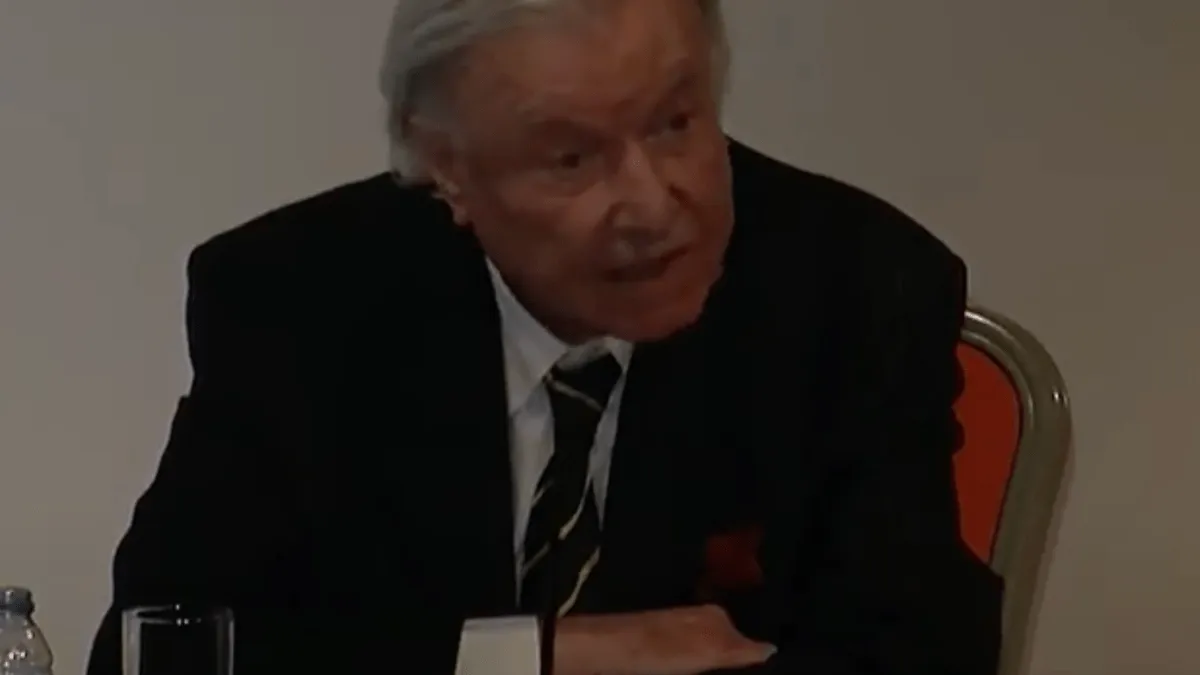
Khalidi, a leading scholar of the Nakba and co-founder of the Palestine-studies" class="entity-link entity-organization" data-entity-id="41734" data-entity-type="organization">Institute for Palestine Studies, died in the US on Sunday.Walid Khalidi gives a lecture, 'Palestine and Palestine Studies, One Century since the First World War and the Balfour Declaration', on March 6, 2014 at the Centre for Palestine Studies, SOAS, University of London [SOAS University of London]Published On 9 Mar 2026Walid Khalidi, the venerated Palestinian historian whose research helped document the Nakba and shaped generations of scholarship on Palestine, has died aged 100.Khalidi, dubbed “the historian of the Palestinian cause”, passed away on Sunday in Massachusetts in the United States, according to an obituary issued by the Palestine-studies" class="entity-link entity-organization" data-entity-id="41734" data-entity-type="organization">Institute for Palestine Studies (IPS) – the research centre that he co-founded in 1963.Recommended Stories list of 4 itemslist 1 of 4Doctors try to save girl as father was killed in Gaza Israeli attacklist 2 of 4Palestinians risk life and limb to fish in Gaza’s Israeli-controlled sealist 3 of 4Israeli settlers kill three more Palestinians in the occupied West Banklist 4 of 4Is Israel reshaping Lebanon, trying to separate Hezbollah from its people?end of listFollowing the news, tributes from scholars, diplomats and Palestinian officials flooded social media, with Husam Zomlot, the Palestinian ambassador to the United Kingdom, calling Khalidi “a national treasure, a guardian of memory, and a mentor to generations” in a post on X.Born in Jerusalem in 1925 into a prominent intellectual family, Khalidi received his early education in Ramallah before attending St George’s School in Jerusalem.He later graduated from the University of Oxford in 1951 and went on to enjoy an illustrious academic career, teaching political studies at the American University of Beirut until 1982, before becoming a research fellow at Harvard University’s Center for International Affairs.Chronicling the NakbaKhalidi was perhaps best known for his meticulous documentation of the destruction of Palestinian villages during the Nakba (“catastrophe”), the ethnic cleansing of Palestine by Zionist militias in 1948.His landmark book All That Remains, published in 1992, catalogued how more than 400 Palestinian villages were destroyed or depopulated during the first Arab-Israeli war and combined historical research, maps and testimonies to reconstruct the lives of communities that had disappeared.The IPS described Khalidi as a “pioneer in uncovering many long-concealed features that explained how the Zionist movement succeeded in occupying Palestine in 1948”, adding that in the 1960s, he was the first to reveal “its master plan for the occupation of Palestine and the expulsion of its people, known as ‘Plan Dalet’”.Another major work by Khalidi, Before Their Diaspora, used archival photographs to document Palestinian society before 1948, offering a rare visual record of daily life in cities and villages across the country.(Al Jazeera)Academic and diplomatic rolesAfter a period teaching at Oxford, Khalidi spent decades at the American University of Beirut, and co-founded the Palestine-studies" class="entity-link entity-organization" data-entity-id="41734" data-entity-type="organization">Institute for Palestine Studies, which grew into one of the leading research organisations dedicated to Palestinian history, politics, and society.Khalidi later served as a research fellow at Harvard’s Center for International Affairs, lectured at institutions including Princeton University in the US, and was elected a fellow of the American Academy of Arts and Sciences.Beyond academia, he also played a role in Palestinian diplomacy.After the 1967 war, which later became known as the Naksa, in which Israel seized the West Bank, East Jerusalem, Gaza, the Syrian Golan Heights and Egypt’s Sinai Peninsula, Khalidi moved towards diplomacy.He served as an adviser to the Iraqi delegation to the United Nations, later joined an Arab Summit delegation to the British government in 1983, and, in the mid-1980s, served as a special adviser to the Arab League secretary-general.He was also part of the joint Jordanian-Palestinian delegation to the 1991 Madrid peace conference.Khalidi was a proponent of a two-state solution, writing in Foreign Affairs in 1988 that a Palestinian state within the 1967 borders in “peaceful coexistence alongside Israel” was “the only conceptual candidate for a historical compromise of this century-old conflict”.Khalidi is ‘synonymous with his beloved homeland’Tributes from Palestinian officials and scholars highlighted Khalidi’s role in shaping the historical understanding of Palestine.Khalil Jahshan, the executive director of the Arab Center Washington DC, said in a post on X that Khalidi’s name was “synonymous with his beloved homeland, Palestine” as he offered “heartfelt condolences to his family, to the people of Palestine, and to all who knew him”.The Palestine-studies" class="entity-link entity-organization" data-entity-id="41734" data-entity-type="organization">Institute for Palestine Studies described Khalidi as one of the most prominent historians of Palestine and said his work helped build the foundation for modern scholarship on Palestine.Jehad Abusalim, policy analyst and author of Light in Gaza, wrote on X that Khalidi had “dedicated his life to preserving Palestinian history”, adding that “his scholarship and research are a foundation that generations will continue to build on”.For many historians, Khalidi’s legacy lies not only in his own scholarship, but also in the institutions he helped build and the generations of students and researchers he mentored.At a time when much of Palestine’s historical record risked being scattered or lost, Khalidi devoted his career to documenting it.His work ensured that the history of Palestinian society before and after 1948 would remain part of the global historical record.
SRCAl Jazeera
LANGEN
LEANCenter
WORDS848
ENT12
MON · 2026-03-09 · 13:31 GMTBRIEF NSR-2026-0309-22823
NSR-2026-0309-22823News Report·EN·Human Interest
Walid Khalidi, historian of the Palestinian cause, dies aged 100
Walid Khalidi, a prominent Palestinian historian and scholar of the Nakba, died on Sunday in Massachusetts, US, at the age of 100. Born in Jerusalem in 1925, Khalidi co-founded the Institute for Palestine Studies in 1963 and dedicated his life to researching and documenting Palestinian history.
Nils AdlerAl JazeeraFiled 2026-03-09 · 13:31 GMTLean · CenterRead · 4 min
Al JazeeraFIG 01
Reading time
4min
Word count
848words
Sources cited
4cited
Entities identified
12entities
Quality score
100%
§ 01
Briefing Summary
AI-generatedNEWSAR · AI
Walid Khalidi, a prominent Palestinian historian and scholar of the Nakba, died on Sunday in Massachusetts, US, at the age of 100. Born in Jerusalem in 1925, Khalidi co-founded the Institute for Palestine Studies in 1963 and dedicated his life to researching and documenting Palestinian history. He is best known for his meticulous work chronicling the destruction of Palestinian villages during the 1948 Nakba, particularly his book "All That Remains," which catalogued the destruction and depopulation of over 400 villages. Khalidi taught at the American University of Beirut and was a research fellow at Harvard University. His work has been lauded by scholars and officials as vital to understanding Palestinian history and preserving its memory.
Confidence 0.90Sources 4Claims 4Entities 12
§ 02
Article analysis
Model · rule-basedFraming
Human Interest
Political Strategy
Tone
Measured
AI-assessed
CalmNeutralAlarmist
Factuality
0.80 / 1.00
Factual
LowHigh
Sources cited
4
Well sourced
FewMany
§ 03
Key claims
4 extracted01
Husam Zomlot, the Palestinian ambassador to the United Kingdom, called Khalidi “a national treasure, a guardian of memory, and a mentor to generations”.
quoteHusam Zomlot
Confidence
1.00
02
Khalidi's book All That Remains catalogued how more than 400 Palestinian villages were destroyed or depopulated during the 1948 Arab-Israeli war.
factualAl Jazeera
Confidence
1.00
03
Walid Khalidi, a leading scholar of the Nakba and co-founder of the Institute for Palestine Studies, died in the US on Sunday.
factualAl Jazeera
Confidence
1.00
04
In the 1960s, Khalidi was the first to reveal 'Plan Dalet', the Zionist movement's master plan for the occupation of Palestine.
factualIPS
Confidence
0.90
§ 04
Full report
4 min read · 848 words§ 05
Entities
12 identifiedKey playerOppositionContextPositiveNeutralNegative
Organizations4
Locations5
Events1
§ 06
Keywords & salience
9 termswalid khalidi
1.00
palestinian historian
0.90
nakba
0.90
institute for palestine studies
0.80
palestinian cause
0.70
palestinian villages
0.60
ethnic cleansing
0.50
zionist militias
0.50
all that remains
0.40
§ 07
Topic connections
Interactive graph Network visualization showing 2 related topics
View Full Graph Person Organization Location Event|Click node to navigate|Edge numbers = shared articles