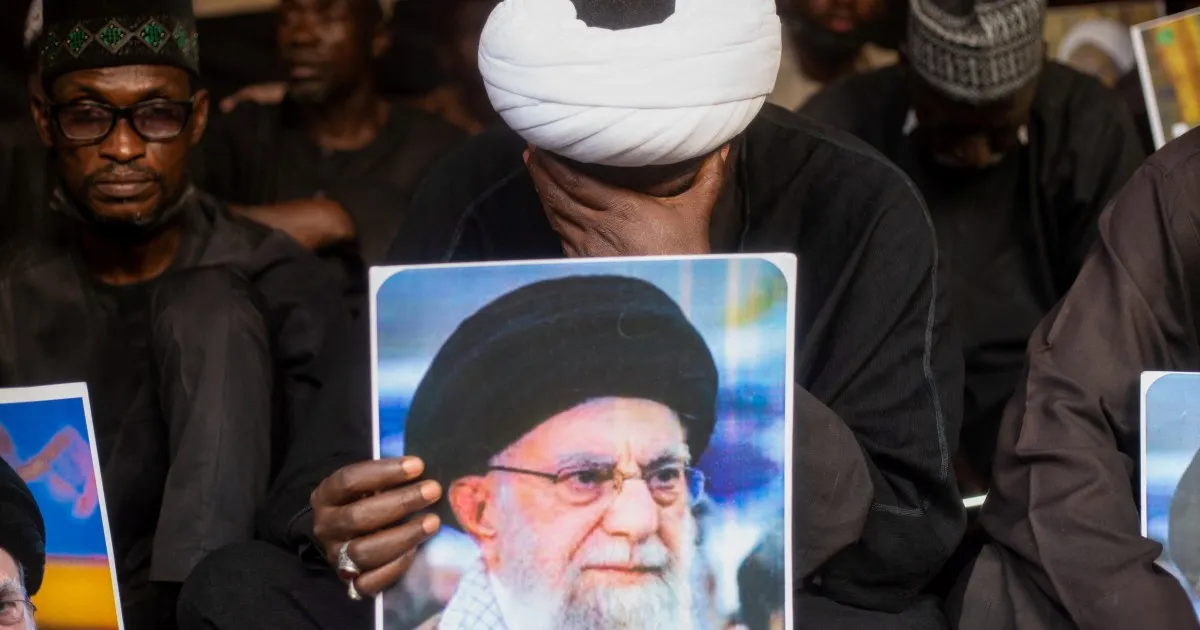
In northern Nigeria, Shias see appointment of new Supreme Leader Mojtaba Khamenei as a ‘continuation of his father’s resistance’.A Shia Muslim man mourns in Kano, Nigeria, as he holds an image of late Iranian Supreme Leader Ayatollah Ali Khamenei [Ameer Nameejy/Reuters]Published On 9 Mar 2026Kano, Nigeria – As the son of Ayatollah Ali Khamenei takes over as Iran’s supreme leader after the assassination of his father in a United States-Israeli attack, hundreds of mourners gathered in a mosque far away from the war in the Middle East to grieve the late leader.The adherents in northern Nigeria’s Kano State solemnly chanted prayers. At one point during the recitations, the voice of the religious leader that carried over the microphone to all corners of the hall, cracked with grief. Among the crowd, one young man wiped his eyes.Recommended Stories list of 3 itemslist 1 of 3What the world is getting wrong about what Iranians thinklist 2 of 3Who is Mojtaba Khamenei, Iran’s new supreme leader amid war?list 3 of 3Iran war: What is happening on day 10 of US-Israel attacks?end of listOn Sunday, Iran named Mojtaba Khamenei as his father’s replacement. In Kano, the community sees it as a move ensuring the “continuation of his father’s resistance”. The assassination of the elder Khamenei last week in an air strike has stirred deep emotions among Nigeria’s minority Muslim Shia, a group that sees its faith and identity intertwined with that of the larger Shia community in Iran.For 60-year-old academic Dauda Nalado, the elder Khamenei’s killing was not merely another event in foreign politics; it was the silencing of a revered spiritual teacher.“Ayatollah Ali Khamenei is not only a leader of the Shiite community or even Muslims alone. He is regarded as a leader of oppressed people across the world,” the university professor told Al Jazeera. “If you look at Iran’s involvement in issues concerning Gaza and Palestine, you will understand why many people admire his leadership.”Khamenei, who was 86 when he was killed, became Iran’s supreme leader in 1989. He shaped the country’s military and political apparatus, which became critical to Iran’s influence in the region; fostered self-reliance in the face of Western sanctions; and responded forcefully to criticism.However, in January, Khamenei faced one of the most significant domestic challenges to his rule over the years when severe economic hardship turned into nationwide protests. Thousands of people were killed in the crackdown. The US has used it as one of the justifications for its current war; however, before his death, Khamenei accused “terrorists” linked to the US and Israel of being behind the violence.Since the US and Israel launched their war on Iran on February 28, at least 1,255 people in Iran have been killed, including 160 girls in an attack on their school in the southern city of Minab. Hundreds of others were injured. Hospitals, residential buildings and historic heritage sites have been severely impacted by the bombings.Across northern Nigeria, which is predominantly Muslim, Shias have taken to the streets to protest against the war, Besides Kano, demonstrators have gathered in Kaduna, Kebbi, Gombe, Bauchi, Katsina, and even in the mixed-faith commercial city of Lagos, in the country’s south.Their demand is for the attacks on Iran to end.“The United States and Israel jointly imposed this war. … Iran has a legitimate right to self-defence,” Nalado said.After the killing of Khamenei, followers of the Islamic Movement Nigeria gather in a mosque in Kano, some holding photos of their leader, Ibrahim el-Zakzaky, and former Iranian Supreme Leaders Ali Khamenei and Ruhollah Khomeini [Ali Rabiu Ali/Al Jazeera]A small but significant minorityMuslims make up about half of Nigeria’s 200 million people. Most in the country follow Sunni Islam, and the Shia are a small minority, numbering one million to five million, according to varying estimates.Sunni and Shia Muslims are separated in their beliefs about the teaching and interpretations of the Quran and which of the companions of the Prophet Muhammad was meant to succeed him.Of the various Shia groups in Nigeria, the Islamic Movement of Nigeria (IMN) is the largest and most powerful. Its leader, Ibrahim el-Zakzaky, is an influential religious scholar credited with expanding a Shia community in a country that was almost completely Sunni Muslim. The 72-year-old is also controversial for perceived “radicalism”.As a Muslim student unionist born to Sunni scholars, Zakzaky was said to have been moved by the success of Iran’s Islamic revolution in 1979. That movement toppled the pro-Western monarchy, and Zakzaky reportedly resolved to lead a similar one in secular Nigeria, which was then scuppered by military coups.He travelled to Iran in the 1980s for further Islamic studies and reportedly met then-Supreme Leader Ruhollah Khomeini in person, an encounter that proved pivotal. Upon his return in the mid-1980s, he set up his Khomeinist movement and began preaching a version of Shia Islam in his hometown of Zaria in Kaduna State, which critics saw as “radical”. His organisation set up social welfare schemes in the impoverished north and sponsored students abroad. By the 2000s, he had millions of followers.Zakzaky voiced disdain for successive governments in his sermons. He was criticised for not recognising the Nigerian state, and IMN members enforced strict dress codes in Zaria although they had no authority to do so. Those activities and suspicions that Iran was backing the group put the IMN on the radar of Nigeria’s security forces even though the IMN has not operated as an armed group. Kabir Adamu, a security analyst based in Abuja, said that while Iran likely provides financial support, there’s no evidence Tehran has armed the IMN in the same way it has done with Hezbollah or Hamas, its proxies in the Middle East.Still, altercations between members and the police became common, and Shia Muslims accused authorities of persecution.Tensions escalated in 2015 when IMN members at a rally blocked road access in Zaria, preventing a convoy for Nigeria’s army chief from passing through. Authorities claimed the IMN tried to “assassinate” the army chief. Clashes erupted, and the military cracked down with brute force, killing at least 350 members, including three of Zakzaky’s sons, in what Amnesty International called a massacre.Zakzaky and his wife were shot and wounded in a raid on his house, leading to the near-loss of sight for the IMN leader. The couple was placed under house arrest for several years despite a court order to free them.In 2019, Nigeria proscribed the IMN as a “terror” group.When he was finally freed in 2021, Zakzaky and his family travelled to Tehran for treatment. He met the late Khamenei, who hailed him as a “true” fighter for the cause of Islam.Nigeria’s Shia community mourn Khamenei in a Kano mosque. Members of the IMN have accused authorities of persecution over the years. A 2015 crackdown on the group was described as a massacre by human rights experts [Ali Rabiu Ali/Al Jazeera]Nigeria’s balancing actTensions between successive Nigerian security forces and Zakzaky’s movement have often forced Abuja into a balancing act of sorts as the country sought to keep friendly ties with Iran.Ideological armed groups like Boko Haram, which emerged in 2009, have caused the state to be more suspicious of religious movements. Authorities in 2013 said they arrested three suspected Hezbollah members in Kano with the help of Israeli officials who claimed they’d embedded within the Shia community.As the war broke out on February 28, the government in Abuja reacted cautiously, calling for dialogue and voicing “deep concern”. Nigeria also said it’s planning to evacuate about 1,000 of its citizens from Iran, many of them students.Nigerian authorities have been silent but watchful as Shia demonstrators held candlelight processions in several cities. In Abuja, security forces flooded the streets last week, cordoning off major roads and preventing any gatherings there.“Authorities are likely worried about possible riots that could be hijacked ahead of general elections in January,” Adamu said.There’s also the fact, he added, that Nigeria has been working more closely with the US to combat armed groups at home with American soldiers arriving in the country last month.Back in Kano, the Shia community, while angry about Khamenei’s killing, is pleased that his son is now taking his place.An IMN member who gave his name as Mustapha KK told Al Jazeera that Mojtaba Khamenei’s succession is a “blessing” and “a shield against American arrogance and Israeli aggression”.“Mojtaba embodies the spirit of defiance, ensuring the Islamic Republic of Iran remains strong in the face of enemies. For us in Nigeria’s Islamic Movement, his leadership is a source of pride and hope for the global struggle against tyranny,” he said.Nalado, meanwhile, said the new supreme leader is “well suited and capable”.“Khamenei has gone, and Khamenei has come,” he said. “Those who stand with Iran will feel relieved and put great hope while those who are against Iran will not feel comfortable. Certainly, the legacy of Khomeini and Khamenei lives on.”At the Kano mosque, some mourners in the crowded hall held up photos of Khomeini, Ali Khamenei and the Iranian flag.As their chanting voices rose, they hit their chests several times in tune with the rhythm, a symbolic ritual that conveys pain and solidarity.Although most there were followers of Zakzaky, some were cautious to identify themselves as IMN members due to its current labelling and said they had gathered not for political reasons but for religious and moral ones.But others were more vocal in sharing their anger over the US role in the Iran war and the fact that Nigeria’s government is now working with the US military.Postgraduate student Salahuddeen Yahaya Alhasan, who also manages a farm in Kano, said the US-Israel strikes on schools and civilian locations in Iran were “reckless and barbaric” to him.“I am a human, [and] fellow humans and Muslims were killed in cold blood,” Alhasan said. “Let them face the problems facing their citizens, but here, they are causing problems and destruction to the entire world.”
SRCAl Jazeera
LANGEN
LEANCenter
WORDS1 644
ENT11
MON · 2026-03-09 · 12:40 GMTBRIEF NSR-2026-0309-22828
NSR-2026-0309-22828News Report·EN·Political Strategy
As Khamenei son takes over, Nigerian Shias mourn Iran’s old supreme leader
Following the assassination of Ayatollah Ali Khamenei in a US-Israeli attack, Mojtaba Khamenei has been named the new Supreme Leader of Iran in March 2026. In Kano, northern Nigeria, Shia Muslims gathered to mourn the late leader, viewing his death as the silencing of a spiritual teacher and a blow to the "continuation of his father's resistance." Nigerian Shias see their faith as intertwined with Iran's Shia community.
By Ali Rabiu AliAl JazeeraFiled 2026-03-09 · 12:40 GMTLean · CenterRead · 7 min
Al JazeeraFIG 01
Reading time
7min
Word count
1 644words
Sources cited
2cited
Entities identified
11entities
Quality score
100%
§ 01
Briefing Summary
AI-generatedNEWSAR · AI
Following the assassination of Ayatollah Ali Khamenei in a US-Israeli attack, Mojtaba Khamenei has been named the new Supreme Leader of Iran in March 2026. In Kano, northern Nigeria, Shia Muslims gathered to mourn the late leader, viewing his death as the silencing of a spiritual teacher and a blow to the "continuation of his father's resistance." Nigerian Shias see their faith as intertwined with Iran's Shia community. The elder Khamenei, who became Supreme Leader in 1989, was seen as a leader of oppressed people globally due to Iran's involvement in issues like Gaza and Palestine. His death has stirred deep emotions among Nigeria's Shia minority.
Confidence 0.90Sources 2Claims 5Entities 11
§ 02
Article analysis
Model · rule-basedFraming
Political Strategy
Human Interest
Tone
Mixed Tone
AI-assessed
CalmNeutralAlarmist
Factuality
0.70 / 1.00
Factual
LowHigh
Sources cited
2
Limited
FewMany
§ 03
Key claims
5 extracted01
The assassination of the elder Khamenei was in a United States-Israeli attack.
factualAl Jazeera
Confidence
1.00
02
Mojtaba Khamenei takes over as Iran’s supreme leader after the assassination of his father.
factualAl Jazeera
Confidence
1.00
03
Since the US and Israel launched their war on Iran on February 28, at least 1,255 people in Iran have been killed.
statisticAl Jazeera
Confidence
0.90
04
In Kano, the community sees it as a move ensuring the “continuation of his father’s resistance”.
quoteAl Jazeera
Confidence
0.90
05
Ayatollah Ali Khamenei is regarded as a leader of oppressed people across the world.
quoteDauda Nalado
Confidence
0.80
§ 04
Full report
7 min read · 1 644 words§ 05
Entities
11 identifiedKey playerOppositionContextPositiveNeutralNegative
People3
Organizations1
§ 06
Keywords & salience
10 termsayatollah ali khamenei
1.00
iran
0.90
mojtaba khamenei
0.90
shia muslims
0.80
supreme leader
0.80
nigeria
0.70
assassination
0.70
continuation of resistance
0.60
shia community
0.60
us-israel attacks
0.60
§ 07
Topic connections
Interactive graph Network visualization showing 51 related topics
View Full Graph Person Organization Location Event|Click node to navigate|Edge numbers = shared articles