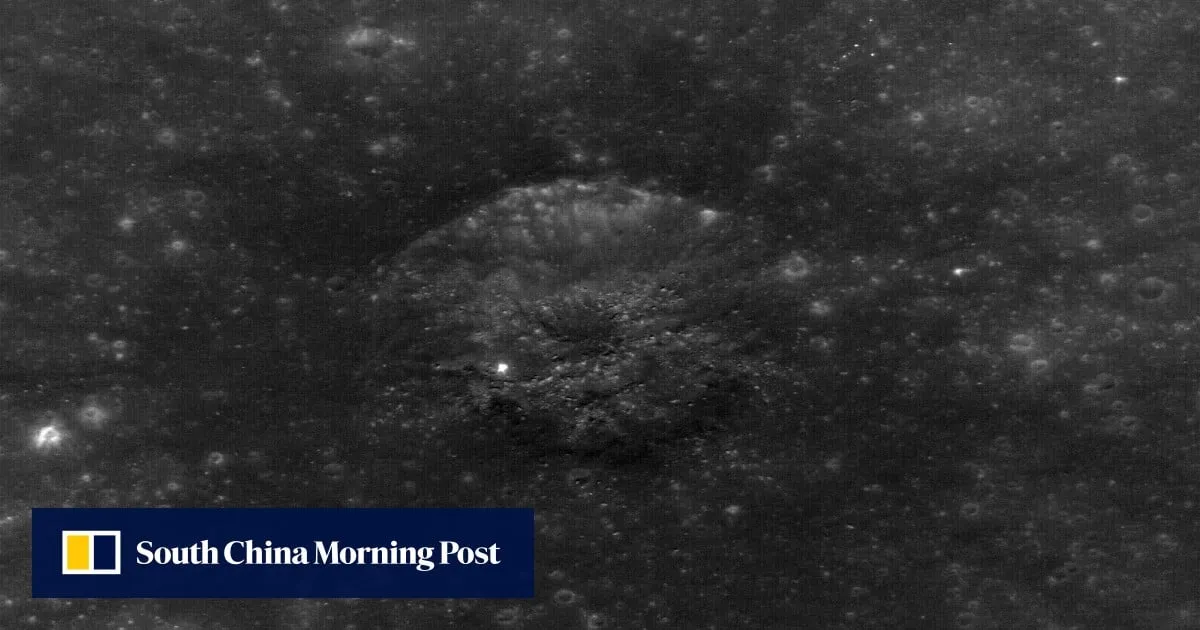
The Rimae Bode region on the lunar nearside is favoured for its diverse geological samples, including volcanic debris, for studying lunar volcanism and its relatively flat ground for safe astronaut access.“Rimae Bode lies in an easily accessible, low-latitude, nearside location with generally flat, traversable terrain,” they wrote in a paper published in the peer-reviewed journal Nature Astronomy on Monday.The purple star marks the proposed landing site LS2. Photo: Nature Astronomy“Both the high scientific value and the favourable landing and exploration conditions make the Rimae Bode region a candidate for missions like the NASA Constellation programme and China’s first crewed lunar mission.”The NASA programme was formulated in 2005 to return to the Moon to establish an outpost and explore Mars, but was cancelled in 2010 because of severe budget overruns.Months before it was cancelled, NASA published a close-up image of a site “near a NASA Constellation region of interest”. It shows a small fresh crater 230 metres (755 feet) wide with dark ejecta, or material thrown out from an impact or eruption, in the highlands near Rima Bode II, a mare unit that was also analysed and identified as one of the four feasible landing sites in the latest paper.In the new study, the researchers from the China-university-of-geosciences" class="entity-link entity-organization" data-entity-id="41995" data-entity-type="organization">China University of Geosciences in Wuhan, Guilin University of Technology, the Chinese Academy of Sciences and the University of Münster College of Science used orbital images and measurements to study a targeted area of the Rimae Bode.The Rimae Bode region and proposed landing sites. Photo: Nature Astronomy
SRCSouth China Morning Post
LANGEN
LEANCenter-Right
WORDS253
ENT11
TUE · 2026-03-10 · 06:00 GMTBRIEF NSR-2026-0310-23048
NSR-2026-0310-23048News Report·EN·Technology
China’s 2030 moon landing: scientists suggest a site that has long been on Nasa’s radar
Chinese scientists have proposed the Rimae Bode region on the near side of the moon as a potential landing site for China's planned 2030 crewed lunar mission. The area is favored due to its diverse geological samples, including volcanic debris, which could provide insights into lunar volcanism.
Holly ChikSouth China Morning PostFiled 2026-03-10 · 06:00 GMTLean · Center-RightRead · 2 min
South China Morning PostFIG 01
Reading time
2min
Word count
253words
Sources cited
1cited
Entities identified
11entities
Quality score
100%
§ 01
Briefing Summary
AI-generatedNEWSAR · AI
Chinese scientists have proposed the Rimae Bode region on the near side of the moon as a potential landing site for China's planned 2030 crewed lunar mission. The area is favored due to its diverse geological samples, including volcanic debris, which could provide insights into lunar volcanism. Rimae Bode also offers relatively flat terrain, making it safer and more accessible for astronauts. The study, published in Nature Astronomy, highlights the region's high scientific value and favorable landing conditions, noting it was previously considered by NASA's Constellation program. Researchers analyzed orbital images to identify feasible landing sites within Rimae Bode, including a fresh crater with dark ejecta.
Confidence 0.90Sources 1Claims 5Entities 11
§ 02
Article analysis
Model · rule-basedFraming
Technology
National Security
Tone
Measured
AI-assessed
CalmNeutralAlarmist
Factuality
0.80 / 1.00
Factual
LowHigh
Sources cited
1
Limited
FewMany
§ 03
Key claims
5 extracted01
The Nasa Constellation programme was cancelled in 2010 due to budget overruns.
factualnull
Confidence
1.00
02
Rimae Bode is favored for diverse geological samples and flat ground.
factualnull
Confidence
1.00
03
Scientists suggest the Rimae Bode region for China's moon landing.
factualnull
Confidence
1.00
04
Rimae Bode region is a candidate for missions like the Nasa Constellation programme.
quoteResearchers from China University of Geosciences et al.
Confidence
0.90
05
China is planning a moon landing by 2030.
predictionnull
Confidence
0.90
§ 04
Full report
2 min read · 253 words§ 05
Entities
11 identifiedKey playerOppositionContextPositiveNeutralNegative
Organizations6
§ 06
Keywords & salience
10 termsmoon landing
1.00
rimae bode
0.90
landing site
0.80
china
0.70
lunar volcanism
0.70
nasa
0.70
lunar nearside
0.60
lunar mission
0.60
geological samples
0.60
astronaut access
0.50
§ 07
Topic connections
Interactive graph No topic relationship data available yet. This graph will appear once topic relationships have been computed.