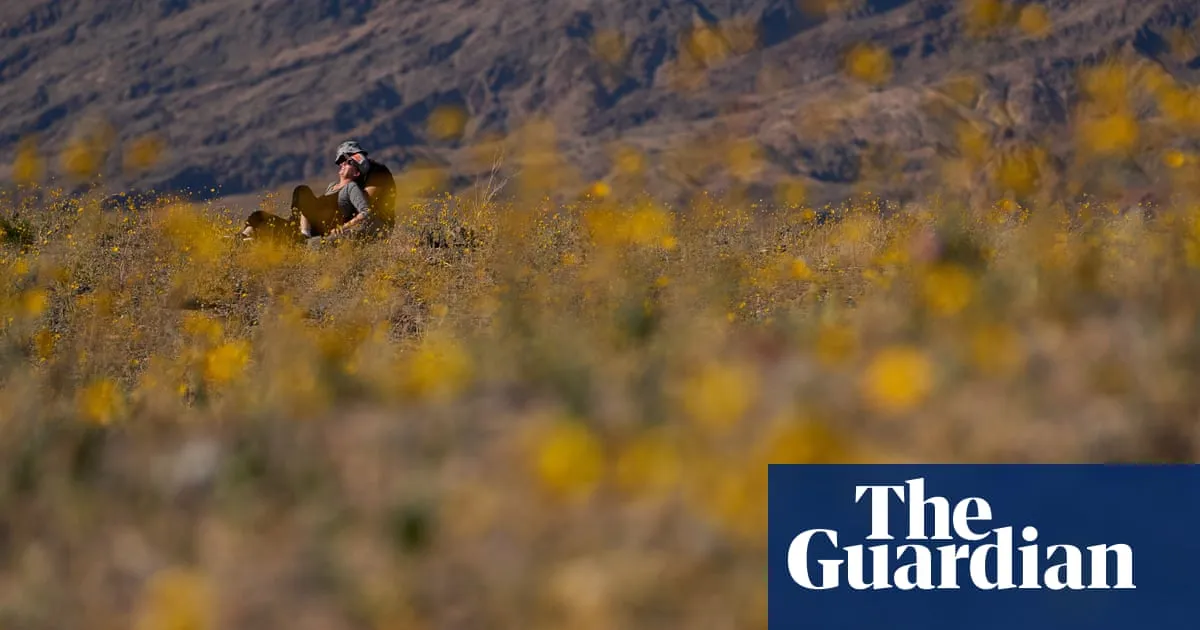
After a winter of record rainfall, a superbloom has erupted in Death Valley, covering the famously arid desert in a blanket of vibrant pink, purple and yellow flowers. As travelers from around the world make their way to the desert, they can expect to be greeted by fragrant air and a quilt of delicate hues.While there is no official definition for a superbloom, the National Park Service uses the term to “describe conditions when so many flowers are present that they appear as swaths of color across the landscape, rather than isolated plants, especially striking at low elevations where the ground is typically sand, gravel and rock”A field of blooming desert sunflowers or desert gold wildflowers are seen as the sun sets on rugged mountains inside Death Valley National Park. Photograph: David Becker/ZUMA Press Wire/ShutterstockSarah Phillips, from Houston, Texas, poses for her husband, Keith Phillips, as he takes a photograph amongst a cluster of desert gold wildflowers blooming in Death Valley National Park. Photograph: MediaNews Group/Inland Valley Daily Bulletin/Getty ImagesThe park last experienced a superbloom in 2016, which can only occur in “perfect conditions”, with “well-spaced rainfall” and mild temperatures.Travelers are flocking to the Death Valley National Park. Photograph: John Locher/APPeople walk through Badwater Basin on 2 March in Death Valley, California. Photograph: Eric Thayer/Los Angeles Times/Getty ImagesThe National Park Service said that low-elevation flowers would continue blooming until mid to late March, depending on the weather. Higher elevations will experience blooms in April through June.Time is of the essence to catch a glimpse of the superbloom, so if tourists can get there in time, they should keep an eye out for some of the most commonly occurring (and eye-catching) flowers: desert gold, brown-eyed evening primrose, golden evening primrose, phacelia, mojave poppy, to name a few.Desert sunflowers and desert sand-verbenas bloom as the sun sets in the Death Valley National Park. Photograph: MediaNews Group/Inland Valley Daily Bulletin/Getty ImagesPurple hues blanket Death Valley in a rare superbloom Photograph: Eric Thayer/Los Angeles Times/Getty Images
SRCThe Guardian - World News
LANGEN
LEANCenter-Left
WORDS332
ENT9
TUE · 2026-03-10 · 15:40 GMTBRIEF NSR-2026-0310-23217
NSR-2026-0310-23217News Report·EN·Environmental
Death Valley bursts into superbloom for first time in a decade
Death Valley is experiencing a rare superbloom for the first time in nearly a decade, transforming the arid landscape into a vibrant display of wildflowers. This phenomenon, characterized by widespread swathes of color, is triggered by record rainfall and favorable temperatures.
Sara BraunThe Guardian - World NewsFiled 2026-03-10 · 15:40 GMTLean · Center-LeftRead · 2 min
The Guardian - World NewsFIG 01
Reading time
2min
Word count
332words
Sources cited
1cited
Entities identified
9entities
Quality score
100%
§ 01
Briefing Summary
AI-generatedNEWSAR · AI
Death Valley is experiencing a rare superbloom for the first time in nearly a decade, transforming the arid landscape into a vibrant display of wildflowers. This phenomenon, characterized by widespread swathes of color, is triggered by record rainfall and favorable temperatures. The superbloom is currently visible at lower elevations, expected to last until mid-to-late March, with higher elevations blooming from April to June. Travelers are visiting Death Valley National Park to witness the event, seeking out flowers like desert gold, evening primrose, and Mojave poppy. The last superbloom occurred in 2016, and these events require specific weather conditions to occur.
Confidence 0.90Sources 1Claims 5Entities 9
§ 02
Article analysis
Model · rule-basedFraming
Environmental
Human Interest
Tone
Measured
AI-assessed
CalmNeutralAlarmist
Factuality
0.80 / 1.00
Factual
LowHigh
Sources cited
1
Limited
FewMany
§ 03
Key claims
5 extracted01
The park last experienced a superbloom in 2016.
factual
Confidence
1.00
02
The National Park Service uses the term 'superbloom' to describe swaths of color across the landscape.
quoteNational Park Service
Confidence
1.00
03
A superbloom has erupted in Death Valley after a winter of record rainfall.
factual
Confidence
1.00
04
Higher elevations will experience blooms in April through June.
predictionNational Park Service
Confidence
0.90
05
Low-elevation flowers will continue blooming until mid to late March, depending on the weather.
predictionNational Park Service
Confidence
0.90
§ 04
Full report
2 min read · 332 words§ 05
Entities
9 identifiedKey playerOppositionContextPositiveNeutralNegative
Organizations1
§ 06
Keywords & salience
8 termssuperbloom
1.00
death valley
0.90
desert flowers
0.80
record rainfall
0.70
national park service
0.60
wildflowers
0.50
tourism
0.50
desert gold
0.40
§ 07
Topic connections
Interactive graph Network visualization showing 3 related topics
View Full Graph Person Organization Location Event|Click node to navigate|Edge numbers = shared articles