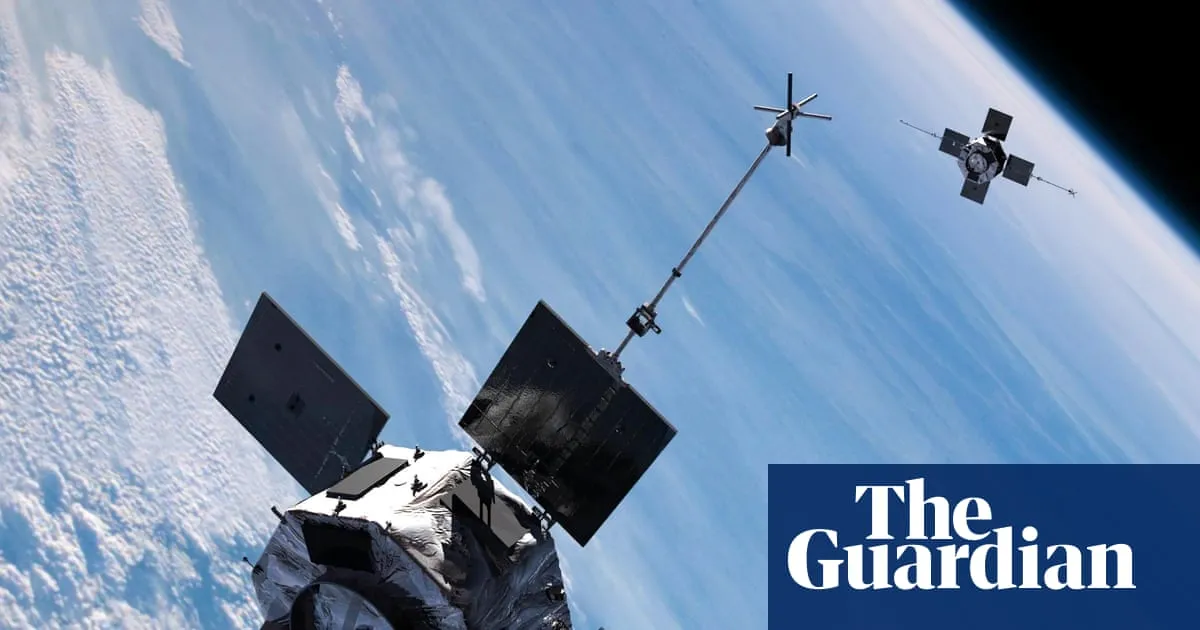
Parts of a giant Nasa satellite will crash to Earth on Tuesday evening, the US space agency is warning – but the chance of being struck is extremely low.According to the US military’s Space Force, the roughly 1,323lb (600kg) spacecraft, one of twin probes launched in 2012 to investigate the Van Allen radiation belt, is estimated to re-enter Earth’s atmosphere at about 7.45pm EDT.Most of the craft, it said in a prediction published Monday, will burn up on re-entry, yet some components are expected to survive. There is a small chance, which the Space Force calculates at 1 in 4,200, that somebody on Earth could be harmed.“Nasa and Space Force will continue to monitor the re-entry and update predictions,” the statement said, adding there was an initial uncertainty of plus or minus 24 hours in the calculations.Debris falling from space is not uncommon, and Wired reported in 2009 that over a 40-year period roughly 5,400 tons are thought to have survived re-entry.But the odds of being hit are low because about 71% of Earth’s surface is covered by water. A 2011 report by space.com said the overall chance of anybody being hurt was 1 in 3,200, and for any given individual far less. “The odds that you will be hit are one in several trillion, so quite low for any particular person,” Mark Matney, a scientist in the orbital debris program office at Nasa’s Johnson Space Center, Houston, told the outlet.One not so lucky was Lottie Williams, a Tulsa, Oklahoma, resident who was walking through a park in January 1997 when she saw a sudden flash of flight, followed by a six-inch chunk of metal striking her on the shoulder.The small, blackened fragment was never formally identified as space junk. But the time and location was confirmed by Nasa as consistent with the re-entry and break up of the second stage of a Delta rocket that had been orbiting for months. And Williams, who was not injured, remains the only person known to have been struck by falling manufactured space debris.On Sunday, a chunk of meteor crashed through the roof of a house in Germany, one of an estimated 15,000-17,000 meteorites to reach Earth every year, although the majority end up on the floor of the ocean.The Space Force advisory about Tuesday’s satellite crash, meanwhile, focuses more on where it came from than where or when it will land. The craft is Van Allen Probe A, launched with its twin, Van Allen Probe B, from Cape Canaveral, Florida, on 30 August 2012 on a mission to investigate the Van Allen belts of charged particles trapped by Earth’s magnetic field.The probes were deactivated in 2019 when they ran out of fuel and were no longer able to orientate themselves towards the sun. Early calculations that they would reenter Earth’s atmosphere in 2034 proved inaccurate, although the second probe is not expected to return before the end of this decade.
SRCThe Guardian - World News
LANGEN
LEANCenter-Left
WORDS488
ENT12
TUE · 2026-03-10 · 15:12 GMTBRIEF NSR-2026-0310-23218
NSR-2026-0310-23218News Report·EN·Technology
Parts of giant Nasa satellite to crash to Earth, posing low risk
A NASA satellite, Van Allen Probe A, is expected to re-enter Earth's atmosphere on Tuesday evening around 7:45 pm EDT, with some parts likely to survive the descent. The 1,323lb spacecraft, launched in 2012 to study the Van Allen radiation belt, will mostly burn up upon reentry.
Richard LuscombeThe Guardian - World NewsFiled 2026-03-10 · 15:12 GMTLean · Center-LeftRead · 2 min
The Guardian - World NewsFIG 01
Reading time
2min
Word count
488words
Sources cited
3cited
Entities identified
12entities
Quality score
100%
§ 01
Briefing Summary
AI-generatedNEWSAR · AI
A NASA satellite, Van Allen Probe A, is expected to re-enter Earth's atmosphere on Tuesday evening around 7:45 pm EDT, with some parts likely to survive the descent. The 1,323lb spacecraft, launched in 2012 to study the Van Allen radiation belt, will mostly burn up upon reentry. The US Space Force estimates a 1 in 4,200 chance of someone on Earth being harmed by falling debris. While space debris re-entry is common, the odds of being hit are very low due to the Earth's surface being mostly water. NASA and the Space Force will continue to monitor the re-entry and update predictions.
Confidence 0.90Sources 3Claims 5Entities 12
§ 02
Article analysis
Model · rule-basedFraming
Technology
Environmental
Tone
Measured
AI-assessed
CalmNeutralAlarmist
Factuality
0.90 / 1.00
Factual
LowHigh
Sources cited
3
Well sourced
FewMany
§ 03
Key claims
5 extracted01
The probes were deactivated in 2019 when they ran out of fuel.
factual
Confidence
1.00
02
There is a small chance, which the Space Force calculates at 1 in 4,200, that somebody on Earth could be harmed.
statisticSpace Force
Confidence
1.00
03
Parts of a giant Nasa satellite will crash to Earth on Tuesday evening.
factualUS space agency
Confidence
1.00
04
The chance of being struck by debris is extremely low.
factualUS space agency
Confidence
0.90
05
The spacecraft is estimated to re-enter Earth’s atmosphere at about 7.45pm EDT.
predictionUS military’s Space Force
Confidence
0.80
§ 04
Full report
2 min read · 488 words§ 05
Entities
12 identifiedKey playerOppositionContextPositiveNeutralNegative
Organizations2
§ 06
Keywords & salience
9 termssatellite crash
0.90
space debris
0.80
re-entry
0.70
nasa
0.70
van allen probes
0.60
risk assessment
0.60
space force
0.50
earth's atmosphere
0.50
orbital debris
0.40
§ 07
Topic connections
Interactive graph No topic relationship data available yet. This graph will appear once topic relationships have been computed.