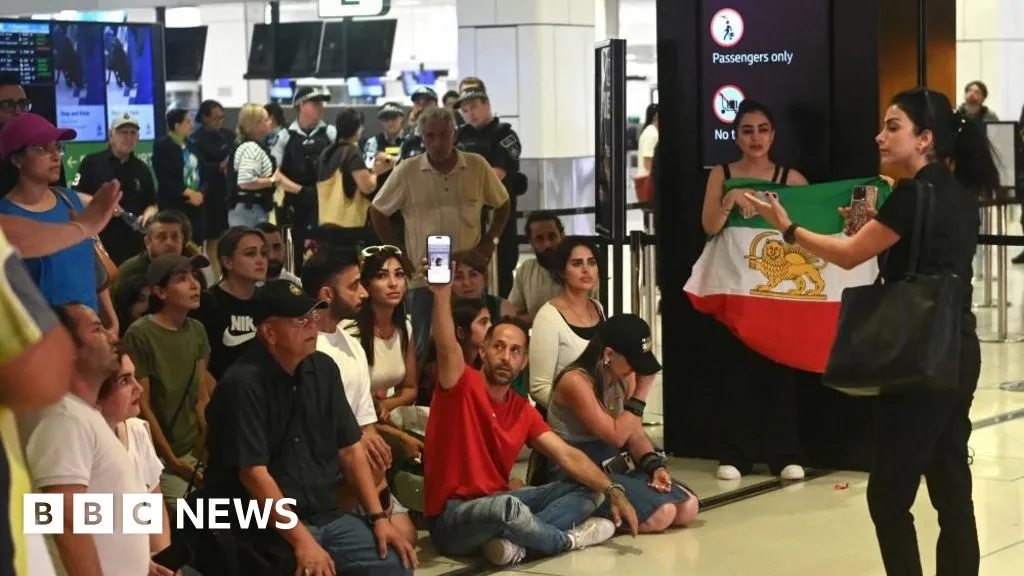
3 hours agoKaty Watson,Australia correspondentandBen HattonReutersActivists trying to ensure the team could stay gathered at Sydney Airport Two more people connected to the Iranian women's football team have remained in Australia and did not board a flight out of the country, the BBC understands.It is believed one is a player and the other member of the team's technical staff. There has been no official confirmation from Australia's Home Affairs or Federal Police.It is understood the remaining Iranian players left Australia on Tuesday night local time - two days after they were knocked out of the Asian Cup.Earlier, the ABC, quoting Home Affairs Minister Tony Burke, said at least two more team members had also sought asylum. The team arrived at Sydney Airport from the Gold Coast, where the Asia Cup is being held, on Tuesday evening. Members of the Australian-Iranian community gathered there to support them and to protest against them returning to Iran.They said some members of the team had signalled for help. Burke, quoted by the ABC, said Border Force officials had made "multiple representations to the team" before they left Sydney, "including private meetings".Local media reported that at least one person refused to board their later flight to Malaysia on their way back to Iran. But some of the players - who were accompanied by chaperones - reportedly told reporters that they wanted to go back to Iran.Australia's humanitarian visa programme grants permanent protection to refugees and people in humanitarian need. Visa holders can live, work and study in the country.Reuters/Australian Department of Home AffairsAustralian Home Affairs Minister Tony Burke with five players granted humanitarian visasIt is not known what repercussions the team and their families might face in Iran after the players refused to sing the national anthem.One conservative commentator on Iranian state media accused them of being "wartime traitors" and called for a harsh punishment.The team did sing the anthem in their last two games before they were eliminated on Sunday, leading critics to believe they had been forced to take part by government officials accompanying them during the tournament as part of the delegation.Earlier on Tuesday, a bus carrying team members was temporarily blocked by activists as it left their hotel on the Gold Coast. Some carried the Lion and Sun flag, which served as the official state flag before the Islamic revolution in Iran.Meanwhile, those who had been granted humanitarian visas left the team hotel were moved to a safe location by police.Burke named them as Fatemeh Pasandideh, Zahra Ghanbari, Zahra Sarbali, Atefeh Ramazanzadeh, and Mona Hamoudi. Shortly after they left, the BBC witnessed some of their minders running across the hotel to try to find them. "They want to be clear they are not political activists. They are athletes who want to be safe," Burke said, adding that talks with them had been going on over several days.Addressing the other team members before they left Australia, he said: "The same opportunity is there. Australia has taken the Iranian women's soccer team into our hearts. These women are tremendously popular in Australia."EPA/ShutterstockProtesters blocked a bus carrying Iranian players and staff on the Gold Coast"Australians have been moved by the plight of these brave women," Australian Prime Minister Anthony Albanese told a news conference on Tuesday. "They're safe here, and they should feel at home here."The Iranian players' situation has also come to the attention of US President Donald Trump, who took to his Truth Social platform to demand action.He said Australia should "give asylum" to the women or "the US will take them if you won't."Around an hour later, Trump posted again to say he had spoken to Australian Prime Minister Anthony Albanese, writing: "five have already been taken care of, and the rest are on their way".The Trump administration put all asylum decisions on hold at the end of last year, and has stopped issuing immigrant visas for citizens from dozens of countries including Iran. It has said the administration wants to bring "an end to the abuse" of the system.
SRCBBC News - World
LANGEN
LEANCenter
WORDS669
ENT12
TUE · 2026-03-10 · 20:39 GMTBRIEF NSR-2026-0310-23287
NSR-2026-0310-23287News Report·EN·Human Rights
Two more connected to Iranian football team stay in Australia, BBC understands
Two more individuals connected to the Iranian women's football team, reportedly a player and a technical staff member, have remained in Australia after the team's departure following the Asian Cup. This follows earlier reports that at least two other team members sought asylum.
BBC News - WorldFiled 2026-03-10 · 20:39 GMTLean · CenterRead · 3 min
BBC News - WorldFIG 01
Reading time
3min
Word count
669words
Sources cited
4cited
Entities identified
12entities
Quality score
100%
§ 01
Briefing Summary
AI-generatedNEWSAR · AI
Two more individuals connected to the Iranian women's football team, reportedly a player and a technical staff member, have remained in Australia after the team's departure following the Asian Cup. This follows earlier reports that at least two other team members sought asylum. The team arrived in Sydney from the Gold Coast, where the tournament was held, and were met by supporters and protestors. Australian officials held private meetings with the team before their departure. It is unknown what repercussions the team and their families might face in Iran, especially after some players refused to sing the national anthem.
Confidence 0.90Sources 4Claims 5Entities 12
§ 02
Article analysis
Model · rule-basedFraming
Human Rights
Political Strategy
Tone
Measured
AI-assessed
CalmNeutralAlarmist
Factuality
0.80 / 1.00
Factual
LowHigh
Sources cited
4
Well sourced
FewMany
§ 03
Key claims
5 extracted01
One conservative commentator on Iranian state media accused them of being 'wartime traitors'.
quoteOne conservative commentator on Iranian state media
Confidence
1.00
02
Border Force officials had made 'multiple representations to the team' before they left Sydney.
quoteTony Burke, quoted by the ABC
Confidence
0.90
03
The remaining Iranian players left Australia on Tuesday night local time.
factualnull
Confidence
0.90
04
Two more people connected to the Iranian women's football team have remained in Australia.
factualBBC
Confidence
0.90
05
At least two more team members had also sought asylum.
factualABC, quoting Home Affairs Minister Tony Burke
Confidence
0.80
§ 04
Full report
3 min read · 669 words§ 05
Entities
12 identifiedKey playerOppositionContextPositiveNeutralNegative
People1
Organizations5
Locations5
§ 06
Keywords & salience
8 termsiranian women's football team
1.00
australia
0.80
asylum
0.70
humanitarian visa
0.60
iran
0.60
political repercussions
0.50
asian cup
0.50
border force
0.40
§ 07
Topic connections
Interactive graph Network visualization showing 51 related topics
View Full Graph Person Organization Location Event|Click node to navigate|Edge numbers = shared articles