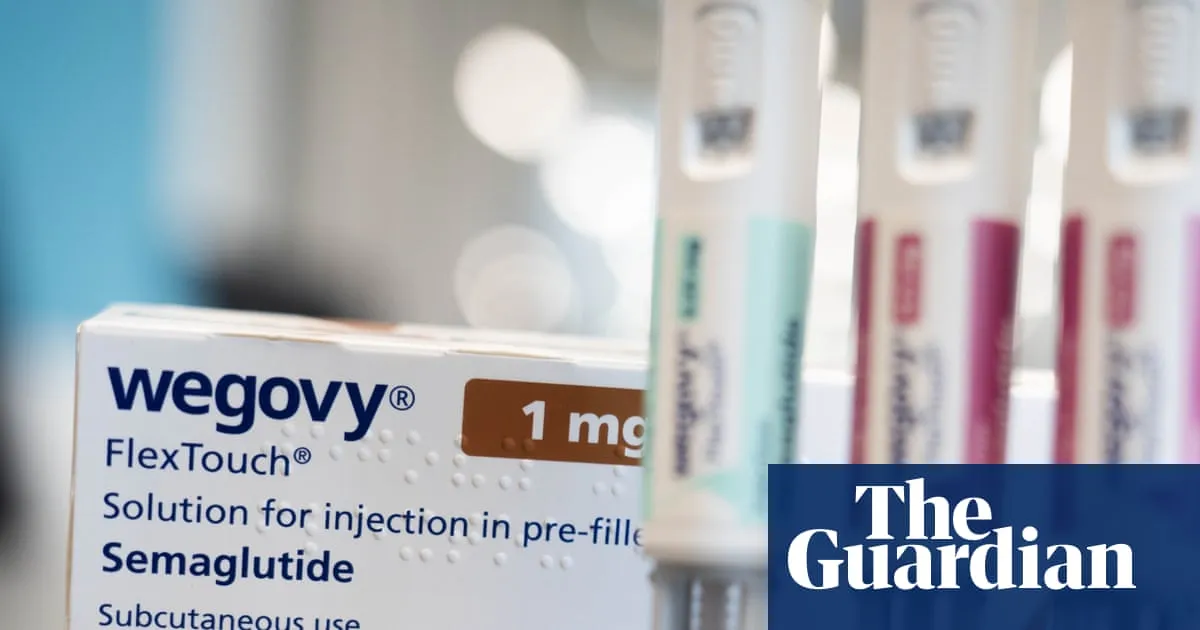
Patients taking Wegovy have nearly five times the risk of sudden sight loss of those on Ozempic, a large-scale study has found.Glucagon-like peptide-1 receptor agonist (GLP-1 RA) medicines such as semaglutide (sold as Wegovy, Ozempic and Rybelsus) and tirzepetide (sold as Mounjaro) help reduce blood sugar levels, slow digestion and reduce appetite, and have been linked to reduced risks of heart attack, fewer drug overdoses and other health benefits.But a study, published in the British Journal of Ophthalmology, found that patients taking Wegovy for weight loss had a fivefold greater chance of developing non-arteritic anterior ischemic optic neuropathy (Naion) than the diabetes drug Ozempic, while men had a three times greater risk than women.These “eye strokes” cause sudden and usually permanent vision loss (pdf) due to reduced blood flow to the optic nerve.Although rare, affecting around one in 10,000 people who take semaglutide, there was “a potential dose-dependent safety concern” for the drug, the study found.Wegovy, Ozempic and Rybelsus – made by Novo Nordisk – all contain semaglutide, but have different dosages and formulations.Dr Edward Margolin, from the department of ophthalmology at the University of Toronto and one of the authors of the research, said Naion was likely to be “a real side-effect” of semaglutide, and faster, quicker or more aggressive weight loss would be likely to “increase the risk” of Naion.The study examined reports of side-effects submitted to the US medicines regulator, the Food and Drug Administration, through its adverse event reporting system between December 2017 and December 2024.Canadian researchers compared any reports of Naion associated with up to 2mg of weekly injectable Ozempic for type 2 diabetes; up to 2.4mg of weekly injectable Wegovy for obesity – the highest approved dose – and a daily Rybelsus tablet for type 2 diabetes. They also examined reported side-effects from tirzepatide (Mounjaro).The study found that Wegovy had the strongest association with sudden vision loss. In contrast, the authors found no increased risk with Rybelsus tablets or tirzepatide.The authors said that the high doses of Wegovy and the fact injections were faster-acting could explain why the association was higher. In contrast, the limited absorption and slower uptake of Rybelsus tablets probably explained the absence of a detectable link, they said.The findings came after the UK Medicines and Healthcare products Regulatory Agency issued a drug safety update in February, warning about the risk of Naion. It followed similar warnings by the European medicines regulator.Dr Alison Cave, the MHRA chief safety officer, said: “The risk of Naion in patients prescribed semaglutide is extremely low. However, as with all medicines, patients and prescribers need to be aware of the symptoms of potential side-effects, even if the risk is very small, to ensure patients receive the appropriate treatment promptly should they occur.”Samantha Mann, a consultant ophthalmologist and diabetic eye screening lead at the Royal College of Ophthalmologists, said: “This study relied on reported side-effects and so cannot prove causation or determine how common this problem truly is. An increase in this form of optic nerve ‘stroke’ has however not been widely observed in routine clinical practice at St Thomas’ in London, where I work. Further studies are therefore needed to clarify if this increased risk is indeed real.”A spokesperson for Novo Nordisk said: “Patient safety is our top priority, and we take any reports about adverse events from the use of our medicines very seriously. We work closely with authorities and regulatory bodies from around the world to continuously monitor the safety profile of our products.”The EU patient leaflets for Wegovy, Ozempic and Rybelsus had been updated to include Naion, they added, but “based on the totality of evidence, we concluded that the data did not suggest a reasonable possibility of a causal relationship between semaglutide and Naion and Novo Nordisk believes that the benefit-risk profile of semaglutide remains favourable”.
SRCThe Guardian - World News
LANGEN
LEANCenter-Left
WORDS634
ENT12
TUE · 2026-03-10 · 22:30 GMTBRIEF NSR-2026-0310-23304
NSR-2026-0310-23304News Report·EN·Public Health
Wegovy users have five times greater risk of sudden sight loss than Ozempic users, study finds
A recent study published in the British Journal of Ophthalmology found that Wegovy users have a significantly higher risk of sudden vision loss compared to Ozempic users. The study, which analyzed reports submitted to the FDA between 2017 and 2024, revealed that Wegovy patients had a fivefold greater chance of developing non-arteritic anterior ischemic optic neuropathy (NAION), an "eye stroke" causing permanent vision loss.
Anna Bawden Health and social affairs correspondentThe Guardian - World NewsFiled 2026-03-10 · 22:30 GMTLean · Center-LeftRead · 3 min
The Guardian - World NewsFIG 01
Reading time
3min
Word count
634words
Sources cited
4cited
Entities identified
12entities
Quality score
100%
§ 01
Briefing Summary
AI-generatedNEWSAR · AI
A recent study published in the British Journal of Ophthalmology found that Wegovy users have a significantly higher risk of sudden vision loss compared to Ozempic users. The study, which analyzed reports submitted to the FDA between 2017 and 2024, revealed that Wegovy patients had a fivefold greater chance of developing non-arteritic anterior ischemic optic neuropathy (NAION), an "eye stroke" causing permanent vision loss. Researchers compared reports of NAION associated with Wegovy, Ozempic, Rybelsus, and Mounjaro. While Wegovy showed a strong association with vision loss, no increased risk was found with Rybelsus or Mounjaro. The higher dosage and faster-acting injection of Wegovy were cited as potential reasons for the increased risk. All drugs contain GLP-1 RAs, which help reduce blood sugar levels, slow digestion and reduce appetite.
Confidence 0.90Sources 4Claims 5Entities 12
§ 02
Article analysis
Model · rule-basedFraming
Public Health
Technology
Tone
Mixed Tone
AI-assessed
CalmNeutralAlarmist
Factuality
0.80 / 1.00
Factual
LowHigh
Sources cited
4
Well sourced
FewMany
§ 03
Key claims
5 extracted01
The study examined reports of side-effects submitted to the US medicines regulator, the Food and Drug Administration.
factualArticle's own claim
Confidence
1.00
02
These “eye strokes” cause sudden and usually permanent vision loss due to reduced blood flow to the optic nerve.
factualArticle's own claim
Confidence
1.00
03
Patients taking Wegovy have nearly five times the risk of sudden sight loss of those on Ozempic.
statisticBritish Journal of Ophthalmology study
Confidence
1.00
04
The risk of Naion in patients prescribed semaglutide is extremely low.
quoteDr Alison Cave, the MHRA chief safety officer
Confidence
0.90
05
Naion was likely to be “a real side-effect” of semaglutide.
quoteDr Edward Margolin
Confidence
0.90
§ 04
Full report
3 min read · 634 words§ 05
Entities
12 identifiedKey playerOppositionContextPositiveNeutralNegative
People1
Organizations8
§ 06
Keywords & salience
10 termswegovy
1.00
sudden sight loss
0.90
ozempic
0.80
semaglutide
0.70
glp-1 ra
0.70
naion
0.70
weight loss
0.60
vision loss
0.60
drug safety
0.50
side effects
0.50
§ 07
Topic connections
Interactive graph Network visualization showing 10 related topics
View Full Graph Person Organization Location Event|Click node to navigate|Edge numbers = shared articles