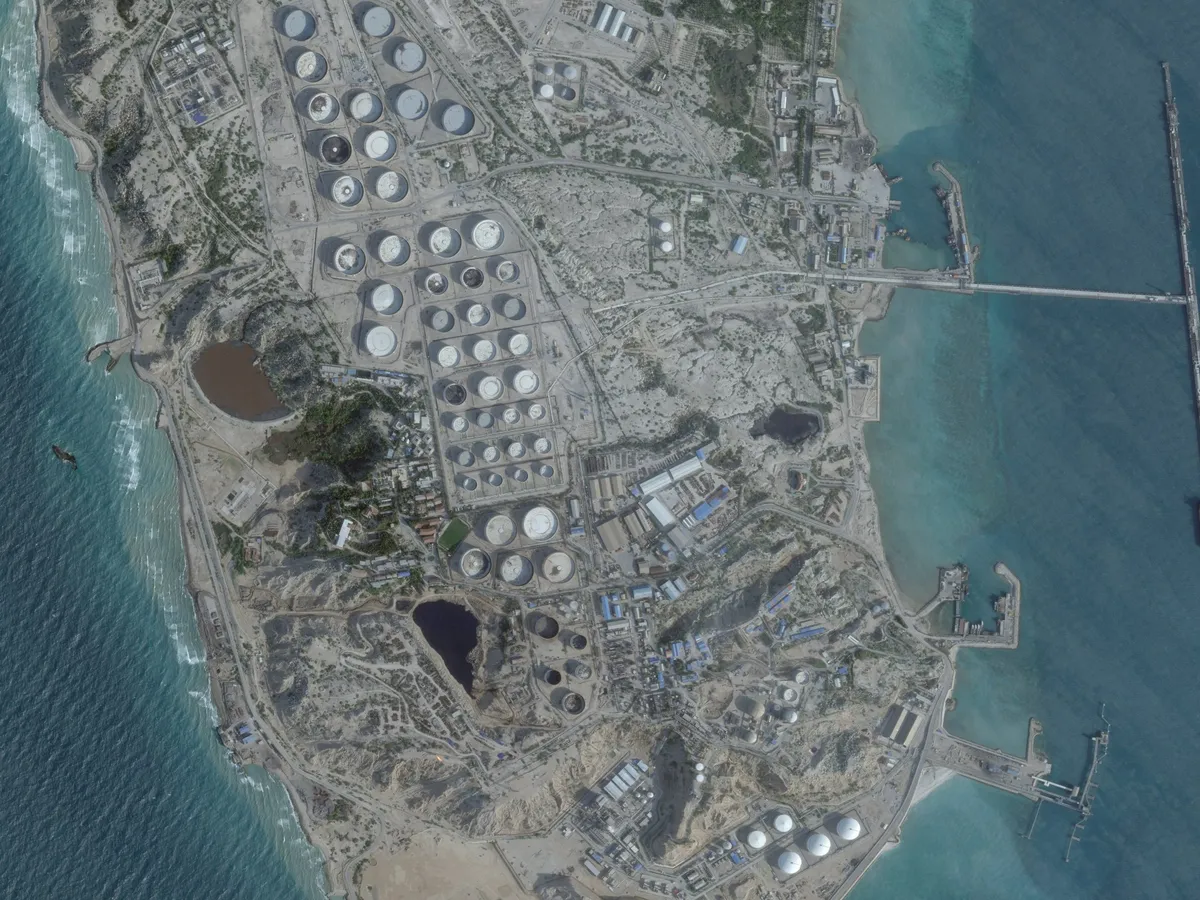
Known as the ‘Forbidden Island’ due to strict military control, this ancient coral outcrop processes 90% of Iran’s crude exports while guarding millennia of human history.A satellite image shows an oil terminal at Kharg Island, Iran, February 25, 2026 [Planet Labs PBC/Handout via Reuters]Beneath the scorching sun of the Gulf, the rhythmic hum of millions of barrels of crude oil rushing through subsea pipelines vibrates against ancient coral rock.Here, the celebrated Iranian writer Jalal Al-e-Ahmad once stood, gazing at the isolated shores, and famously dubbed the landmass the “orphan pearl of the Persian Gulf”.Today, this 22-square-kilometre (8.5-square-mile) coral outcrop in the Bushehr province is widely known among Iranians as the “Forbidden Island”.Shrouded in intense secrecy and guarded by the elite Islamic Revolutionary Guard Corps (IRGC), it is a place where entry is strictly restricted to those with official security clearances.Yet, beyond the imposing steel fences and military watchtowers lies a pristine landscape where millennia of diverse human history quietly coexist with the beating heart of Iran’s modern energy empire.The petroleum nerve centreLocated 55km (34 miles) northwest of the Bushehr port and 15 nautical miles (equivalent to about 28km) from the Iranian mainland, Kharg Island is the undisputed economic backbone of Iran.The island processes 90 percent of the nation’s total oil exports, handling approximately 950 million barrels every year.Measuring just 8km (5 miles) in length and 4 to 5km (2.5 to 3 miles) in width, its deep surrounding waters provide a natural geographic advantage. This depth allows colossal supertankers to dock safely and load crude destined primarily for Asian markets, with China standing as the leading importer.According to the Iranian Ministry of Petroleum, the island’s facilities act as the vital nerve centre for the sector. The terminal receives crude from three major offshore fields – Aboozar, Forouzan, and Dorood – which is then transported via a complex network of subsea pipelines to onshore processing facilities before being stored or shipped to global markets.Despite facing years of international sanctions that periodically stifled production, Iran has aggressively expanded the island’s infrastructure.In May 2025, S&P Global Commodity Insights reported that Tehran added two million barrels to the terminal’s storage capacity by rehabilitating tanks 25 and 27, each capable of holding one million barrels.Historically, the loading capacity of these continuously upgraded terminals has reached a staggering maximum of seven million barrels per day, though current national exports hover around 1.6 million barrels daily, in addition to managing production for the domestic market.A view of oil facilities on the Kharg Island on the Gulf, about 1,250km (776 miles) south of Tehran, on February 23, 2016 [Morteza Nikoubazl/NurPhoto via Getty Images]Empires and exilesThe island’s strategic maritime value made it a coveted prize for conquerors long before the discovery of hydrocarbons. While some mistakenly link the name “Kharg” to the ancient inland city of Charax Spasinou – established by Alexander the Great near modern-day Basra at the confluence of the Tigris and Karkheh rivers – archaeological records confirm they are unrelated.Through the centuries, the island’s name has evolved in local dialects and European maps, recorded variously as Kharg, Khark, Kharaj, and Kharej. Its natural freshwater springs and prime location made it an essential maritime crossroads, facilitating the export of agricultural goods and minerals.During the European colonial era, the Portuguese first seized control of Kharg along with other Gulf islands. By the mid-18th century, Dutch ambitions took root.In 1752, the Dutch Baron Kniphausen secured an agreement with Mir Naser Al-Zaabi, the ruler of Bandar Rig, to establish a trading post. The following year, the Dutch East India Company built a heavily garrisoned fort to protect its interests.However, this colonial foothold was short-lived; after years of mounting tensions, Mir Muhanna, the governor of Bandar Rig, successfully attacked the fortress and definitively expelled the Dutch forces in January 1766.In the 20th century, the island’s narrative took a dark turn when Reza Shah Pahlavi, who was Shah of Iran from 1925 to 1941, transformed it into a remote exile for political prisoners, leaving its broader potential entirely unexploited. The modern petroleum era truly began to take shape after 1958.Shedding its grim penal past, Kharg was selected to become a huge crude export hub, with its new deep-water terminal officially commissioned and sending its first major shipment in August 1960. As offshore fields were discovered in the 1960s, Kharg eclipsed the Abadan port, drawing huge tankers to its deep-water berths.A general view of the Port of Kharg Island Oil Terminal, 25km (16 miles) from the Iranian coast in the Gulf and 483km (300 miles) northwest of the Strait of Hormuz, in Iran [File: Fatemeh Bahrami/Anadolu Agency/Getty Images]Echoes of a diverse pastThe island’s modern industrial facade conceals a profound archaeological wealth. Evidence of human settlement dates back to the end of the second millennium BC, spanning the Elamite, Achaemenid, and Sassanid eras.Among its most revered sites is the Mir Mohammad Shrine, built in the late 7th century AH, featuring two conical domes constructed from rock and mud.Nearby lies the Mir Aram Shrine, housing a 12-metre (39ft) stone bearing Islamic inscriptions and two torches believed to date back to the Achaemenid period. Locals associate this site with Mir Aram, a descendant of the Quranic and biblical prophet Noah.The island is a testament to religious and cultural plurality. An ancient heritage cemetery contains a remarkable mosaic of faiths, featuring:Other historic landmarks dotting the island include the remains of the 1747 Dutch Fort, the Dutch Garden, the Kharg Orchard, an old railway line, Islamic cemeteries, and a deeply significant Achaemenid inscription. This coral rock engraving, measuring 85 by 116cm (33 by 46 inches), is celebrated as one of the oldest archaeological records explicitly mentioning the “Persian Gulf”.Kharg Island bears the heavy scars of its geopolitical prominence, having endured relentless and devastating bombardments during the Iran-Iraq war in the 1980s before being painstakingly rebuilt by Iranian authorities.Today, as geopolitical tensions repeatedly threaten the region’s waterways, the island remains heavily militarised, keeping tourists at bay and inadvertently preserving its pristine ecological character.As supertankers quietly slip away into the deep waters of the Gulf, carrying the economic lifeblood of a heavily sanctioned nation, the ancient Zoroastrian and Christian graves watch silently from the coral shores – a haunting reminder that while empires and energy wars come and go, the “orphan pearl” remains forever tethered to the turbulent tides of history.
SRCAl Jazeera
LANGEN
LEANCenter
WORDS1 050
ENT12
WED · 2026-03-11 · 05:30 GMTBRIEF NSR-2026-0311-23398
NSR-2026-0311-23398News Report·EN·Economic Impact
The ‘orphan pearl’: Inside Kharg, the beating heart of Iran’s oil empire
Kharg Island, also known as the "Forbidden Island," is a heavily guarded coral outcrop in the Persian Gulf that serves as Iran's primary oil export hub. Located off the coast of Bushehr province, the island processes 90% of Iran's crude oil exports, totaling approximately 950 million barrels annually.
Mohammad MansourAl JazeeraFiled 2026-03-11 · 05:30 GMTLean · CenterRead · 5 min
Al JazeeraFIG 01
Reading time
5min
Word count
1 050words
Sources cited
2cited
Entities identified
12entities
Quality score
100%
§ 01
Briefing Summary
AI-generatedNEWSAR · AI
Kharg Island, also known as the "Forbidden Island," is a heavily guarded coral outcrop in the Persian Gulf that serves as Iran's primary oil export hub. Located off the coast of Bushehr province, the island processes 90% of Iran's crude oil exports, totaling approximately 950 million barrels annually. Kharg's deep waters allow for supertanker docking, facilitating shipments mainly to Asian markets, particularly China. Despite facing international sanctions, Iran has expanded the island's infrastructure, including increasing storage capacity. The island's facilities receive crude from major offshore fields via subsea pipelines, making it a vital nerve center for Iran's petroleum sector. Access to Kharg Island is strictly controlled by the Islamic Revolutionary Guard Corps.
Confidence 0.90Sources 2Claims 5Entities 12
§ 02
Article analysis
Model · rule-basedFraming
Economic Impact
National Security
Tone
Measured
AI-assessed
CalmNeutralAlarmist
Factuality
0.80 / 1.00
Factual
LowHigh
Sources cited
2
Limited
FewMany
§ 03
Key claims
5 extracted01
Current national exports hover around 1.6 million barrels daily.
statisticArticle's own claim
Confidence
1.00
02
Tehran added two million barrels to the terminal’s storage capacity in May 2025.
factualS&P Global Commodity Insights
Confidence
1.00
03
The island handles approximately 950 million barrels every year.
statisticArticle's own claim
Confidence
1.00
04
Kharg Island processes 90% of Iran’s total oil exports.
statisticArticle's own claim
Confidence
1.00
05
China is the leading importer of crude oil from Kharg Island.
factualArticle's own claim
Confidence
0.90
§ 04
Full report
5 min read · 1 050 words§ 05
Entities
12 identifiedKey playerOppositionContextPositiveNeutralNegative
Organizations3
§ 06
Keywords & salience
9 termskharg island
1.00
oil exports
0.90
iran
0.90
crude oil
0.80
energy empire
0.70
oil terminal
0.60
persian gulf
0.60
international sanctions
0.50
islamic revolutionary guard corps
0.50
§ 07
Topic connections
Interactive graph Network visualization showing 29 related topics
View Full Graph Person Organization Location Event|Click node to navigate|Edge numbers = shared articles