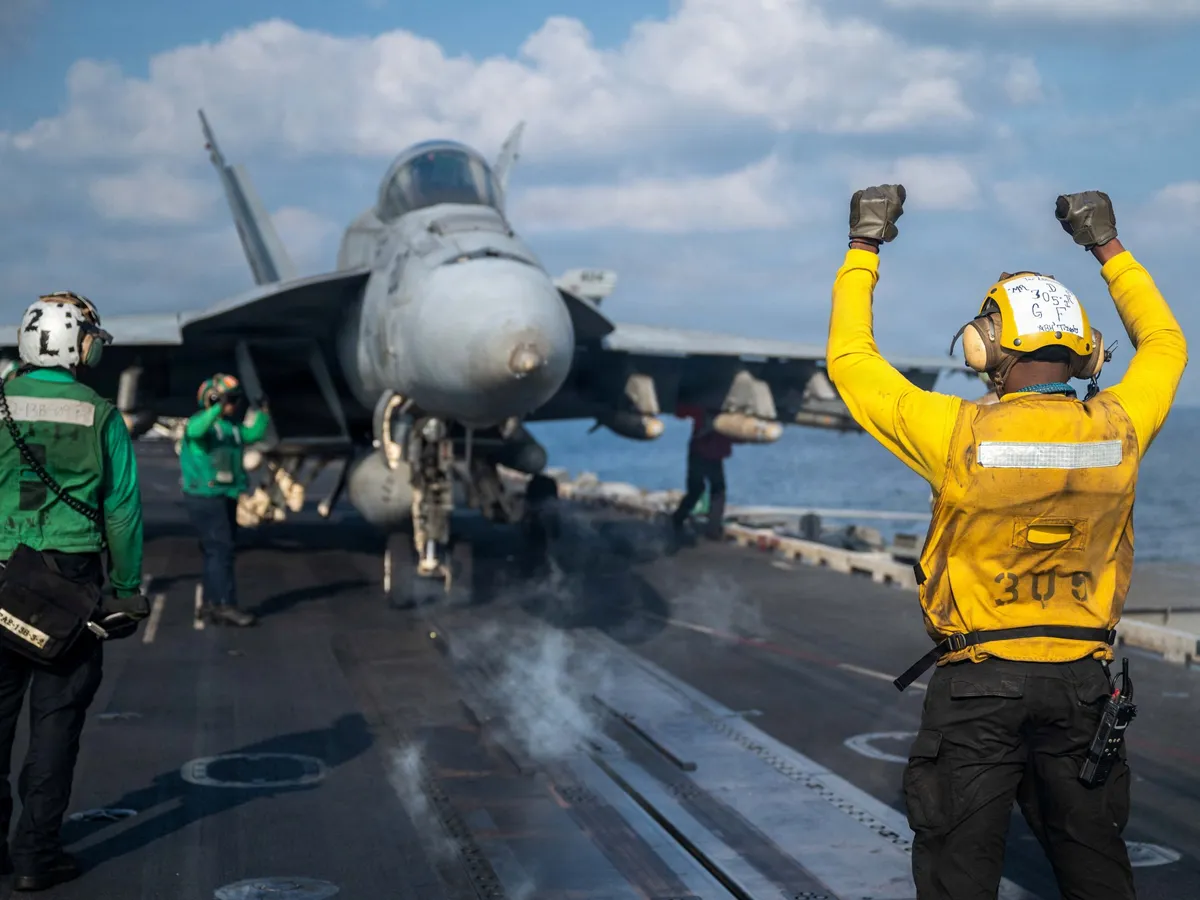
While last year’s escalation ended in a fragile truce, a strategic and seismic shift from targeting nuclear sites in Iran to “decapitation” strikes has erased all diplomatic off-ramps.A US Navy sailor signals an F/A-18E Super Hornet on the flight deck of the Nimitz-class aircraft carrier USS Abraham Lincoln in support of the attack on Iran at an undisclosed location on March 4, 2026 [US Navy/Handout via Reuters]Published On 11 Mar 2026In eastern Tehran, a resident named Sepehr keeps the front door of his apartment unlocked. It is a grim, calculated routine, allowing his family to sprint to an underground car park the moment the booming explosions return to shake their windows.As thick, toxic smoke from burning oil facilities blankets the city of 10 million, the reality of a limitless conflict has set in. “The war might last weeks, so my family and I will only leave if it gets too bad,” Sepehr says. “For now, life goes on”.For Iranians and the wider Middle East, there is a haunting sense of deja vu. Today marks the 12th day of the joint United States and Israeli military war against Iran. Exactly at this point during the June 2025 escalation, a fragile, US-brokered truce took effect, halting 12 days of intense bombardment.Top military leaders and hundreds of civilians were killed in Iran by Israeli strikes, and 28 were killed in Israel, with Iran’s largely symbolic salvo on Al Udeid Air Base in Qatar, which hosts US assets, marking the final curtain of that 12-day war.Things look much more perilous for the region and the world beyond this time.The current conflict bears little resemblance to last year’s contained warfare. A drastic strategic pivot – from degrading nuclear infrastructure to executing a “decapitation” strike against the Iranian leadership – has shattered the previous rules of engagement, dragging the region into an open-ended war of attrition with zero diplomatic off-ramps.The death of diplomacyDuring the June 2025 war, Israeli and US forces largely concentrated their firepower on specific nuclear and military facilities in Natanz, Fordow, and Isfahan, though Tehran also came under heavy attack. While devastating, the defined scope of those targets left room for negotiations. The conflict ended on June 24 after intense mediation by Oman, which had been facilitating indirect nuclear talks in Geneva.This time, the US and Israel adopted a fundamentally different objective. The opening salvo on February 28, 2026 assassinated Supreme Leader Ayatollah Ali Khamenei and several family members in Tehran. The strike was seemingly based on the assumption that eliminating the head of state would precipitate the instant capitulation of the government.That has not happened. And now another Khamenei, the second son Mojtaba, has been selected as the new supreme leader, with the powerful Islamic Revolutionary Guard Corps (IRGC) and key leaders all pledging loyalty.US President Donald Trump has oscillated between demanding the “unconditional surrender” of Iran, calling for a popular uprising, and offering amnesty to military commanders who switch sides. Yet, despite Washington and Israel claiming they have struck more than 5,000 targets and decimated Iran’s air force and navy, the government in Tehran has not collapsed.Iran says US and Israeli forces have bombed nearly 10,000 civilian sites in the country and killed more than 1,300 civilians since the war began.Surviving the shock: The ‘mosaic defence’The gamble that Iran’s state apparatus would fracture without its supreme leader fundamentally misjudged Iranian military doctrine. Analysts note that Tehran spent two decades designing a framework to survive exactly this scenario.Formulated by the IRGC, the concept of “decentralised mosaic defence” diffuses command and control across regional layers. Coupled with a “fourth successor” redundancy plan, it ensures that even if senior leaders are killed and central communications are severed, local combat units retain the authority and capacity to act.Consequently, the Iranian establishment swiftly appointed Mojtaba Khamenei as the new supreme leader, and Iran’s vast missile forces continued firing. Using a mix of short- and medium-range ballistic missiles, as well as drone swarms, Iran has turned time into a strategic weapon, aiming to deplete Israeli interceptor stockpiles and inflict continuous economic paralysis.(Al Jazeera)A wider, costlier battlefieldThe absence of an off-ramp has allowed the war to metastasise across the region. In 2025, Iran’s retaliation was largely contained to Israel and specific US assets. In 2026, Tehran has widened the map, launching strikes across nine countries.Missiles and drones have hit US military presence and civilian infrastructure in all Gulf states, including Bahrain, Kuwait, Qatar, Saudi Arabia, Oman and the United Arab Emirates. The Iranian military has also restricted traffic through the Strait of Hormuz, driving Brent crude oil prices past $100 a barrel, with wild swings ongoing, and prompting fears of a global energy crisis.(Al Jazeera)The financial burden of this limitless war is staggering. According to the Center for Strategic and International Studies (CSIS), the first 100 hours of Operation Epic Fury cost the US approximately $3.7bn, mostly unbudgeted. Israel, already reeling from the economic strain of its prolonged wars in Gaza and Lebanon, faces mounting domestic pressure as daily sirens force millions into bunkers.While politicians and generals debate the shifting parameters of “victory”, civilians are absorbing the catastrophic costs. At least 1,255 people have been killed in Iran, alongside 570 in Lebanon, 13 in Israel, and eight US soldiers.Among the Iranian dead are 200 children and 11 healthcare workers. In the southern city of Minab, a strike obliterated the Shajareh Tayyebeh girls’ elementary school, killing 165 people, mostly young students. While the US says it’s investigating that strike, independent analysts say the presence of Tomahawk missile debris seems to point blame firmly towards Washington.Trump recently claimed the war would be over “very soon”, but the reality on the ground suggests a prolonged tragedy.In the rubble of the Minab school, a grieving man clutched the remains of a seven-year-old child, screaming accusations of war crimes at the sky. For this soul, and millions of others caught in a conflict stripped of diplomatic exits, military doctrines and strategic blueprints offer no solace, only prolonged loss and suffering.
SRCAl Jazeera
LANGEN
LEANCenter
WORDS997
ENT12
WED · 2026-03-11 · 11:38 GMTBRIEF NSR-2026-0311-23492
NSR-2026-0311-23492News Report·EN·Conflict
12 days: How 2025 Iran blueprint trapped US, Israel in longer war
In March 2026, the United States and Israel are engaged in a military conflict with Iran, marking its 12th day. Unlike the previous escalation in June 2025, which ended in a truce after 12 days, this conflict is characterized by a strategic shift towards "decapitation" strikes targeting Iranian leadership, rather than solely focusing on nuclear infrastructure.
Mohammad MansourAl JazeeraFiled 2026-03-11 · 11:38 GMTLean · CenterRead · 4 min
Al JazeeraFIG 01
Reading time
4min
Word count
997words
Sources cited
1cited
Entities identified
12entities
Quality score
100%
§ 01
Briefing Summary
AI-generatedNEWSAR · AI
In March 2026, the United States and Israel are engaged in a military conflict with Iran, marking its 12th day. Unlike the previous escalation in June 2025, which ended in a truce after 12 days, this conflict is characterized by a strategic shift towards "decapitation" strikes targeting Iranian leadership, rather than solely focusing on nuclear infrastructure. This change has eliminated diplomatic options and escalated the conflict into an open-ended war. The initial strike on February 28, 2026, resulted in the assassination of Iran's Supreme Leader. The war has caused widespread disruption and fear in Iran, with residents preparing for a prolonged conflict. The situation is considered more dangerous than the previous conflict due to the lack of defined targets and the absence of diplomatic off-ramps.
Confidence 0.90Sources 1Claims 5Entities 12
§ 02
Article analysis
Model · rule-basedFraming
Conflict
National Security
Tone
Sensational
AI-assessed
CalmNeutralAlarmist
Factuality
0.60 / 1.00
Mixed
LowHigh
Sources cited
1
Limited
FewMany
§ 03
Key claims
5 extracted01
Another Khamenei, the second son Mojtaba, has been selected as the new supreme leader.
factual
Confidence
1.00
02
The opening salvo on February 28, 2026 assassinated Supreme Leader Ayatollah Ali Khamenei.
factual
Confidence
1.00
03
Today marks the 12th day of the joint United States and Israeli military war against Iran.
factual
Confidence
1.00
04
A strategic pivot to executing a “decapitation” strike against the Iranian leadership has shattered the previous rules of engagement.
factual
Confidence
0.90
05
The war might last weeks.
quoteSepehr, Tehran resident
Confidence
0.80
§ 04
Full report
4 min read · 997 words§ 05
Entities
12 identifiedKey playerOppositionContextPositiveNeutralNegative
People1
Organizations1
§ 06
Keywords & salience
9 termsus-iran conflict
0.90
decapitation strike
0.80
israeli strikes
0.70
diplomatic off-ramps
0.70
fragile truce
0.60
war of attrition
0.60
middle east
0.50
nuclear sites
0.50
military war
0.40
§ 07
Topic connections
Interactive graph Network visualization showing 51 related topics
View Full Graph Person Organization Location Event|Click node to navigate|Edge numbers = shared articles