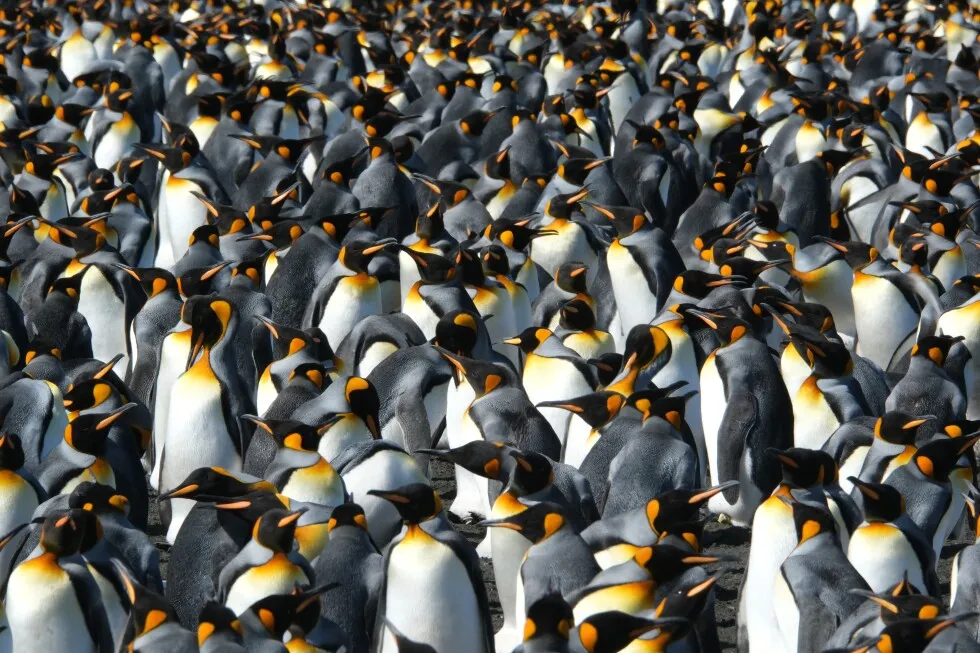
In this photo provided by Gaël Bardon, part of the King Penguin colony is visible at La Baie du Marin, Possession Island, Crozet Archipelago, Jan. 16, 2026. (Gaël Bardon/CSM/CNRS/IPEV via AP) Updated [hour]:[minute] [AMPM] [timezone], [monthFull] [day], [year] Washington (AP) — The warming world has disrupted the timing for plant and animal reproduction, and it’s usually bad news for species that depend on each other — like flowers blooming too early and pollinating bees arriving too late. But researchers have found the rare critter that’s getting a boost from the change: King penguins.A new study of 19,000 king penguins in a sub-Antarctic island chain found their breeding is starting 19 days earlier than it did in 2000. Mating earlier has increased the breeding success rate by 40%, according to a study in Wednesday’s journal Science Advances.The study of timing in nature is called phenology. It’s been a major concern for biologists because predators and prey and pollinators and plants are mostly adapting to warmer climates at different rates. And that means crucial mismatches in timing. It’s especially common in birds and pollinating species such as bees. Most birds, especially in North America, aren’t keeping pace with changes in phenology, according to Clemson University biological sciences professor Casey Youngflesh, who wasn’t part of the study. In this photo provided by Gaël Bardon, a King Penguin chick hatches from its egg on Possession Island, Crozet Archipelago, Jan. 6, 2026. (Gaël Bardon/CSM/CNRS/IPEV via AP) In this photo provided by Gaël Bardon, a King Penguin chick hatches from its egg on Possession Island, Crozet Archipelago, Jan. 6, 2026. (Gaël Bardon/CSM/CNRS/IPEV via AP) Add AP News on Google Add AP News as your preferred source to see more of our stories on Google. Having a species like the King Penguin adapt so well to seasonal shifts and timing changes “is unprecedented,” said study co-author Celine Le Bohec, a seabird ecologist at the French science agency CNRS. “It’s quite striking.” Unlike other penguins — which are threatened with dwindling numbers because of earlier breeding — the King Penguin has the ability to breed from late October to March. And they are taking advantage of that flexibility, Le Bohec said. They are succeeding even though the water is warming and the food web that they rely on is changing with it, said Le Bohec and study lead author Gaël Bardon, a seabird ecologist at the Scientific Centre of Monaco. “They can adjust really well their foraging behavior,” Bardon said. “We know that some birds are going directly to the south, to the polar front. Some are going to the north. Some are staying around the colony and so they can adjust their behavior and that’s what makes king penguins cope really well with such changes for the moment.” Le Bohec added that it may only be a temporary adjustment to an environment that is changing quickly. “So that’s why for the moment the species is able to cope with this change, but till when? This, we don’t know, because it’s going very, very fast.”Other penguins that have limited diets are more threatened by changes coming from a warming ocean and the makeup of the food chain. But king penguins — which are so abundant they are considered a species of least concern — can eat other prey besides the lanternfish that makes up their primary diet, researchers said.“The King Penguin may have a bit of flexibility as a trick up its sleeve, and may be in a good position to adapt as their environment changes,” said Michelle LaRue, a professor of Antarctic marine science at the University of Canterbury in New Zealand who was not part of the study. But she said she wonders what happens after breeding because king penguins live 20 or more years in the wild and this study looks at only a small part of their lifespan. Outside scientists are just as cautious as Le Bohec and Bardon over whether to declare the king penguins a rare good-news climate change story.“Winning for this species might mean losing for another species if they are competing for resources,” Clemson’s Youngflesh said.Ignacio Juarez Martinez, a biologist at Oxford University in the United Kingdom, who conducted a study of different penguins with earlier breeding, said: “This study shows that king penguins might be a winner for now, which is excellent news, but climate change is ongoing and future changes to currents, precipitation or temperatures can undo these gains.”___The Associated Press’ climate and environmental coverage receives financial support from multiple private foundations. AP is solely responsible for all content. Find AP’s standards for working with philanthropies, a list of supporters and funded coverage areas at AP.org. Borenstein is an Associated Press science writer, covering climate change, disasters, physics and other science topics. He is based in Washington, D.C.
SRCAssociated Press (AP)
LANGEN
LEANCenter
WORDS800
ENT10
WED · 2026-03-11 · 18:23 GMTBRIEF NSR-2026-0311-23608
NSR-2026-0311-23608News Report·EN·Environmental
King penguins are the rare species benefiting from a warming world. But that could change
A new study reveals that king penguins in a sub-Antarctic island chain are benefiting from a warming world, a rare occurrence amidst widespread disruption to animal reproduction cycles. Researchers found that king penguins are breeding 19 days earlier than in 2000, leading to a 40% increase in breeding success.
By
SETH BORENSTEINAssociated Press (AP)Filed 2026-03-11 · 18:23 GMTLean · CenterRead · 4 min
Associated Press (AP)FIG 01
Reading time
4min
Word count
800words
Sources cited
3cited
Entities identified
10entities
Quality score
100%
§ 01
Briefing Summary
AI-generatedNEWSAR · AI
A new study reveals that king penguins in a sub-Antarctic island chain are benefiting from a warming world, a rare occurrence amidst widespread disruption to animal reproduction cycles. Researchers found that king penguins are breeding 19 days earlier than in 2000, leading to a 40% increase in breeding success. This adaptation is notable because many species struggle to adjust their timing to climate change, causing mismatches in predator-prey relationships. King penguins' flexibility in breeding season, from late October to March, allows them to thrive despite warming waters and changes in their food web. The study, published in Science Advances, highlights the unprecedented ability of this species to adapt to seasonal shifts.
Confidence 0.90Sources 3Claims 5Entities 10
§ 02
Article analysis
Model · rule-basedFraming
Environmental
Human Interest
Tone
Measured
AI-assessed
CalmNeutralAlarmist
Factuality
0.80 / 1.00
Factual
LowHigh
Sources cited
3
Well sourced
FewMany
§ 03
Key claims
5 extracted01
King penguins have the ability to breed from late October to March.
factualCeline Le Bohec, seabird ecologist at CNRS
Confidence
1.00
02
Mating earlier has increased the breeding success rate by 40%.
statisticResearchers (study in Science Advances)
Confidence
1.00
03
King penguin breeding is starting 19 days earlier than it did in 2000.
factualResearchers (study in Science Advances)
Confidence
1.00
04
Having a species like the king penguin adapt so well to seasonal shifts and timing changes “is unprecedented.”
quoteCeline Le Bohec, seabird ecologist at CNRS
Confidence
0.90
05
It may only be a temporary adjustment to an environment that is changing quickly.
predictionCeline Le Bohec, seabird ecologist at CNRS
Confidence
0.60
§ 04
Full report
4 min read · 800 words§ 05
Entities
10 identifiedKey playerOppositionContextPositiveNeutralNegative
Organizations3
§ 06
Keywords & salience
7 termsking penguins
1.00
warming world
0.80
breeding success
0.70
climate change
0.60
phenology
0.60
adaptation
0.50
seabird ecology
0.40
§ 07
Topic connections
Interactive graph No topic relationship data available yet. This graph will appear once topic relationships have been computed.