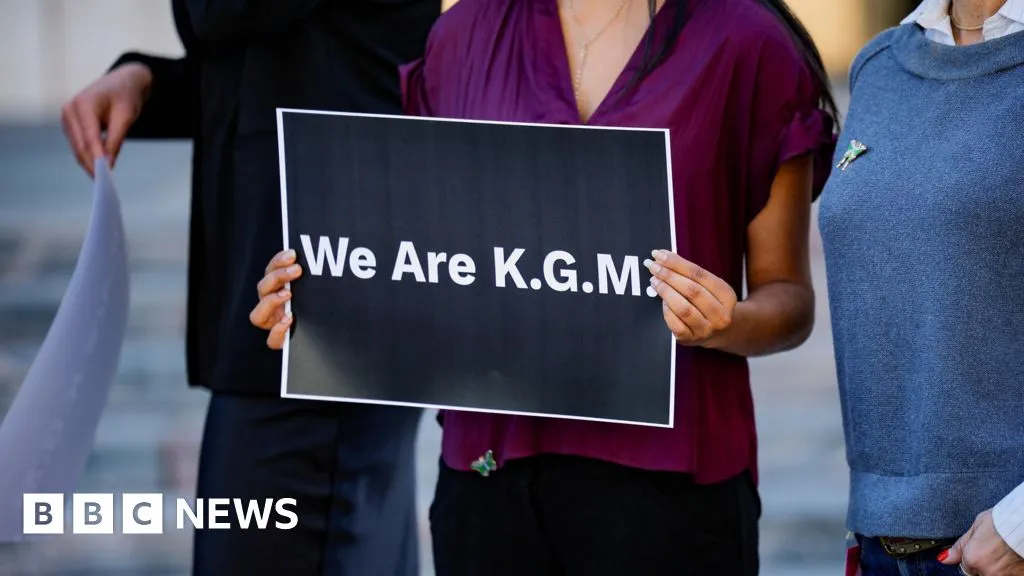
3 hours agoKali Hays,Technology reporterandLily Jamali,North America Technology correspondentReutersPeople attending the trial showed support for Kaley, who is identified only by her first name and initials to protect her privacyKaley would look at Instagram until she fell asleep. She would wake up in the middle of the night to check her notifications. She would open the app as soon as she woke up. One day, she spent 16 hours on Instagram."I stopped engaging with my family because I was spending all my time on social media," Kaley told a jury in Los Angeles during a landmark lawsuit against Meta and Google, two of the biggest companies in the world.TikTok and Snapchat, who were also named in her original suit, settled out of court.Known only by her first name or initials to protect her privacy, Kaley's story has become the test case for more than 2,000 similar lawsuits looking to hold social-media companies to account for their alleged harm to the mental health of their youngest users. As the first of its kind, the five-week trial is being watched closely by legal experts and parents who believe their children were damaged, even pushed to suicide, by social media.Lori Schott spent several days attending the Los Angeles trial despite having no part in the lawsuit. Her daughter Annalee took her own life aged 18, a tragedy Schott attributes to the way Instagram exposed her to psychologically damaging content, despite allegedly knowing what such content could do to young people."They hid the research. They knew that it was addictive. They gave us a false sense of security," Schott said, describing to the BBC what she learned from the trial. "Their public relations team just seemed to try and convince us that the world was all lollipops and unicorns."High stakes Central to the case are questions of whether Kaley had an addiction to social media and whether social media companies designed their platforms to be addictive. If they did, the jury will need to decide what the companies owe to young people like Kaley who may have been harmed because of those designs. The stakes of the trial, for Meta, Google and other social media platforms, are high.Most of the legal issues in the case, namely that social media platforms are addictive to young users and intentionally designed to be so, are "completely unprecedented," as Judge Carolyn Kuhl said several times throughout the trial.So potentially fraught is the outcome that Mark Zuckerberg, the billionaire co-founder and chief executive of Meta, which owns Instagram, Facebook and WhatsApp, appeared in person to defend his platforms. It was the first time he had ever given such testimony before a court, despite his company being sued hundreds of times in the past.If the jury sides with Kaley, it would upset decades of legal and cultural precedent that have treated platforms as mere repositories of human nature.It would also lay the groundwork for potentially historic settlements to be paid from companies like Meta.Thousands of other cases similar to Kaley's currently working their way through the US court system will inevitably be influenced by the outcome of this first trial.Even if the Los Angeles jury does not find Meta or Google liable in Kaley's case, public and political pressure has been building in recent years against large tech companies.They say platforms are exposing children to everything from impossible standards of beauty to sexual predators.Aaron Ping has also been watching the trial closely. His son Avery took his own life aged 16. He described to the BBC a boy who went from being his "adventure companion" to one he often fought with over his use of YouTube."We wrote up this agreement about screen time with his school counsellors, what he had to get accomplished in order to get an allotted amount of screen time," Ping said.Meta and YouTube did not respond to a request for comment regarding Schott and Ping's experiences.ReutersKaley explained in court that she began using YouTube at age six, and Instagram aged nine.Meta claims to prohibit users under age 13 from any of its platforms, while YouTube offers different versions of its platform for children, like YouTube Kids.She had soon created dozens of accounts on both platforms in an effort to drive likes and interactions with the content she was posting – selfies on Instagram and videos of her singing on YouTube. Kaley wanted to feel liked and validated.When she wasn't posting her own content, she would scroll Instagram and watch videos on YouTube for hours on end. She started to go outside less and found it difficult to engage with other people offline.Around 10 years old is when Kaley remembered having her first feelings of anxiety and depression, disorders for which she would be diagnosed years later by a therapist.She also started to obsess about her physical appearance and began using Instagram filters that would change the way she looked – smaller nose, bigger eyes, makeup – almost as soon as she started using the platform as a child.Kaley has since been diagnosed with body dysmorphia, a condition where people worry excessively about their physical appearance and do not see themselves as others do.Asked by her lawyer, Mark Lanier, whether she had suffered such feelings prior to being on social media, Kaley said: "No, I didn't."'Problematic'? Or an addiction?As far as Meta is concerned, Kaley's mental health struggles stem from her personal life and upbringing and cannot be blamed on her use of Instagram.Adam Mosseri, who heads Instagram, testified in court that even 16 hours of Instagram use did not strike him as an addiction. Mosseri instead referred to someone spending almost an entire day on social media as "problematic".When Mark Zuckerberg testified, after being escorted into the courthouse surrounded by four personal security guards, he repeated many times that his company has always had a policy prohibiting users under the age of 13.Asked to explain multiple internal company documents provided as part of the lawsuit in which Meta executives discussed the millions of children using Instagram and Facebook, and even praised and planned to grow usage among children, Zuckerberg became frustrated."I don't see why this is so complicated," the billionaire said at one point. "It's been our consistent policy that they're not allowed and we try to remove them. We're not perfect."Lawyers for Kaley pressed Zuckerberg on his claim that Meta's only goal was to create platforms that are useful, something he said naturally leads to more usage.Lanier said addiction also leads people to use something more and Zuckerberg for a moment seemed at a loss."I don't know what to say to that," he said. "I think that may be true, but I don't know if that applies. I'm trying to build a service here."The focus by Kaley's lawyers on social media addiction may be a tough argument to make, as the condition does not officially exist.When lawyers for Meta spoke to a therapist who had treated Kaley, she admitted to never having diagnosed her patient with an addiction to social media.Meta's arguments mainly focused on Kaley's home life, at times referencing her own posts to Instagram, showing a girl who was dealing with parents who were unstable, critical of her appearance and at times emotionally, verbally and physically abusive.The company's overarching question to the jury has been whether Kaley's mental health problems were clearly caused by her social media use, while making the case that many other factors were to blame.This is what's known as the "but for" test in legal liability. If a harm would have occurred even without a defendant's purported action, then they cannot be blamed for the harm.Today, Kaley said she has a loving relationship with her mother and she is working while going to school.Her use of social media continues - she even admitted to the court that she would be interested in a career in social media management.But when asked if her life would be better had she never used platforms like Instagram, Kaley's answer was simple."Yes."Katy Bailes, Peter Bowes and Regan Morris contributed to this report.
SRCBBC News - World
LANGEN
LEANCenter
WORDS1 338
ENT11
SAT · 2026-03-14 · 00:02 GMTBRIEF NSR-2026-0314-24354
NSR-2026-0314-24354News Report·EN·Legal & Judicial
She spent 16 hours on Instagram. It's up to a jury to decide if Meta is to blame
A landmark lawsuit against Meta and Google is underway in Los Angeles, focusing on the alleged harm social media platforms cause to young users' mental health. The case centers on Kaley, a young woman who claims she became addicted to Instagram, spending up to 16 hours a day on the app.
BBC News - WorldFiled 2026-03-14 · 00:02 GMTLean · CenterRead · 6 min
BBC News - WorldFIG 01
Reading time
6min
Word count
1 338words
Sources cited
2cited
Entities identified
11entities
Quality score
100%
§ 01
Briefing Summary
AI-generatedNEWSAR · AI
A landmark lawsuit against Meta and Google is underway in Los Angeles, focusing on the alleged harm social media platforms cause to young users' mental health. The case centers on Kaley, a young woman who claims she became addicted to Instagram, spending up to 16 hours a day on the app. The jury must decide if Meta and Google designed their platforms to be addictive and, if so, what responsibility they have for the harm caused to users like Kaley. This is the first of over 2,000 similar lawsuits seeking to hold social media companies accountable. The trial is being closely watched by legal experts and parents who believe social media contributed to their children's mental health issues, with some even attributing suicides to the platforms. The outcome could have significant implications for Meta, Google, and other social media companies.
Confidence 0.90Sources 2Claims 5Entities 11
§ 02
Article analysis
Model · rule-basedFraming
Legal & Judicial
Technology
Tone
Mixed Tone
AI-assessed
CalmNeutralAlarmist
Factuality
0.70 / 1.00
Factual
LowHigh
Sources cited
2
Limited
FewMany
§ 03
Key claims
5 extracted01
Mark Zuckerberg appeared in court to defend Meta's platforms.
factualReuters
Confidence
1.00
02
Annalee took her own life aged 18, a tragedy Schott attributes to Instagram.
quoteLori Schott
Confidence
1.00
03
More than 2,000 similar lawsuits are looking to hold social-media companies to account.
factualReuters
Confidence
1.00
04
TikTok and Snapchat settled out of court in a lawsuit with Kaley.
factualReuters
Confidence
1.00
05
Kaley spent 16 hours on Instagram one day.
quoteKaley
Confidence
1.00
§ 04
Full report
6 min read · 1 338 words§ 05
Entities
11 identifiedKey playerOppositionContextPositiveNeutralNegative
People5
Organizations5
Locations1
§ 06
Keywords & salience
10 termssocial media addiction
0.90
lawsuit
0.80
instagram
0.80
social media harm
0.70
mental health
0.70
meta
0.70
jury trial
0.70
addictive design
0.60
google
0.60
young users
0.50
§ 07
Topic connections
Interactive graph No topic relationship data available yet. This graph will appear once topic relationships have been computed.