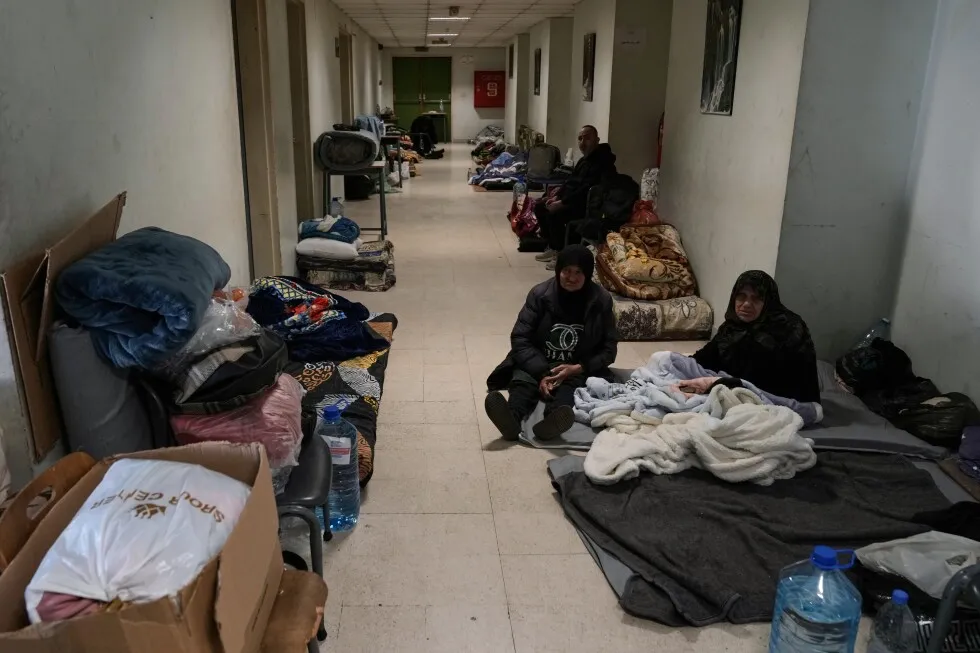
War has already displaced nearly a million Lebanese, and aid groups warn of a humanitarian crisis 1 of 6 | In just 10 days, more than 800,000 people in Lebanon have been displaced by war, just over a year since the last conflict uprooted over a million from their homes. That’s one in every seven people in the tiny country, according to humanitarian organization the Norwegian Refugee Council. 2 of 6 | Displaced people fleeing Israeli airstrikes in southern Lebanon and Dahiyeh, Beirut’s southern suburbs, settle at the Bir Hassan Technical Institute, which has been turned into a shelter, in Beirut, Lebanon, Wednesday, March 11, 2026. (AP Photo/Bilal Hussein) 3 of 6 | Displaced children run between tents set up inside the Camille Chamoun Sports City Stadium, which has been turned into a shelter for people displaced by Israeli airstrikes in southern Lebanon and Dahiyeh, Beirut’s southern suburbs, in Beirut, Lebanon, Tuesday, March 10, 2026. (AP Photo/Hassan Ammar) 4 of 6 | An elderly displaced woman who fled Israeli airstrikes with her family in southern Lebanon sits at the Bir Hassan Technical Institute, which has been turned into a shelter, in Beirut, Lebanon, Wednesday, March 11, 2026. (AP Photo/Bilal Hussein) 5 of 6 | A displaced woman who fled Israeli airstrikes in southern Lebanon sleeps on the ground at the Bir Hassan Technical Institute, which has been turned into a shelter, in Beirut, Lebanon, Wednesday, March 11, 2026. (AP Photo/Bilal Hussein) 6 of 6 | A displaced migrant woman, who among many others who fled Israeli strikes in southern and eastern Lebanon and Beirut’s southern suburbs, sits with her children on mattresses at Saint Joseph Church, which has been turned into a shelter for displaced migrants, mostly from African nations, in Beirut, Wednesday, March 11, 2026. (AP Photo/Hussein Malla) 1 of 6 In just 10 days, more than 800,000 people in Lebanon have been displaced by war, just over a year since the last conflict uprooted over a million from their homes. That’s one in every seven people in the tiny country, according to humanitarian organization the Norwegian Refugee Council. Add AP News on Google Add AP News as your preferred source to see more of our stories on Google. 2 of 6 Displaced people fleeing Israeli airstrikes in southern Lebanon and Dahiyeh, Beirut’s southern suburbs, settle at the Bir Hassan Technical Institute, which has been turned into a shelter, in Beirut, Lebanon, Wednesday, March 11, 2026. (AP Photo/Bilal Hussein) Add AP News on Google Add AP News as your preferred source to see more of our stories on Google. 3 of 6 Displaced children run between tents set up inside the Camille Chamoun Sports City Stadium, which has been turned into a shelter for people displaced by Israeli airstrikes in southern Lebanon and Dahiyeh, Beirut’s southern suburbs, in Beirut, Lebanon, Tuesday, March 10, 2026. (AP Photo/Hassan Ammar) Add AP News on Google Add AP News as your preferred source to see more of our stories on Google. 4 of 6 An elderly displaced woman who fled Israeli airstrikes with her family in southern Lebanon sits at the Bir Hassan Technical Institute, which has been turned into a shelter, in Beirut, Lebanon, Wednesday, March 11, 2026. (AP Photo/Bilal Hussein) Add AP News on Google Add AP News as your preferred source to see more of our stories on Google. 5 of 6 A displaced woman who fled Israeli airstrikes in southern Lebanon sleeps on the ground at the Bir Hassan Technical Institute, which has been turned into a shelter, in Beirut, Lebanon, Wednesday, March 11, 2026. (AP Photo/Bilal Hussein) Add AP News on Google Add AP News as your preferred source to see more of our stories on Google. 6 of 6 A displaced migrant woman, who among many others who fled Israeli strikes in southern and eastern Lebanon and Beirut’s southern suburbs, sits with her children on mattresses at Saint Joseph Church, which has been turned into a shelter for displaced migrants, mostly from African nations, in Beirut, Wednesday, March 11, 2026. (AP Photo/Hussein Malla) Add AP News on Google Add AP News as your preferred source to see more of our stories on Google. Updated [hour]:[minute] [AMPM] [timezone], [monthFull] [day], [year] Beirut (AP) — Fatima Nazha slept on the street for two days after she and her family fled their home in Beirut’s southern suburbs following an Israeli mass evacuation order.All of the schools the government turned into shelters were full, and the family couldn’t afford a hotel or an apartment, so she and her husband eventually moved into a tent in the country’s biggest stadium while their kids and grandchildren found shelter near the southern coastal city of Sidon. In just 10 days, more than 800,000 people in Lebanon have been displaced by war, just over a year since the last conflict uprooted over a million Lebanese from their homes. That’s one in every seven people in the tiny country, according to humanitarian organization the Norwegian Refugee Council. Many don’t have a place to stay, and the cash-strapped government has only been able to accommodate roughly 120,000 people as it scrambles to open shelters and bring in more supplies. Nazha, who uses a wheelchair, said being forced from her home has been far more difficult this time than when Israel and Hezbollah were last at war more than a year ago. The strikes targeting the Iran-backed militant group have been more intense and unpredictable, and Israel’s evacuation order came abruptly, leaving her unable to gather all her belongings.“The strikes used to target a specific area, but now they’re hitting all the areas,” she said, taking a drag off her cigarette. Lebanon’s Health Ministry said Friday that more than 700 people, including 103 children, have died in the war. Divisions simmer in LebanonIsrael ramped up its strikes on its northern neighbor after Hezbollah fired several rockets into Israel following the killing of Iran’s Supreme Leader Ali Khamenei at the start of the war.Most Lebanese were hoping Hezbollah wouldn’t respond to the attack on Iran, as the militant group’s support for another Iran-backed group, Hamas, in 2023 led to Israeli attacks on Hezbollah in Lebanon. Resentment toward Hezbollah and its backers has surged in Lebanon, as internal tensions and divisions in the deeply divided country continue to simmer. Fearing becoming a target, landlords have been hiking apartment rents to dissuade new tenants. Hotels, meanwhile, have been vetting guests more strictly since Israel struck two hotel rooms, saying it was targeting Iranian Revolutionary Guard members who were operating in Beirut. Some who don’t have family and friends to stay with or can’t afford an apartment or a hotel room have been sleeping on the streets or in their cars around central Beirut, trading comfort for safety. That sense of safety was shattered, though, after an overnight Israeli strike killed at least eight people and wounded more than 30 others in the capital’s Ramlet el-Bayda neighborhood, where many displaced people pitched tents by the sea or slept on mattresses on the boardwalk.Humanitarian groups, saddled by years of underfunding, are struggling to keep up. They warn of a humanitarian crisis.“The needs are escalating much faster than our capacity to respond,” Mathieu Luciano, the head of the International Organization for Migration in Lebanon, said during a recent press briefing. No time to prepareThe government, meanwhile, is using Lebanon’s largest sports stadium as a makeshift shelter, where Nazha, her husband and more than 800 other people have been sleeping in the semiopen corridors under the stands. It has toilets and sinks, but no showers and only sporadic electricity.“It’s not enough that they bring us food. … A tin of sardines or a loaf of bread or a gallon of water, that’s not enough,” Nazha said Thursday from her foldout bed.In the parking lot of the stadium where Lebanon’s national soccer team regularly plays in peacetime, children played a pickup game as an Israeli drone flew overhead, recognizable by its whirring. From there, one can see and hear the bombs that have been exploding daily in nearby neighborhoods.Naji Hammoud, who oversees sporting facilities for the Lebanese Youth and Sports Ministry, said he didn’t expect to have to take on such a heavy responsibility. “It’s a race against time,” Hammoud said as aid workers and volunteers scrambled to pitch tents.More than a million people were displaced in the last war, but that was toward the end of it after a year of limited fighting that gradually escalated. This time, what took months took days.Hezbollah’s initial rocket attack followed by Israel’s swift bombardments overnight rattled Lebanon and the mass evacuation notices caught people off-guard. Israel first called on dozens of villages south of the Litani River to flee north. It later warned residents to evacuate Dahiyeh, an area of predominantly Shiite suburbs on Beirut’s southern edge that is one of the country’s most densely populated places.All of the main roads leading to the capital from southern Lebanon were gridlocked as people scrambled to find somewhere safe to stay. “We were on the road for two days until we found this place here that accepted us,” said Seganish Gogamo, a worker from Ethiopia who fled the southern city of Nabatieh and found shelter in a Beirut church hosting migrant workers from Asia and Africa. She fled in the middle of the night after intense airstrikes.Uncertainty aboundsThere is no end in sight to the fighting, as some 100,000 Israeli troops have amassed along the U.N.-mandated Blue Line which divides the two countries in an anticipated ground invasion. Many fear the Israel-Hezbollah conflict could continue beyond the Iran war.Joe Sayyah was among dozens of residents who remained in their border village, Alma al-Shaab, during the first few days of the war, hoping they wouldn’t have to leave. It’s a Christian village, and Israel has mostly targeted Shiite communities where Hezbollah operates.Sayyah and others appealed to the Vatican and the U.S., describing themselves as bystanders in the conflict, insisting there was no military presence or activity among them. They also spent days sheltering in a church.But when his friend was killed in an Israeli drone strike while watering his plants, they knew it was time to leave. He and the others rang the church bell one last time before they left for the capital in a convoy escorted by United Nations peacekeepers.After arriving at a church in the northern outskirts of Beirut to hold a funeral Mass for his friend, Sayyah said the sense of relief that came with reaching somewhere safe was quickly replaced by the grim realization that this war could be different from the last.“This time around, there’s a huge possibility we may not be able to go back to our village,” he said.___Associated Press reporters Jamey Keaten in Geneva and Fadi Tawil in Beirut contributed to this story. Chehayeb is an Associated Press reporter in Beirut.
SRCAssociated Press (AP)
LANGEN
LEANCenter
WORDS1 809
ENT8
SAT · 2026-03-14 · 11:23 GMTBRIEF NSR-2026-0314-24446
NSR-2026-0314-24446News Report·EN·Human Interest
War has already displaced nearly a million Lebanese, and aid groups warn of a humanitarian crisis
As of March 11, 2026, war has displaced over 800,000 people in Lebanon in just ten days, according to the Norwegian Refugee Council. This figure represents approximately one in seven residents of the country.
By
KAREEM CHEHAYEB and MALAK HARBAssociated Press (AP)Filed 2026-03-14 · 11:23 GMTLean · CenterRead · 8 min
Associated Press (AP)FIG 01
Reading time
8min
Word count
1 809words
Sources cited
1cited
Entities identified
8entities
Quality score
100%
§ 01
Briefing Summary
AI-generatedNEWSAR · AI
As of March 11, 2026, war has displaced over 800,000 people in Lebanon in just ten days, according to the Norwegian Refugee Council. This figure represents approximately one in seven residents of the country. The displaced are fleeing Israeli airstrikes in southern Lebanon and the southern suburbs of Beirut. Many are seeking refuge in temporary shelters such as technical institutes, sports stadiums, and churches in Beirut. Aid groups are warning of a potential humanitarian crisis due to the scale of displacement, which follows another conflict that displaced over a million people just a year prior.
Confidence 0.90Sources 1Claims 4Entities 8
§ 02
Article analysis
Model · rule-basedFraming
Human Interest
Conflict
Tone
Mixed Tone
AI-assessed
CalmNeutralAlarmist
Factuality
0.80 / 1.00
Factual
LowHigh
Sources cited
1
Limited
FewMany
§ 03
Key claims
4 extracted01
Displaced people are fleeing Israeli airstrikes in southern Lebanon and Dahiyeh, Beirut’s southern suburbs.
factualArticle
Confidence
0.90
02
That’s one in every seven people in the tiny country.
statisticNorwegian Refugee Council
Confidence
0.90
03
A previous conflict displaced over a million people from their homes just over a year ago.
factualArticle
Confidence
0.90
04
More than 800,000 people in Lebanon have been displaced by war in just 10 days.
statisticArticle
Confidence
0.90
§ 04
Full report
8 min read · 1 809 words§ 05
Entities
8 identifiedKey playerOppositionContextPositiveNeutralNegative
Organizations1
§ 06
Keywords & salience
8 termsdisplaced people
1.00
humanitarian crisis
0.90
war
0.90
lebanon
0.80
israeli airstrikes
0.70
shelter
0.60
norwegian refugee council
0.50
conflict
0.40
§ 07
Topic connections
Interactive graph Network visualization showing 51 related topics
View Full Graph Person Organization Location Event|Click node to navigate|Edge numbers = shared articles