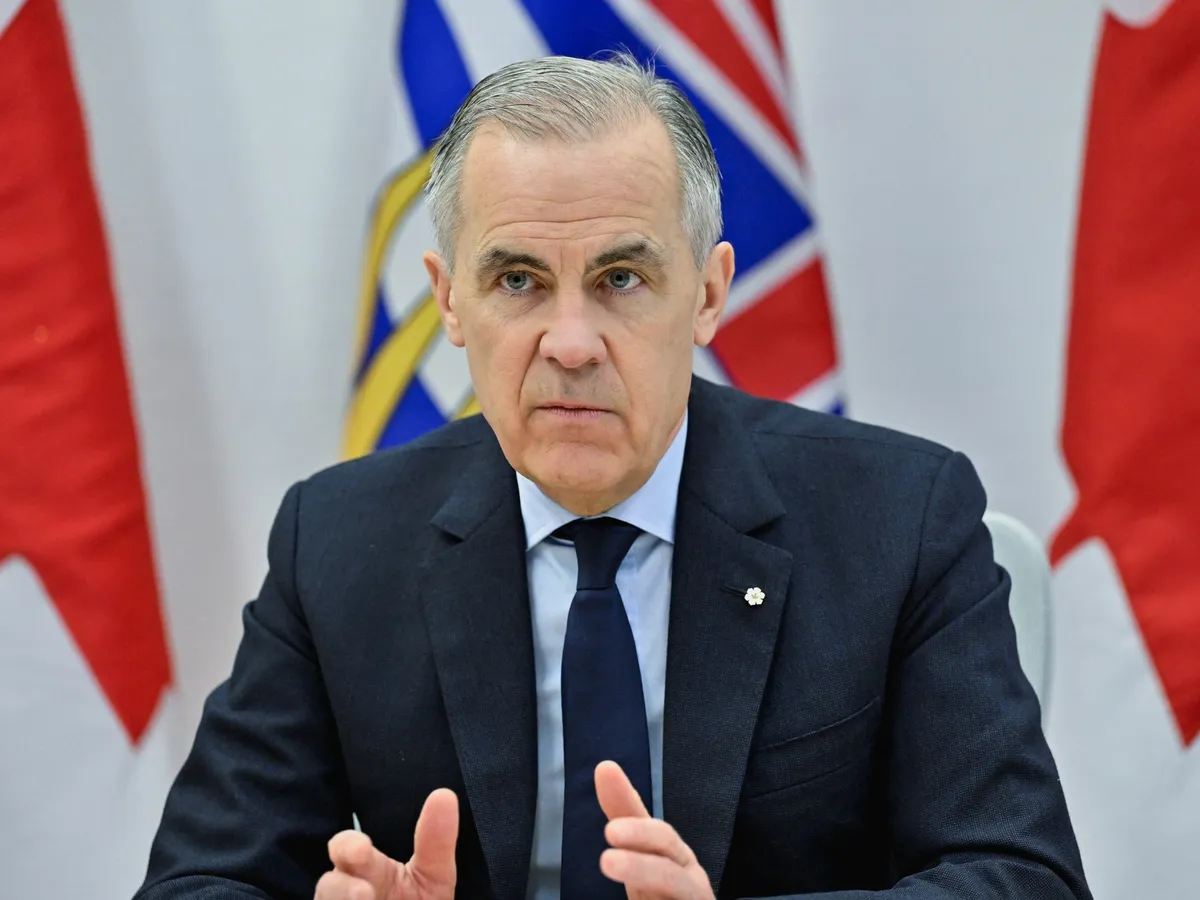
Some First Nations are challenging Carney’s resource-extraction plans to strengthen Canadian economy from US threats.Canada's Prime Minister Mark Carney was elected on a plank to strengthen the economy against US tariffs [File: Jennifer Gauthier/Reuters]Published On 14 Mar 2026Vancouver, Canada – Prime Minister Mark Carney’s efforts to unite Canadians around protecting the nation’s economy from the US are hitting roadblocks as he nears one year in power.Indigenous peoples across Canada are increasingly divided over Carney’s aggressive push to expand resource extraction and projects on their ancestral lands.Recommended Stories list of 4 itemslist 1 of 4IEA announces release of 400 million barrels of oil. But is it enough?list 2 of 4Hopes for justice rise as The Voice of Hind Rajab heads to Oscarslist 3 of 4Cuban President Diaz-Canel says talks held with US amid Trump threatslist 4 of 4A president suing himself? Why experts say Trump’s $10bn lawsuit might failend of listSome experts question how his government can advance its agenda while respecting Indigenous rights enshrined in the country’s constitution.March 14 will mark one year since Carney, former head of Canada’s central bank, was sworn into office.After an election last year, his centrist Liberal Party formed a minority government with the highest share of the popular vote in 40 years.A key to Carney’s victory was his pledge to “stand strong” against US trade threats and grow Canada’s economic sovereignty, an assertive approach the prime minister has called “elbows up”.“In the face of global trade shifts … we will build big and build fast to create a stronger, more sustainable, more independent economy,” Carney said in a statement on March 6.Part of that push was to create a Major Projects Office to speed up approvals of economic developments, starting by fast-tracking 10 mega-projects.They include two massive liquefied natural gas (LNG) plants and an open-pit mine in British Columbia, a nuclear plant in Ontario, a Quebec shipping terminal, and wind power in Atlantic Canada.Those developments are worth 116 billion Canadian dollars ($85bn), the government estimates.‘Our rights get pushed to the side’Carney’s approach to the US trade war has gained support from Canadians, according to recent opinion surveys.A March 3 poll of 1,500 citizens by Abacus Data found that 50 percent say Carney is protecting Canada’s core interests when dealing with Trump — compared with 36 percent with negative views.“Whenever Canada is threatened, the protectionist nature of the state kind of re-emerges,” said Shady Hafez, assistant politics professor at Toronto Metropolitan University.“Self-preservation of Canada becomes the priority.”Hafez, a research associate with the Yellowhead Institute, is a member of the Kitigan Zibi Anishinabeg First Nation in Quebec.He said there are growing concerns in his community and others about Carney’s push to accelerate mega-projects across the country.“For that to happen, Canada needs land, and it needs resources,” Hafez said, “and it takes those lands and resources from us.”Blowback was swift after Carney pledged to build a highly controversial oil pipeline to the west coast in a late November deal signed with Alberta, Canada’s oil powerhouse.Carney’s culture minister swiftly resigned, decrying “no consultation” with Indigenous nations and “major environmental impacts”.And the Assembly of First Nations (AFN), which represents more than 600 Indigenous chiefs, unanimously passed an emergency resolution opposing a new pipeline.“First Nations people, we stand with Canada against Trump’s illegal tariffs, but not at the expense of our rights,” AFN National Chief Cindy Woodhouse Nepinak told Al Jazeera in an interview. “If you want to fast-track anything, you better make sure that First Nations are being included right off the bat.“Trying to sideswipe or push aside First Nations people when there’s agreements between provinces and the feds — they have to remember that First Nations are here … and they are to be respected in their own homelands.”The rights of Indigenous people in the country are enshrined in Canada’s constitution.But too often, Hafez said, in the name of national prosperity, “Indigenous communities have to suffer.”“Whenever there’s somewhat of an emergency, our rights get pushed to the side.”But the resistance to the major projects push isn’t universal.The First Nations Natural Gas Alliance praised Carney’s “much more aggressive” approach compared with his predecessor on developing energy resources.But the group’s CEO, Karen Ogen, acknowledged there’s a “highly charged environment” on such issues.“First Nations communities continue to face significant socioeconomic barriers”, stated the former chief of Wet’suwet’en First Nation. “LNG and natural gas development are not just an opportunity; they are a national imperative.“Billions of dollars in procurement benefits and revenues are flowing to First Nations.”Call for collaboration ‘on all major projects’The trade war with the US has galvanised and united many Canadians — but with little acknowledgement of the impacts on Indigenous communities, said Sheryl Lightfoot, political science professor at the University of Toronto.Lightfoot is vice-chair of the UN Expert Mechanism on the Rights of Indigenous Peoples.“These projects, by many accounts, are advancing without full consultation or transparency”, she told Al Jazeera.“It appears that economic or geopolitical pressures … are being used to justify bypassing Indigenous rights and environmental safeguards.”But Canada’s Major Projects Office insists it will “seek input, hear concerns and ideas, and work in partnership moving forward” with Indigenous communities — and “will not be skipping over vital project steps including consultations with Indigenous Peoples,” an agency spokesperson wrote in an emailed statement.“We are unlocking Canada’s economic potential, while respecting our environmental responsibilities and the rights of Indigenous Peoples,”A significant number of projects on Carney’s fast-track list are concentrated in British Columbia (BC).Those include two liquefied natural gas (LNG) terminals on the Pacific coast — LNG Canada and Ksi Lisims LNG — as well as the electric transmission line to power the sector, and a copper and gold mine.BC is unique in the country because, historically, very little of its land was subject to treaties between the Crown and First Nations. Canada’s top court has repeatedly ruled in favour of First Nations rights and title in the westernmost province.All four major projects in the province have proven divisive among the region’s Indigenous peoples — even though several have the backing of individual First Nations governments.One of those is the massive Ksi Lisims LNG plant, in which the Nisga’a Nation is a direct partner.Co-developed with Texas-based Western LNG, the mega-project will “benefit all Canadians,” said Nisga’a President Eva Clayton.In 2000, her nation became the first in BC to reach a modern self-government treaty.“We are co-developing the Ksi Lisims LNG project on land that our nation owns under our treaty,” she told a parliamentary committee on February 24.“This project is expected to bring in 30 billion [Canadian] dollars [$22bn] in investment, create thousands of skilled careers, and strengthen Canada’s leadership in low-emission LNG.”‘Elbows up’ meets oppositionBut LNG is fiercely opposed by other nearby First Nations.Tara Marsden is Wilp sustainability director for the Gitanyow Hereditary Chiefs, traditional leaders of the 900-member Gitanyow community.“We have a lot more concerns and evidence regarding impacts in our territory,” she said.
SRCAl Jazeera
LANGEN
LEANCenter
WORDS1 146
ENT10
SAT · 2026-03-14 · 15:18 GMTBRIEF NSR-2026-0314-24502
NSR-2026-0314-24502News Report·EN·Conflict
How Carney’s ‘build fast’ push divides Canada’s Indigenous peoples
Canadian Prime Minister Mark Carney, nearing his first year in office in March 2026, faces challenges to his plan to strengthen Canada's economy against US trade threats. Carney's strategy involves rapidly expanding resource extraction and infrastructure projects, aiming to create a more independent economy.
David P BallAl JazeeraFiled 2026-03-14 · 15:18 GMTLean · CenterRead · 5 min
Al JazeeraFIG 01
Reading time
5min
Word count
1 146words
Sources cited
1cited
Entities identified
10entities
Quality score
100%
§ 01
Briefing Summary
AI-generatedNEWSAR · AI
Canadian Prime Minister Mark Carney, nearing his first year in office in March 2026, faces challenges to his plan to strengthen Canada's economy against US trade threats. Carney's strategy involves rapidly expanding resource extraction and infrastructure projects, aiming to create a more independent economy. This "build fast" approach, including the creation of a Major Projects Office to expedite approvals, has sparked division among Indigenous peoples across Canada, as many of these projects are planned on their ancestral lands. While Carney's stance against US trade policies has gained public support, questions arise regarding the government's ability to balance economic development with constitutionally protected Indigenous rights. The proposed projects include LNG plants, mines, nuclear facilities, shipping terminals, and wind power developments across British Columbia, Ontario, Quebec, and Atlantic Canada.
Confidence 0.90Sources 1Claims 5Entities 10
§ 02
Article analysis
Model · rule-basedFraming
Conflict
Economic Impact
Tone
Measured
AI-assessed
CalmNeutralAlarmist
Factuality
0.70 / 1.00
Factual
LowHigh
Sources cited
1
Limited
FewMany
§ 03
Key claims
5 extracted01
50% say Carney is protecting Canada’s core interests when dealing with Trump.
statisticAbacus Data
Confidence
1.00
02
Carney pledged to 'stand strong' against US trade threats.
quoteMark Carney
Confidence
1.00
03
Carney's government plans to fast-track 10 mega-projects worth $116 billion CAD.
factual
Confidence
0.90
04
Mark Carney's efforts to protect Canada's economy from the US are facing resistance.
factual
Confidence
0.90
05
Indigenous peoples are divided over Carney's push to expand resource extraction.
factual
Confidence
0.80
§ 04
Full report
5 min read · 1 146 words§ 05
Entities
10 identifiedKey playerOppositionContextPositiveNeutralNegative
Organizations3
§ 06
Keywords & salience
10 termsmark carney
1.00
canadian economy
0.90
indigenous rights
0.80
first nations
0.80
resource extraction
0.70
us trade threats
0.70
economic sovereignty
0.60
lng plants
0.50
major projects office
0.50
political division
0.40
§ 07
Topic connections
Interactive graph Network visualization showing 51 related topics
View Full Graph Person Organization Location Event|Click node to navigate|Edge numbers = shared articles