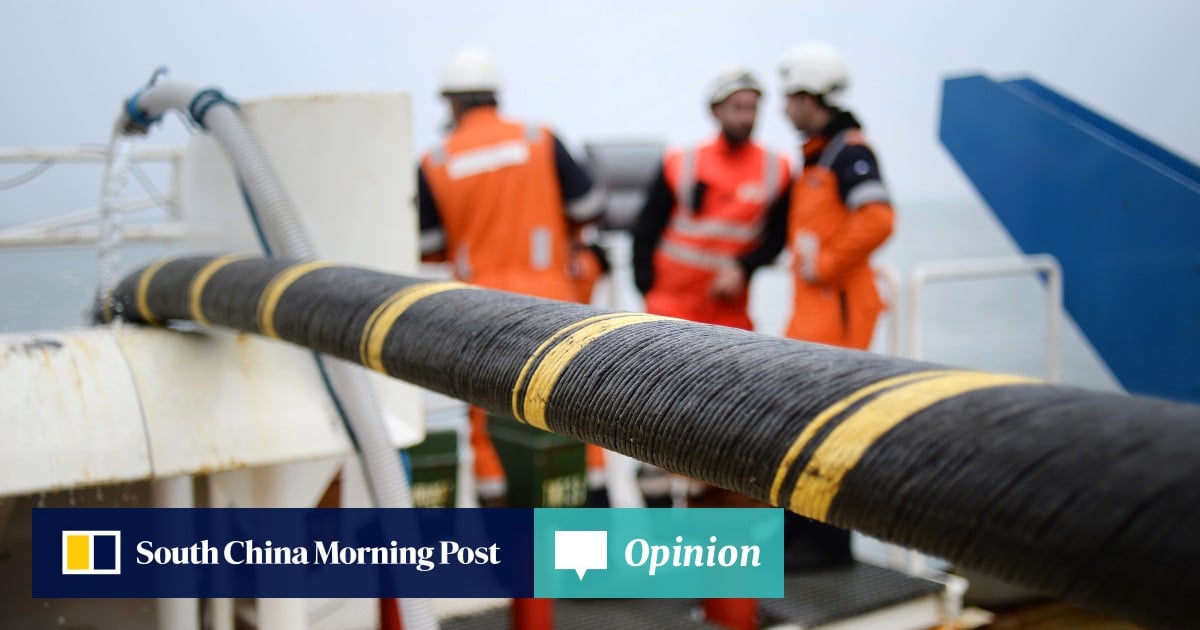
What does the world’s digital economy rest on? Thousands of kilometres of fibre-optic cable lying on the ocean floor and, increasingly, in the crosshairs of great-power rivalry.The confluence of recent subsea cable disruptions, gaps in the 1982 UN Convention on the Law of the Sea (Unclos) and intensifying great-power competition has elevated this underwater infrastructure from a technical and commercial concern to a security issue – characterised as “this century’s hidden battleground”. It has also, however, generated momentum for closer Asean–EU collaboration.Subsea fibre-optic cables carry roughly 99 per cent of intercontinental data traffic, yet this critical infrastructure is highly exposed and has faced repeated disruptions across Europe and the Asia-Pacific.For the Association of Southeast Asian Nations and the European Union, this shared vulnerability opens a pragmatic avenue for enhanced interregional cooperation – one that sidesteps the binary logic of US–China competition by focusing on infrastructure resilience rather than alignment with either power.Asean foreign ministers join hands for a photo during a summit in Kuala Lumpur on October 25, 2025. Photo: EPARecent statements by EU High Representative for Foreign Affairs and Security Policy Kaja Kallas and Singapore’s Defence Minister Chan Chun Sing both highlight that protecting subsea cables increasingly demands that countries far apart work together, “because an attack on one part of such infrastructure is an attack on the entire network”.
SRCSouth China Morning Post
LANGEN
LEANCenter-Right
WORDS221
ENT10
SUN · 2026-03-15 · 04:00 GMTBRIEF NSR-2026-0315-24619
NSR-2026-0315-24619Analysis·EN·National Security
Underwater and unprotected: why Asean and the EU must secure subsea lifelines
Subsea fibre-optic cables, which carry 99% of intercontinental data traffic, are increasingly vulnerable and subject to disruptions, raising security concerns. The 1982 UN Convention on the Law of the Sea (Unclos) has gaps that do not adequately protect these cables.
Barbora ValockovaSouth China Morning PostFiled 2026-03-15 · 04:00 GMTLean · Center-RightRead · 1 min
South China Morning PostFIG 01
Reading time
1min
Word count
221words
Sources cited
2cited
Entities identified
10entities
Quality score
100%
§ 01
Briefing Summary
AI-generatedNEWSAR · AI
Subsea fibre-optic cables, which carry 99% of intercontinental data traffic, are increasingly vulnerable and subject to disruptions, raising security concerns. The 1982 UN Convention on the Law of the Sea (Unclos) has gaps that do not adequately protect these cables. This shared vulnerability has created an opportunity for increased collaboration between the Association of Southeast Asian Nations (ASEAN) and the European Union (EU). Both organizations recognize the need to protect this critical infrastructure, viewing an attack on one part of the network as an attack on the entire system. Recent statements from EU and Singapore officials highlight the necessity of international cooperation to secure these vital underwater lifelines, focusing on resilience rather than geopolitical alignment.
Confidence 0.90Sources 2Claims 4Entities 10
§ 02
Article analysis
Model · rule-basedFraming
National Security
Political Strategy
Tone
Measured
AI-assessed
CalmNeutralAlarmist
Factuality
0.60 / 1.00
Mixed
LowHigh
Sources cited
2
Limited
FewMany
§ 03
Key claims
4 extracted01
Protecting subsea cables demands countries work together because an attack on one part is an attack on the entire network.
quoteKaja Kallas and Chan Chun Sing
Confidence
0.90
02
Subsea fibre-optic cables carry roughly 99 per cent of intercontinental data traffic.
statistic
Confidence
0.90
03
Recent subsea cable disruptions, gaps in Unclos, and great-power competition have elevated subsea infrastructure to a security issue.
factual
Confidence
0.80
04
This underwater infrastructure is highly exposed and has faced repeated disruptions across Europe and the Asia-Pacific.
factual
Confidence
0.70
§ 04
Full report
1 min read · 221 words§ 05
Entities
10 identifiedKey playerOppositionContextPositiveNeutralNegative
Organizations3
§ 06
Keywords & salience
10 termssubsea cables
1.00
asean
0.90
eu
0.90
great-power rivalry
0.80
digital economy
0.70
infrastructure resilience
0.70
security issue
0.60
interregional cooperation
0.60
data traffic
0.50
unclos
0.40
§ 07
Topic connections
Interactive graph Network visualization showing 51 related topics
View Full Graph Person Organization Location Event|Click node to navigate|Edge numbers = shared articles