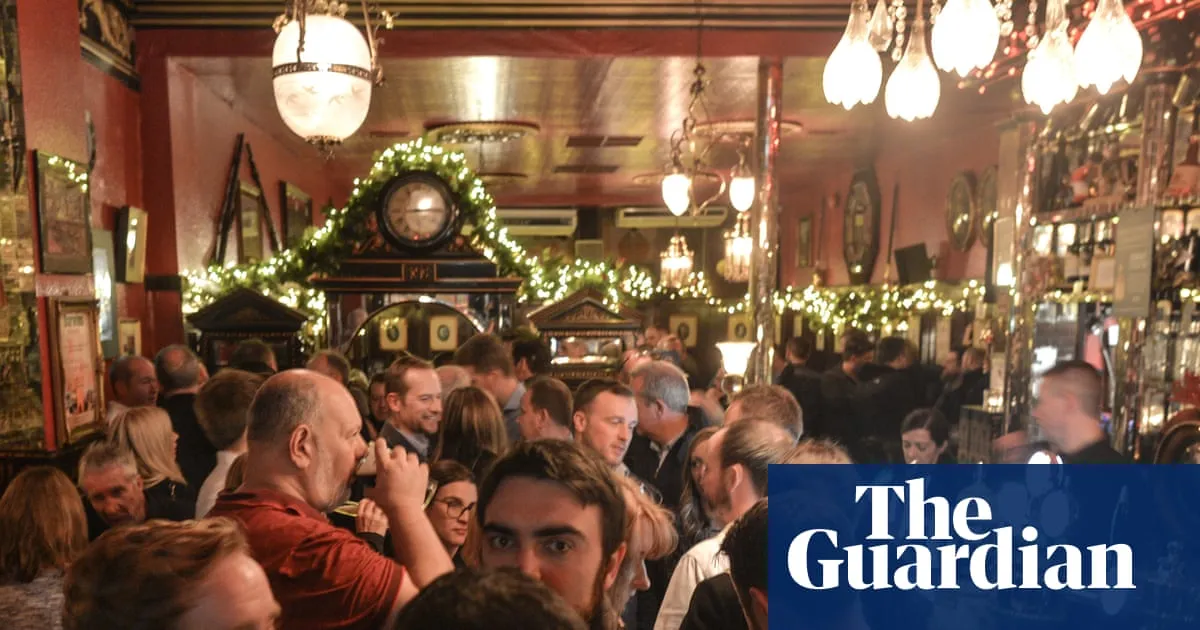
Like triple-distilled whiskey, Irish pubs appear to have timeless appeal. They are staple setting in films, books and plays, draw tourists to Ireland, replicate themselves around the world and induce social media quests for the perfect snug and the perfect pint.Scholars have now bestowed academic imprimatur on this cultural treasure status by examining – and celebrating – pubs through the lens of history, sociology, architecture, psychology, design, art and literature.Two new books, The Irish Pub: Invention and Reinvention, and The Dublin Pub: A Social and Cultural History, brim with footnotes, data and lore as they analyse what makes a “perfect pub” and the mysterious alchemy that produces “craic”.However, in each case the authors come to a sobering conclusion: Irish pubs are in trouble. They are vanishing from rural Ireland and many are struggling to survive in the capital.“It feels like a moment of transition,” said Donal Fallon, author of The Dublin Pub. “Every Dubliner should drive through rural towns to see what’s happening. The pub has been knocked off its perch.”Some villages have lost all their pubs and new housing developments often omit pubs, said Perry Share, a co-editor of The Irish Pub, a collection of essays by 20 writers. “Planners are not insisting that pubs be put in. That could create problems in future in terms of loneliness and community cohesion.”A closed-down pub in Inistioge, County Kilkenny. Photograph: Ian Dagnall/AlamySince 2005, Ireland has lost a quarter of its pubs, more than 2,100, averaging 112 closures a year. Cited reasons include high taxes on alcohol, drink-driving laws, rising property prices and a fall in alcohol consumption.It is a global phenomenon – traditional bars are shuttering across Britain and much of Europe and Asia – but for Ireland the stakes are particularly high, said Share, who heads the school of social science and humanities at Atlantic Technological University.“Our society is becoming segmented into different interest groups so it’s important to have these places to interact across class and gender lines,” he said. “In the pub it’s OK to express emotion in a certain way and to grab someone and hug them.”Just over half of the population live within 300 metres of Ireland’s remaining 7,000 pubs, and, Share said, pubs remained central to expressions of Irish culture, such as in novels by authors including Sally Rooney and Paul Murray, TV shows such as Trespasses, and Hollywood depictions of Ireland.“Even if declining, the pub is still part of the fabric of everyday life. If it does disappear it’s a real loss. People talk of alternatives, like coffee shops, but no one says they had great craic in the coffee shop,” he said.People enjoy festive drinks outside a Dublin pub decorated with Christmas lights. Photograph: Clodagh Kilcoyne/ReutersThe volume Share co-edited with Moonyoung Hong, a professor of English at the University of Hong Kong, ranges over the evolution of taverns in the era of Jonathan Swift, the emergence of gay pubs in the 20th century, and the export of Irish-themed pubs from Nepal to Peru.An essay by Kevin Martin – the author of a previous volume on pubs titled Have Ye No Homes to Go To? – identifies 10 elements for an ideal pub, including “a great pint of Guinness at a decent price” and “convivial company when required, and peace when not”.Social media influencers chronicle searches for “the best” Irish pub on Instagram and other platforms but Fallon, a social historian, said that missed the point: “This veneration of a handful of places, this ranking system, is often driven by aesthetics rather than any appreciation of what the pub is. Something doesn’t have to be the best to be important. It has to be part of its community. If you’ve had the worst day in your life the nearest pub is probably the best pub.”O’Neills pub interior in Dublin. Photograph: Sergio Azenha/AlamyFallon’s book uncovers colourful tales involving figures such as the American photographer Lee Miller, who photographed the Palace bar while on assignment in Dublin for Vogue in the 1940s, but also explores and toasts unsung, nondescript suburban pubs.Fallon notes the word pub stems from public house. “There is real warmth in that term. It implies a shared space and a living space. It captures the collective sense of what a pub is.”
SRCThe Guardian - World News
LANGEN
LEANCenter-Left
WORDS709
ENT1
SUN · 2025-11-30 · 05:00 GMTBRIEF NSR-2025-1130-247
NSR-2025-1130-247News Report·EN·Economic Impact
Can you have a community without craic? Scholars of Ireland’s pubs warn of declining numbers
Two new books analyzing Irish pubs through various academic lenses highlight their cultural significance but also reveal a concerning decline. Since 2005, Ireland has lost over 2,100 pubs, a quarter of its total, due to factors like high taxes, stricter drink-driving laws, and changing social habits.
Rory Carroll Ireland correspondentThe Guardian - World NewsFiled 2025-11-30 · 05:00 GMTLean · Center-LeftRead · 3 min
The Guardian - World NewsFIG 01
Reading time
3min
Word count
709words
Sources cited
2cited
Entities identified
1entities
Quality score
100%
§ 01
Briefing Summary
AI-generatedNEWSAR · AI
Two new books analyzing Irish pubs through various academic lenses highlight their cultural significance but also reveal a concerning decline. Since 2005, Ireland has lost over 2,100 pubs, a quarter of its total, due to factors like high taxes, stricter drink-driving laws, and changing social habits. This decline is particularly worrying because pubs play a vital role in Irish community cohesion, providing a space for social interaction across different demographics. Scholars warn that the disappearance of pubs, especially in rural areas and new housing developments, could lead to increased loneliness and a loss of cultural expression. The trend mirrors a broader global decline in traditional bars, but carries particular weight in Ireland given the pub's central role in its identity.
Confidence 0.90Sources 2Claims 5Entities 1
§ 02
Article analysis
Model · rule-basedFraming
Economic Impact
Human Interest
Tone
Measured
AI-assessed
CalmNeutralAlarmist
Factuality
0.70 / 1.00
Factual
LowHigh
Sources cited
2
Limited
FewMany
§ 03
Key claims
5 extracted01
Just over half of the population live within 300 metres of Ireland’s remaining 7,000 pubs.
statisticShare
Confidence
1.00
02
Ireland has lost a quarter of its pubs since 2005, more than 2,100.
statisticArticle
Confidence
1.00
03
Reasons for pub closures include high taxes on alcohol, drink-driving laws, rising property prices and a fall in alcohol consumption.
factualArticle
Confidence
0.90
04
Some villages have lost all their pubs and new housing developments often omit pubs.
factualPerry Share
Confidence
0.90
05
Planners are not insisting that pubs be put in. That could create problems in future in terms of loneliness and community cohesion.
quotePerry Share
Confidence
0.80
§ 04
Full report
3 min read · 709 words§ 05
Entities
1 identifiedKey playerOppositionContextPositiveNeutralNegative
Locations1
§ 06
Keywords & salience
8 termsirish pubs
1.00
pub closures
0.80
community
0.70
craic
0.60
social cohesion
0.60
irish culture
0.50
alcohol consumption
0.40
rural ireland
0.40
§ 07
Topic connections
Interactive graph Network visualization showing 51 related topics
View Full Graph Person Organization Location Event|Click node to navigate|Edge numbers = shared articles