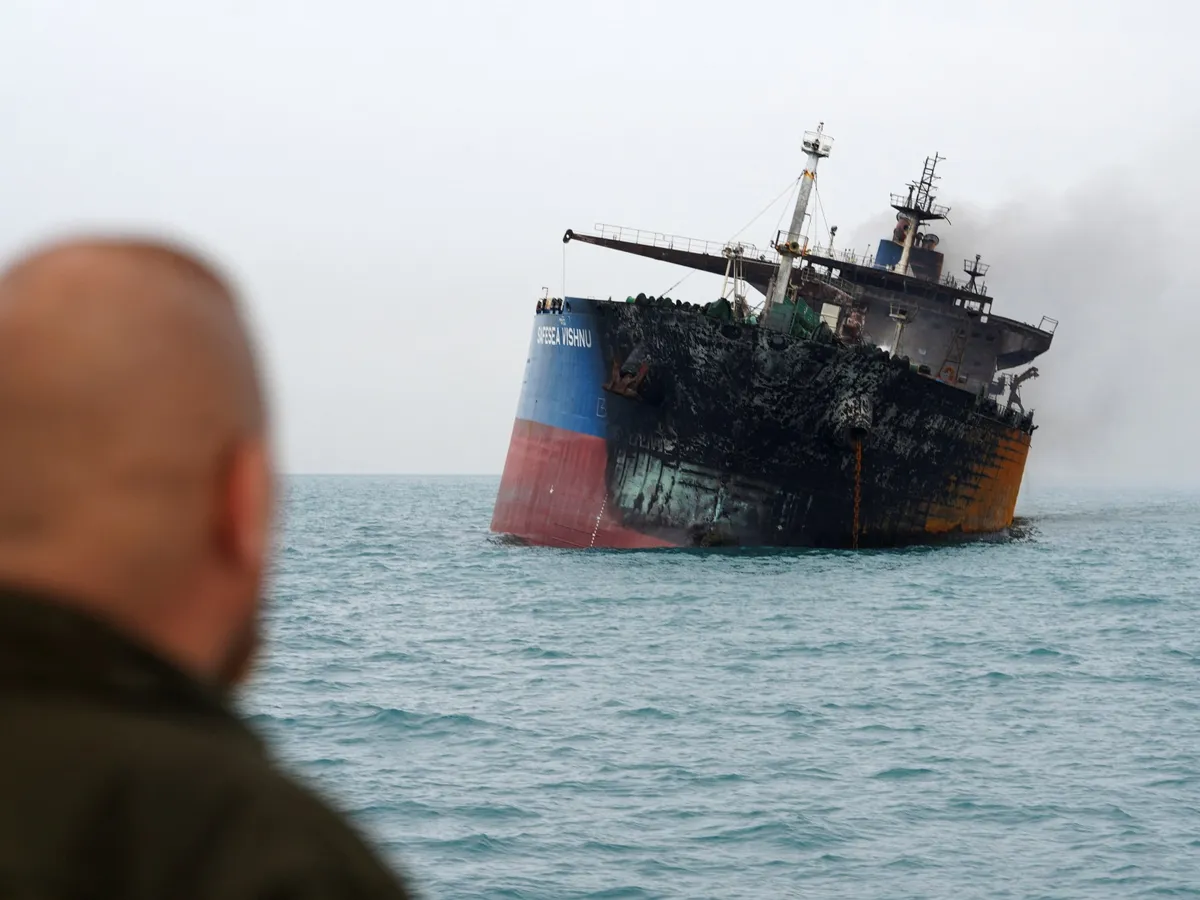
Record oil release steadies markets, but war-driven disruption in the Strait of Hormuz will keep global energy supplies uncertain.A foreign tanker carrying Iraqi fuel oil is damaged after catching fire in Iraq's territorial waters, following unidentified attacks that targeted two foreign tankers, according to Iraqi port officials, near Basra, Iraq, March 12, 2026 [Mohammed Aty/Reuters]Published On 15 Mar 2026Hundreds of tankers sit idle on both sides of the Strait of Hormuz as Iran has effectively closed the waterway, pushing oil prices above $100 – the highest since 2022, after the start of the Russia-Ukraine war.Oil tanker traffic in the strait, through which one-fifth of global oil passes, has plunged after Israel and the United States launched attacks on Tehran on February 28. Asian countries, including India, China and Japan, as well as some European countries, source large portions of their energy needs from the Gulf. A disruption in supply will rattle the global economy.With an aim to cushion from the shock, the International Energy Agency (IEA) has decided to release 400 million barrels of oil from emergency reserves, the largest coordinated drawdown in the agency’s history. But it has failed to push the prices down.The agency had released about 182 million barrels after Russia’s invasion of Ukraine to stablise the oil prices.According to the agency, oil shipments through the strategic waterway have fallen to less than 10 percent of pre-war levels, threatening one of the most critical arteries in the global energy system.IEA members collectively hold about 1.25 billion barrels in government-controlled emergency reserves, alongside roughly 600 million barrels in industry stocks tied to government obligations.A large number in a massive marketThe figure may appear vast, but it shrinks quickly against the scale of global energy demand.“This feels like a small bandage on a large wound,” energy strategist Naif Aldandeni said, describing the world’s largest coordinated emergency oil release as governments scramble to steady markets shaken by war.The US Energy Information Administration (EIA) estimates world consumption of petroleum and other liquids will average 105.17 million barrels per day in 2026. At that rate, 400 million barrels would theoretically cover just four days of global consumption.Even when compared with normal traffic through the Strait of Hormuz – around 20 million barrels per day – the released oil equals only about 20 days of typical flows.Aldandeni told Al Jazeera that emergency reserves can calm panic in markets but cannot replace the lost function of a disrupted shipping corridor.“The release may soften the shock and calm nerves temporarily,” he said, “but it will remain limited as long as the fundamental problem — the freedom of supply and tanker movement through Hormuz – remains unresolved.”Oil prices reflect those anxieties. Brent crude ended trading on Friday at $103.14 per barrel, after surging to nearly $120 earlier as fears of disrupted production and shipping intensified.Geopolitical risk premiumOil expert Nabil al-Marsoumi said the price surge cannot be explained by supply fundamentals alone.“The closure of the Strait of Hormuz added roughly $40 per barrel as a geopolitical risk premium above what market fundamentals would normally dictate,” he told Al Jazeera.From that perspective, releasing strategic reserves serves primarily as a temporary tool to dampen that premium rather than fundamentally rebalance the market.Prices above $100 per barrel are uncomfortable for major consuming economies already struggling to curb inflation and protect economic growth.Recent EIA projections suggest global demand has not yet declined significantly because of the war, remaining close to 105 million barrels per day. The market pressure, therefore, stems less from falling consumption and more from fears of supply shortages and delays in deliveries to refineries and consumers.Threats to oil infrastructureThe latest escalation could deepen those fears.United States President Donald Trump said on Friday that the US Central Command (CENTCOM) had “executed one of the most powerful bombing raids in the History of the Middle East and totally obliterated every MILITARY target in Iran’s crown jewel, Kharg Island”.He added that “for reasons of decency” he had “chosen NOT to wipe out the Oil Infrastructure on the Island”, but warned Washington could reconsider that restraint if Iran continues to disrupt shipping through the Strait of Hormuz.CENTCOM confirmed the operation, stating US forces had struck “more than 90 Iranian military targets on Kharg Island, while preserving the oil infrastructure”.Iranian officials have meanwhile warned they would target energy facilities linked to the US across the region if Iranian oil infrastructure comes under direct attack.Kharg Island is not simply a military location. It serves as the primary export terminal for Iranian crude, making it a critical node in the country’s oil supply network.If attacks move from obstructing shipping to targeting export infrastructure itself, the crisis could shift from a chokepoint disruption scenario to one involving direct losses of production and export capacity.In such circumstances, the oil released from emergency reserves would act only as a temporary bridge rather than a lasting solution to lost supply.Major oil companies such as QatarEnergy, the world’s largest producer of liquefied natural gas (LNG), Kuwait Petroleum Corporation and Bahrain state oil company Bapco have shut production and declared force majeure, while Saudi Aramco, the world’s largest oil producer, and UAE state oil company ADNOC have shut down their refineries.Limits of emergency reservesEven under a less severe scenario – where maritime disruption persists but infrastructure remains intact — the ability of strategic reserves to stabilise markets remains constrained by logistics.The US Department of Energy said the US Strategic Petroleum Reserve held 415.4 million barrels as of 18 February 2026. Its maximum drawdown capacity is 4.4 million barrels per day, and oil requires about 13 days to reach US markets after a presidential release order.That means even the world’s largest emergency stockpile cannot flood the market with crude immediately. The release must move through pipelines, shipping networks and refining capacity before reaching consumers.Aldandeni said the current intervention would likely produce only a temporary stabilising effect, while al-Marsoumi warned that prolonged disruption in the Strait of Hormuz – or the spread of threats to other chokepoints such as the Bab al-Mandeb Strait in the Red Sea could quickly send prices further higher.
SRCAl Jazeera
LANGEN
LEANCenter
WORDS1 010
ENT10
SUN · 2026-03-15 · 15:11 GMTBRIEF NSR-2026-0315-24756
NSR-2026-0315-24756News Report·EN·Economic Impact
Strategic oil release may calm markets but cannot fix Hormuz disruption
In March 2026, the Strait of Hormuz, a critical route for global oil supply, experienced a significant drop in tanker traffic after attacks by Israel and the United States on Tehran in late February. This disruption, effectively closing the waterway by Iran, caused oil prices to surge above $100 a barrel.
Al Jazeera StaffAl JazeeraFiled 2026-03-15 · 15:11 GMTLean · CenterRead · 5 min
Al JazeeraFIG 01
Reading time
5min
Word count
1 010words
Sources cited
1cited
Entities identified
10entities
Quality score
100%
§ 01
Briefing Summary
AI-generatedNEWSAR · AI
In March 2026, the Strait of Hormuz, a critical route for global oil supply, experienced a significant drop in tanker traffic after attacks by Israel and the United States on Tehran in late February. This disruption, effectively closing the waterway by Iran, caused oil prices to surge above $100 a barrel. The International Energy Agency (IEA) responded by releasing 400 million barrels of oil from emergency reserves, the largest coordinated release in its history, to stabilize markets. However, this action has not significantly lowered prices, as shipments through the Strait have fallen to less than 10 percent of pre-war levels. While the IEA members hold substantial emergency reserves, the released amount only covers a small fraction of global daily consumption, highlighting the limited impact on a major supply disruption.
Confidence 0.90Sources 1Claims 5Entities 10
§ 02
Article analysis
Model · rule-basedFraming
Economic Impact
Conflict
Tone
Measured
AI-assessed
CalmNeutralAlarmist
Factuality
0.70 / 1.00
Factual
LowHigh
Sources cited
1
Limited
FewMany
§ 03
Key claims
5 extracted01
World consumption of petroleum and other liquids will average 105.17 million barrels per day in 2026.
statisticUS Energy Information Administration (EIA)
Confidence
1.00
02
The IEA has decided to release 400 million barrels of oil from emergency reserves.
factualnull
Confidence
1.00
03
Emergency reserves can calm panic in markets but cannot replace the lost function of a disrupted shipping corridor.
quoteNaif Aldandeni
Confidence
0.90
04
Oil tanker traffic in the strait has plunged after attacks on Tehran on February 28.
factualnull
Confidence
0.90
05
Iran has effectively closed the Strait of Hormuz, pushing oil prices above $100.
factualnull
Confidence
0.90
§ 04
Full report
5 min read · 1 010 words§ 05
Entities
10 identifiedKey playerOppositionContextPositiveNeutralNegative
People1
Organizations1
§ 06
Keywords & salience
9 termsoil release
0.90
strait of hormuz
0.90
energy supplies
0.80
oil prices
0.70
emergency reserves
0.60
global economy
0.60
oil tanker traffic
0.50
supply disruption
0.50
iea
0.50
§ 07
Topic connections
Interactive graph Network visualization showing 51 related topics
View Full Graph Person Organization Location Event|Click node to navigate|Edge numbers = shared articles