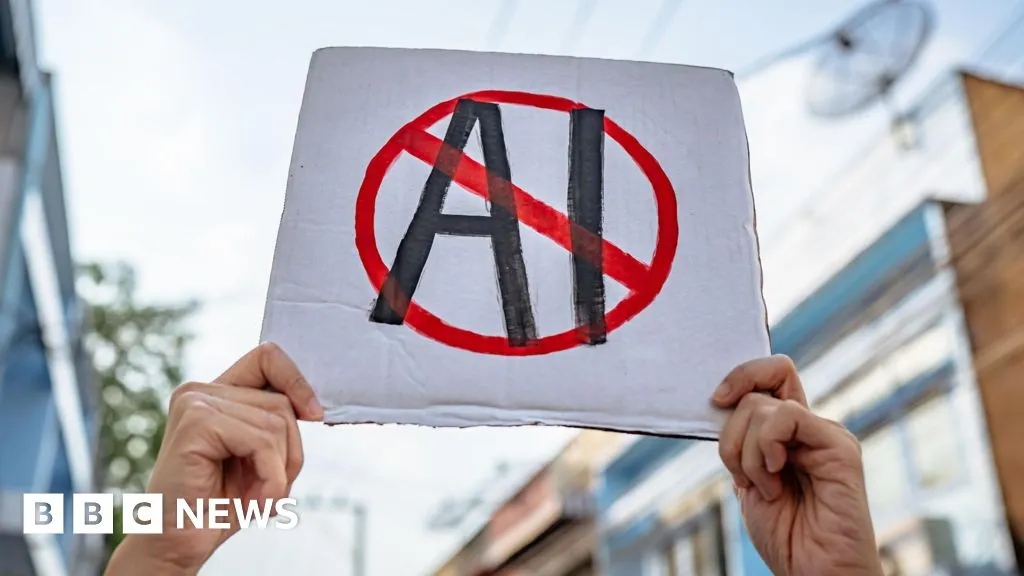
3 hours agoJoe TidyCyber correspondent, BBC World ServiceGettyOrganisations worldwide are racing to develop a universally recognised label for "human-made" products and services as part of the growing backlash against AI use.Declarations like "Proudly Human", "Human-made", '"No A.I" and "AI-free" are appearing across films, marketing, books and websites.It is in response to fears that jobs or entire professions are being swept away in a wave of AI-powered automation.BBC News has counted at least eight different initiatives trying to come up with a label that could get the kind of global recognition that the "Fair Trade" logo has for ethically made products.But with so many competing labels - as well as confusion over the definition of "AI-free" - experts say consumers are in danger of being left confused unless a single standard can be agreed on."AI is creating significant disruption and competing definitions of what is 'human made' are confusing consumers," says consumer expert Dr Amna Khan from Manchester Metropolitan University."A universal definition is essential to build trust, clarification and confidence" she told BBC News.Labels and stamps have been launched by companies and non-profits from the UK, Australia and the US.The movement to create AI-free certification systems follows generative AI tools being used to replace human work and creativity in range of industries including fashion, advertising, publishing, customer services and music.The organisations trying to come up with the labels include companies as well as non-profits, based in the UK, Australia and the US.How the certifications workSome labels like no-ai-icon.com, ai-free.io and notbyai.fyi, can be downloaded by anyone for free or for a fee without much or any auditing.Other systems like aifreecert require payment and have a strict process of vetting whether or not a product has used AI or not. Auditors use professional analysts and AI-detecting software.But AI experts say that getting industries to agree what truly counts as "human made" will prove complicated as AI is integrated into so many everyday tools.Not By AINot By AI offers a vetting service or you can just download and use their badges for a fee"AI is now so ubiquitous and so integrated into different platforms and services, that it's truly complicated to establish what 'AI free' means," says AI Research Scientist Sasha Luccioni."From a technical perspective, it's hard to implement. I think that AI is a spectrum, and we need more comprehensive certification systems, rather than a binary with AI/AI-free approach," she said.Generative AI-freeSome think that the line should be drawn at the use of generative AI - chatbots that create text, code, music or video with human prompts.In the closing credits of the 2024 Hugh Grant thriller Heretic producers wrote a disclaimer saying: "No generative AI was used in the making of this film."Film distributor The Mise en scène Company has taken this idea on and recently added a 'No AI was used' stamp to the poster for its latest film which was written, directed and edited largely by one person.The distributor has also published its own classification online that it hopes others in the industry will follow."We support the AI industry and we think its an exciting time but we think that as a result of AI content there is an economic premium put on human-made content and we want to lean into that," says CEO Paul Yates.AI disruptionThe arts industry is particularly rife with AI-made products and seems to be the current focus for the push back against AI use.Entire books and films are being made with AI far faster and more cheaply than using traditional methods.Bollywood film studio Itelliflicks specialises in making films with AI and proudly boasts about it.IntelliflicksIntelliflicks has made many films purely using Generative AI toolsBut sometimes products that rely on AI don't make that clear to consumers. Elsewhere in the book industry, publishing giant Faber and Faber began putting a "Human Written" stamp onto some of its books.Author Sarah Hall requested the stamp be added to her novel Helm. Hall also described the intellectual property theft of books used to train AI models as "creative larceny at scale".But Faber has not said how it classes 'Human Written' books or what auditing it does to ensure no AI is being used.UK company Books by People agrees there needs to be a trusted standard for how human authorship should be disclosed."Publishers are grappling with a new landscape where books can be produced in minutes rather than months or years and readers can no longer be sure if a book reflects a human experience or machine imitation," says co-founder Esme Dennys.Books by PeopleBooks By People is awarding stamps to publishers that pay for anti-AI auditingThe company has signed up five publishers and put its first stamp on the book Telenova which came out in November.Books by People charges publishers and requires them to carry out questionnaires about their practises and how they vet their authors. The company also checks samples of books periodically to check for AI writing.In Australia, competing company Proudly Human uses a similar but even more rigorous system to ensure authors are not using generative AI. Their auditors carry out checks at every stage of publication including checking any changes made from manuscript to ebook edition.The company is set to announce partnerships with some large publishing houses and plans to move into music, photography, film and animation too.Company boss Alan Finkel says systems like his are vital because industry efforts to analyse and label content as being made with AI have failed."A certification of 'human origin' is needed but self certification is not good enough so we have a full verification process to make sure that its truly human originated material," he said.
SRCBBC News - World
LANGEN
LEANCenter
WORDS937
ENT10
MON · 2026-03-16 · 00:32 GMTBRIEF NSR-2026-0316-24844
NSR-2026-0316-24844News Report·EN·Technology
Race on to establish globally recognised 'AI-free' logo
Organizations worldwide are competing to establish a globally recognized "AI-free" label for products and services in response to growing concerns about AI's impact on jobs and industries. Various declarations and labels are emerging across different sectors, aiming to signify human-made creations.
BBC News - WorldFiled 2026-03-16 · 00:32 GMTLean · CenterRead · 4 min
BBC News - WorldFIG 01
Reading time
4min
Word count
937words
Sources cited
3cited
Entities identified
10entities
Quality score
100%
§ 01
Briefing Summary
AI-generatedNEWSAR · AI
Organizations worldwide are competing to establish a globally recognized "AI-free" label for products and services in response to growing concerns about AI's impact on jobs and industries. Various declarations and labels are emerging across different sectors, aiming to signify human-made creations. At least eight initiatives are underway in the UK, Australia, and the US, each attempting to create a standard similar to the "Fair Trade" logo. However, the lack of a unified definition of "AI-free" and the proliferation of competing labels risk confusing consumers. Experts emphasize the need for a universal standard to build trust and clarity, as AI becomes increasingly integrated into everyday tools and platforms.
Confidence 0.90Sources 3Claims 5Entities 10
§ 02
Article analysis
Model · rule-basedFraming
Technology
Economic Impact
Tone
Measured
AI-assessed
CalmNeutralAlarmist
Factuality
0.70 / 1.00
Factual
LowHigh
Sources cited
3
Well sourced
FewMany
§ 03
Key claims
5 extracted01
No generative AI was used in the making of the film Heretic.
factualHeretic producers
Confidence
1.00
02
BBC News has counted at least eight different initiatives trying to come up with an 'AI-free' label.
factualBBC News
Confidence
1.00
03
AI is now so ubiquitous that it's truly complicated to establish what 'AI free' means.
quoteSasha Luccioni, AI Research Scientist
Confidence
0.90
04
AI is creating significant disruption and competing definitions of what is 'human made' are confusing consumers.
quoteDr Amna Khan, Manchester Metropolitan University
Confidence
0.90
05
Organisations are developing labels for 'human-made' products amid backlash against AI use.
factual
Confidence
0.90
§ 04
Full report
4 min read · 937 words§ 05
Entities
10 identifiedKey playerOppositionContextPositiveNeutralNegative
Organizations4
§ 06
Keywords & salience
10 termsai-free logo
1.00
artificial intelligence
0.90
human-made
0.80
ai-free
0.80
certification systems
0.70
global recognition
0.60
consumer trust
0.60
generative ai
0.50
ai-powered automation
0.50
ai detection
0.40
§ 07
Topic connections
Interactive graph No topic relationship data available yet. This graph will appear once topic relationships have been computed.