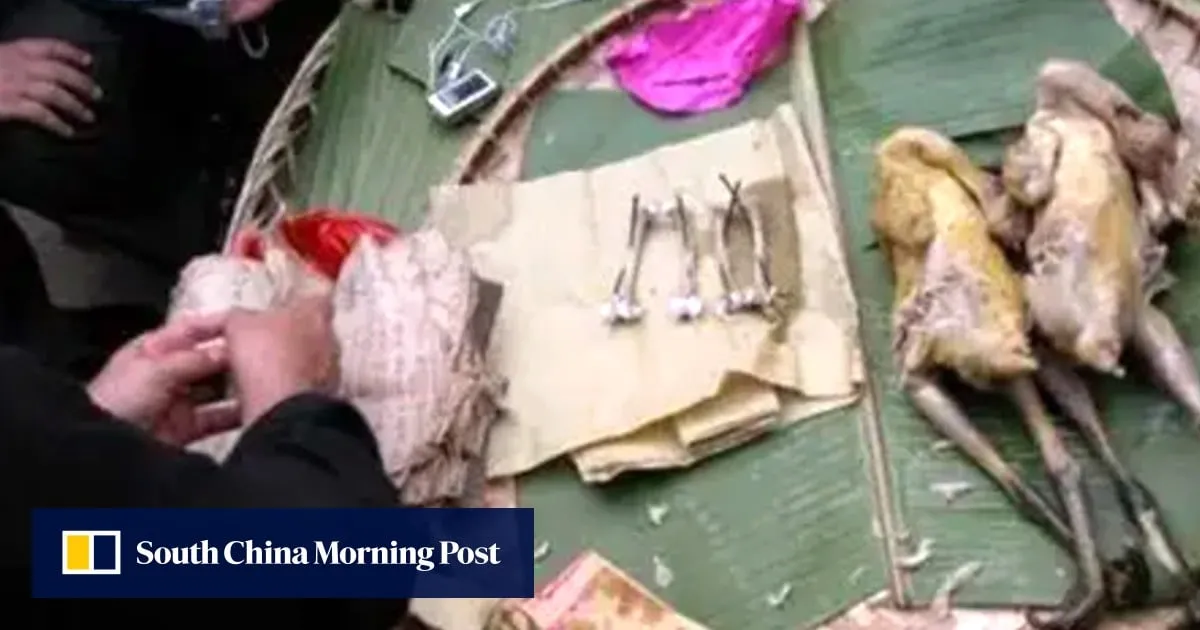
Ethnic minority groups in China have long relied on a gruesome method to predict their fortunes: beating a rooster to death and reading its femur bones, a practice that has lasted for centuries.Tracing back to the Tang (618–907) and Song (960–1279) dynasties, the custom is known as “Dajibu”, meaning chicken divination.It originated from ancient spiritual beliefs in southwestern China, where people lacking access to medicine would beat bronze drums to pray for healing.Chicken bone divination remains prevalent today among ethnic groups such as the Yi, Mosuo, Zhuang and Yao.Historical records, above, reveal that the ritual dates back centuries. Photo: zhihu.comIt is a traditional form of divination that uses a chicken as a medium, predicting good or bad fortune by observing its physical characteristics after it is slaughtered.
SRCSouth China Morning Post
LANGEN
LEANCenter-Right
WORDS127
ENT7
MON · 2026-03-16 · 10:00 GMTBRIEF NSR-2026-0316-24921
NSR-2026-0316-24921News Report·EN·Human Interest
How China ethnic minority groups use chicken bones of small roosters to predict fortunes
For centuries, ethnic minority groups in southwestern China, including the Yi, Mosuo, Zhuang, and Yao, have practiced "Dajibu," or chicken divination, to predict their fortunes. This custom, dating back to the Tang and Song dynasties, involves slaughtering a rooster and examining its femur bones.
Yating YangSouth China Morning PostFiled 2026-03-16 · 10:00 GMTLean · Center-RightRead · 1 min
South China Morning PostFIG 01
Reading time
1min
Word count
127words
Sources cited
0cited
Entities identified
7entities
Quality score
100%
§ 01
Briefing Summary
AI-generatedNEWSAR · AI
For centuries, ethnic minority groups in southwestern China, including the Yi, Mosuo, Zhuang, and Yao, have practiced "Dajibu," or chicken divination, to predict their fortunes. This custom, dating back to the Tang and Song dynasties, involves slaughtering a rooster and examining its femur bones. The practice originated from ancient spiritual beliefs where bronze drums were beaten for healing in the absence of medicine. Chicken bone divination uses the physical characteristics of the slaughtered chicken to predict good or bad fortune. This traditional ritual remains prevalent among these ethnic groups today.
Confidence 0.85Claims 4Entities 7
§ 02
Article analysis
Model · rule-basedFraming
Human Interest
Tone
Mixed Tone
AI-assessed
CalmNeutralAlarmist
Factuality
0.80 / 1.00
Factual
LowHigh
Sources cited
0
No named sources
FewMany
§ 03
Key claims
4 extracted01
The ritual dates back centuries to the Tang (618–907) and Song (960–1279) dynasties.
factual
Confidence
1.00
02
Chicken bone divination remains prevalent among ethnic groups such as the Yi, Mosuo, Zhuang and Yao.
factual
Confidence
1.00
03
The custom is known as “Dajibu”, meaning chicken divination.
factual
Confidence
1.00
04
Ethnic minority groups in China use chicken bones to predict fortunes.
factual
Confidence
1.00
§ 04
Full report
1 min read · 127 words§ 05
Entities
7 identifiedKey playerOppositionContextPositiveNeutralNegative
People1
§ 06
Keywords & salience
8 termschicken bone divination
1.00
ethnic minority groups
0.90
fortune telling
0.80
china
0.70
traditional divination
0.60
dajibu
0.60
rooster
0.50
spiritual beliefs
0.50
§ 07
Topic connections
Interactive graph Network visualization showing 51 related topics
View Full Graph Person Organization Location Event|Click node to navigate|Edge numbers = shared articles