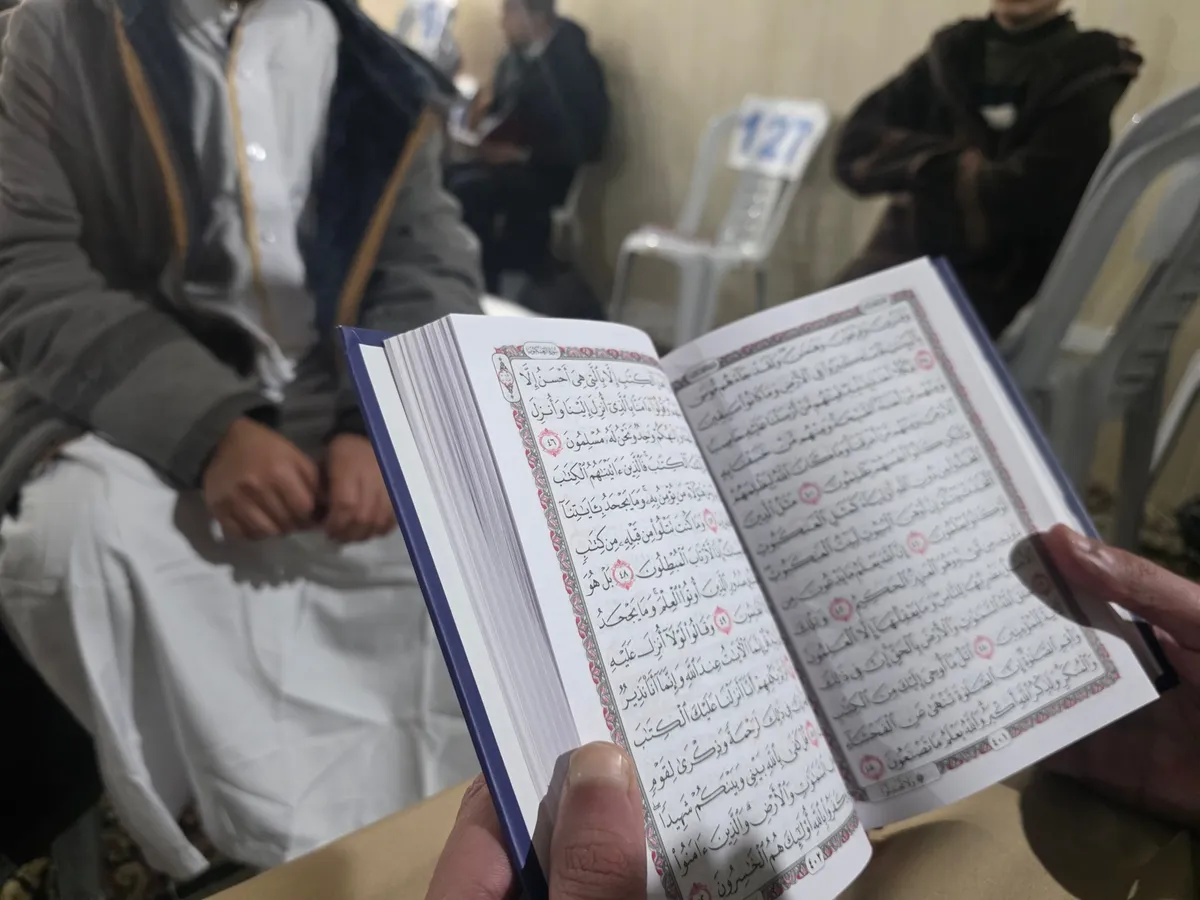
Quran memorisers in Gaza overcome devastation from war, reciting the holy book as a source of hope and strength.Quran memorisers spend years learning and revising the Muslim holy book [Ahmed Al-Najjar/Al Jazeera]Published On 16 Mar 2026Khan Younis, Gaza Strip – Dawn marks the beginning of another day in Ramadan. At the partially damaged al-Shafii Mosque in western Khan Younis, the buzz of Israeli drones overhead was not the only sound heard as the dawn prayer concluded.Instead, a solemn echo filled the air – verses of the Quran recited aloud.Recommended Stories list of 3 itemslist 1 of 3Hopes for justice rise as The Voice of Hind Rajab heads to Oscarslist 2 of 3Destroy, displace, dismantle: Israel’s Gaza doctrine comes to Lebanonlist 3 of 3What’s happened in Gaza and the West Bank since the start of the Iran war?end of listRows upon rows of Palestinian men and boys dressed in white cloaks filled the mosque’s yard for one single purpose: to recite the entire Quran before sunset. Some sat on chairs while others lay on the floor, but all remained focused on the sacred task before them.Two hundred and fifty-six Quran memorisers – Palestinians who have committed the entire holy book to memory – sat in the place while companions beside them listened attentively, following each word carefully to ensure the recitation remained flawless.The gathering, titled “Safwat Al-Huffaz” – “The Elite of Quran Memorisers”, has become a special collective way of observing Ramadan in Gaza. Yet after nearly two years of Israel’s genocidal war on the enclave, its meaning has grown far deeper.Memorising the Quran is considered one of the most noble Islamic honours, one that requires years of disciplined study, repetition, and devotion. Over the years, Gaza has developed a rich tradition of Quran memorisation circles that nurture spiritual values and strengthen connection with religious faith.The massive recitation sessions, where Quran memorisers collectively recite the entire book by heart, have become one of the most distinguished expressions of that tradition.Despite the devastation created by Israel’s genocidal war on Gaza – which has killed more than 75,000 Palestinians – participants have insisted on holding the gathering again this year in an act of spiritual perseverance.Among those carefully reciting was 51-year-old Mohammad al-Qiranawi, a Quran memoriser whose dark glasses concealed the fact that he has been blind since childhood.Losing his eyesight early in life never prevented him from memorising the Quran.“The Quran has always been my best companion,” al-Qiranawi said as he paused briefly from his recitation.“By the time I turned 10, I had completely lost my eyesight due to health issues. But even through that loss, [God] granted me another gift. I continued memorising the Quran and relied on my hearing to perfect it.”Over the years, he went on to teach the Quran to his children and others, who also memorised the Quran.But Israel’s genocide has made his journey more difficult.Displacement, destruction, and the daily struggle to survive have disrupted the memorisation circles he once attended regularly. Still, he continued reciting whenever possible.“Despite these hardships, I held on to my companion,” he said. “I kept reciting and joined sessions whenever I could to preserve the Quran in my heart and teach younger students the rules of recitation.”Crowd of Quran memorisers sitting in the al-Shafii Mosque hall reciting the Quran by heart [Courtesy of Dar al-Quran and Sunna Institute]War on religious lifeFor Gaza’s predominantly Muslim society, mosques have long served as pillars of both spiritual and social life.Faith is a lived practice woven into daily life, rather than something confined to words or symbolic gestures.In nearly every neighbourhood, the mosque functions as a community hub where people seek not only religious guidance but also relief from the pressures of daily life.Through generations, these religious spaces have nurtured Palestinians from all walks of life. Scholars, doctors, engineers, and labourers alike passed through the same Quranic circles that taught discipline, patience, and faith.But Israel’s genocide in Gaza has harmed that spiritual infrastructure.According to Gaza’s Ministry of Endowments and Religious Affairs, more than 89 percent of the territory’s mosques, more than 1,000 in total, have been destroyed or severely damaged by Israeli attacks.Israeli strikes have also killed worshipers while they were gathered for prayer in mosques, in addition to bombing and damaging Gaza’s three historic churches.The widespread destruction has left religious institutions in ruins, forcing worshippers and students to scatter across displacement camps and makeshift shelters.And yet, despite the conditions, many Palestinians have made it a priority to establish makeshift religious spaces. In camps and shelters, mosques have been built from wood, tarps, or scraps of fabric.There, people gather to pray, study, and recite the Quran, even as copies of the holy book have become scarce and often have to be shared.These fragile spaces have allowed Gaza’s Quranic tradition to endure, enabling new generations of Quran memorisers to continue despite the immense difficulties around them.Thirteen-year-old Abdul Rahman Abu Nimr had just completed nearly eight hours of recitation when he reached the final chapter of the Quran.“I finished memorising the Quran while being displaced,” Abu Nimr said. The genocide has transformed his life. “I lost my home, my uncle, and many friends,” he said.“We are exhausted from displacement and wish we could return to normal life.”“The Quran circles with other displaced students consoled me during these times,” he said. “Today, I am very happy to recite it again, and I will continue revising it so I never forget.”Mohammad al-Qiranawi, left, was able to memorise the Quran despite being blind [Ahmed al-Najjar/Al Jazeera]Faith under fireFor some participants, the assault on religious life has not been limited to domes and minarets.Wasim Abu Sahloul, another Quran memoriser taking part in the gathering, sat murmuring verses with a steady face. But behind his poise was multilayered trauma.Abducted during the genocide and then released from Israeli prisons in February 2025 as part of a prisoner exchange, Abu Sahloul said that religious practices inside prison were heavily constrained.“The [Israeli] occupation deprived us of copies of the Quran,” he said. “They prevented us from praying freely or even hearing the call to prayer.”But Abu Sahloul explained that did not stop him from teaching the Quran to others.“We began teaching others to memorise,” Abu Sahloul explained. “Some prisoners memorised chapters, while others eventually memorised the entire Quran. Some of them are here among us today.”Freedom brought Abu Sahloul back to his family – but the reunion was tragically brief.Months after his release, an Israeli air strike killed nine members of his family.“On July 18, I lost my mother and my nine-year-old son, Islam, along with my brother and his children,” he said painfully.“I dedicate today’s recitation to the souls of my mother, my child, and my entire family.”Despite the loss, Abu Sahloul said the Quran remains a source of his strength.“I will keep reciting the Quran until my last breath,” he said. “My message to my jailer and killer is that we live through the Quran.”Rebuilding religious spacesAmong the institutions trying to preserve Gaza’s Quranic tradition is the Dar al-Quran and Sunna Institute, one of roughly 30 religious educational institutions severely affected by the war.
SRCAl Jazeera
LANGEN
LEANCenter
WORDS1 180
ENT8
MON · 2026-03-16 · 12:38 GMTBRIEF NSR-2026-0316-24993
NSR-2026-0316-24993News Report·EN·Human Interest
Quran echoes loudly as Palestinian reciters gather in Gaza
In Khan Younis, Gaza, 256 Palestinian Quran memorizers gathered at the al-Shafii Mosque during Ramadan to collectively recite the entire Quran. The event, called "Safwat Al-Huffaz" ("The Elite of Quran Memorisers"), is an annual tradition, but this year holds deeper significance after nearly two years of war.
Ahmed Al-NajjarAl JazeeraFiled 2026-03-16 · 12:38 GMTLean · CenterRead · 5 min
Al JazeeraFIG 01
Reading time
5min
Word count
1 180words
Sources cited
1cited
Entities identified
8entities
Quality score
100%
§ 01
Briefing Summary
AI-generatedNEWSAR · AI
In Khan Younis, Gaza, 256 Palestinian Quran memorizers gathered at the al-Shafii Mosque during Ramadan to collectively recite the entire Quran. The event, called "Safwat Al-Huffaz" ("The Elite of Quran Memorisers"), is an annual tradition, but this year holds deeper significance after nearly two years of war. Despite the devastation in Gaza, participants persisted in holding the gathering as an act of spiritual resilience. The memorizers, some of whom have spent years learning the Quran, recited from dawn until sunset, with companions ensuring accuracy. The event highlights Gaza's tradition of Quran memorization and its role in providing hope and strength amidst conflict.
Confidence 0.90Sources 1Claims 5Entities 8
§ 02
Article analysis
Model · rule-basedFraming
Human Interest
Conflict
Tone
Mixed Tone
AI-assessed
CalmNeutralAlarmist
Factuality
0.60 / 1.00
Mixed
LowHigh
Sources cited
1
Limited
FewMany
§ 03
Key claims
5 extracted01
The Quran has always been my best companion.
quoteMohammad al-Qiranawi
Confidence
1.00
02
Two hundred and fifty-six Quran memorisers gathered to recite the entire Quran before sunset.
factual
Confidence
1.00
03
The gathering, titled “Safwat Al-Huffaz” – “The Elite of Quran Memorisers”, has become a special collective way of observing Ramadan in Gaza.
factual
Confidence
0.90
04
Quran memorisers in Gaza overcome devastation from war, reciting the holy book as a source of hope and strength.
factual
Confidence
0.80
05
Israel’s genocide has made his journey difficult.
factual
Confidence
0.70
§ 04
Full report
5 min read · 1 180 words§ 05
Entities
8 identifiedKey playerOppositionContextPositiveNeutralNegative
§ 06
Keywords & salience
10 termsquran memorisers
1.00
gaza
0.90
quran recitation
0.80
ramadan
0.70
islamic faith
0.60
spiritual perseverance
0.60
war
0.50
palestinians
0.50
devastation
0.50
holy book
0.40
§ 07
Topic connections
Interactive graph Network visualization showing 51 related topics
View Full Graph Person Organization Location Event|Click node to navigate|Edge numbers = shared articles