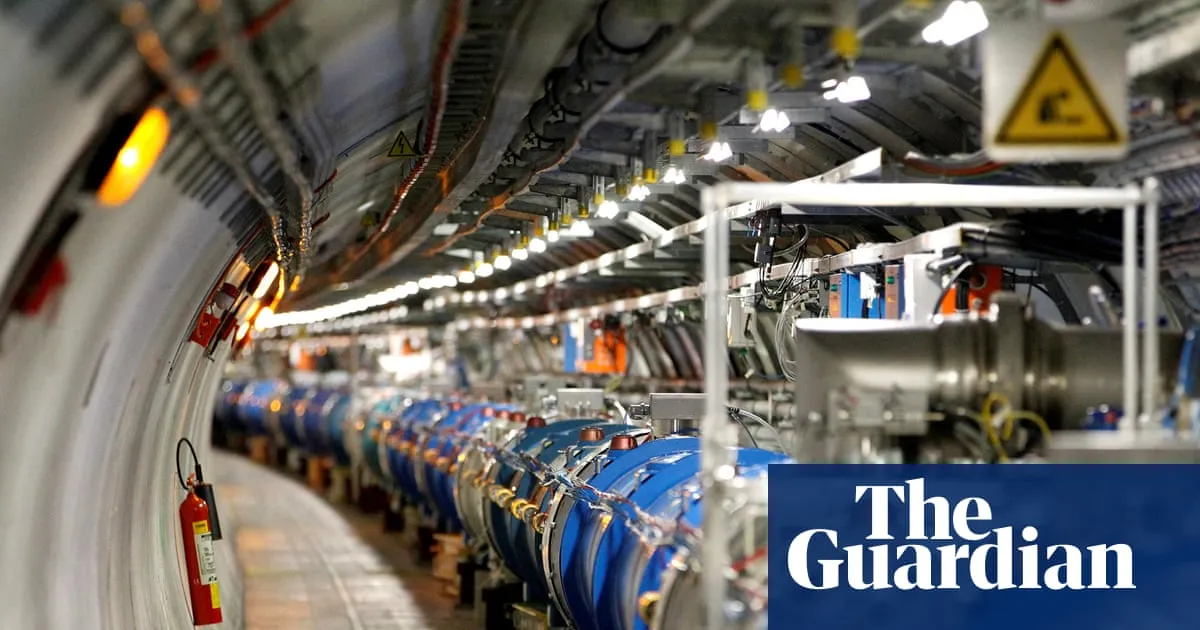
Scientists at the Cern nuclear physics laboratory near Geneva have discovered a heavier version of the proton, the subatomic particle that sits at the heart of every known atom in the universe.They spotted the particle in a shower of debris that lit up a detector at the Large Hadron Collider (LHC), located deep beneath the ground at Cern, which smashes protons together at close to the speed of light. The collisions recreate in microcosm conditions that prevailed just after the big bang, with the energy converting to particles that spray in all directions. The newfound particle, which is four times heavier than the regular proton, should help physicists refine their understanding of the strong nuclear force that glues together the innards of all atomic nuclei. The force is unusual because it behaves like a rubber band, getting stronger as the distance between subatomic particles increases.Physicists working on the LHCb experiment found the heavy proton after the detector was upgraded to make it more powerful.“This is just the first of many expected insights that can be gained with the new LHCb detector,” said Prof Tim Gershon at the University of Warwick, who takes over as the LHCb international lead in July. “The improved detection capability allowed us to find the particle after only one year, while we could not see it in a decade of data collected with the original LHCb.”Atoms of hydrogen, the simplest and most abundant element in the observable universe, contain only a proton and an electron. Protons, along with neutrons in heavier atoms, consist of elementary subatomic particles called quarks. A proton contains two up quarks and one down quark, but there are heavier, unstable versions of quarks known as charm, strange, top and bottom.In the heavy proton detected at Cern, both up quarks are replaced with charm quarks. The particle, snappily named Xi-cc-plus, was revealed by its signature decay into other particles. After popping into existence, it does not hang around: scientists suspect it survives for less than a millionth of a millionth of a second before breaking down.“The more we learn about these particles, the more we can learn about the strong force, and that is the same strong force that binds our protons and neutrons together,” said Prof Chris Parkes, a physicist at the University of Manchester.The discovery comes as UK Research and Innovation(UKRI), the nation’s science funder, faces fierce criticism for its plans to pull £50m funding for the LHCb’s final upgrade in the 2030s. The revamp would ensure the detector made the most of a major transformation to the LHC that could substantially improve its discovery potential.UK scientists working in particle physics, astronomy and nuclear physics have been told their grants will be slashed following cost overruns at major science facilities. Projects have also been hit, including the next LHCb upgrade and an electron-ion collider under development with researchers in the US.Last week, Chi Onwurah, chair of the Commons science committee, sent a scathing letter to Prof Ian Chapman, chief executive of the UKRI, and Patrick Vallance, the science minister, calling the cuts “wholly unacceptable” and “a failure” by UKRI, the Science and Technology Facilities Council and the Department for Science, Innovation and Technology.The letter demands “swift and decisive action” and asks whether the decision on the LHCb upgrade is final.“It is so important that we can overcome the problems caused by the UKRI decision to deprioritise the funding for this project,” Gershon said. “No other experiment either running or planned will be able to do this physics.”
SRCThe Guardian - World News
LANGEN
LEANCenter-Left
WORDS586
ENT6
TUE · 2026-03-17 · 08:00 GMTBRIEF NSR-2026-0317-25252
NSR-2026-0317-25252News Report·EN·Technology
Scientists discover heavier version of proton with upgraded detector
Scientists at CERN's Large Hadron Collider (LHC) have discovered a heavier version of the proton, named Xi-cc-plus, using an upgraded LHCb detector. The particle, four times heavier than a regular proton, was identified through its decay signature after being created in high-energy proton collisions.
Ian Sample Science editorThe Guardian - World NewsFiled 2026-03-17 · 08:00 GMTLean · Center-LeftRead · 3 min
The Guardian - World NewsFIG 01
Reading time
3min
Word count
586words
Sources cited
3cited
Entities identified
6entities
Quality score
100%
§ 01
Briefing Summary
AI-generatedNEWSAR · AI
Scientists at CERN's Large Hadron Collider (LHC) have discovered a heavier version of the proton, named Xi-cc-plus, using an upgraded LHCb detector. The particle, four times heavier than a regular proton, was identified through its decay signature after being created in high-energy proton collisions. The discovery allows physicists to further refine their understanding of the strong nuclear force, which binds atomic nuclei. The upgraded detector allowed for the particle's detection after only one year, whereas it was undetectable with the original LHCb. The newfound particle contains two charm quarks instead of the two up quarks found in a regular proton.
Confidence 0.90Sources 3Claims 5Entities 6
§ 02
Article analysis
Model · rule-basedFraming
Technology
Economic Impact
Tone
Measured
AI-assessed
CalmNeutralAlarmist
Factuality
0.80 / 1.00
Factual
LowHigh
Sources cited
3
Well sourced
FewMany
§ 03
Key claims
5 extracted01
UKRI plans to pull £50m funding for the LHCb’s final upgrade in the 2030s.
factual
Confidence
1.00
02
The improved detection capability allowed us to find the particle after only one year.
quoteProf Tim Gershon
Confidence
1.00
03
The newfound particle is four times heavier than the regular proton.
factual
Confidence
1.00
04
Scientists at Cern have discovered a heavier version of the proton.
factual
Confidence
1.00
05
The particle survives for less than a millionth of a millionth of a second before breaking down.
factual
Confidence
0.90
§ 04
Full report
3 min read · 586 words§ 05
Entities
6 identifiedKey playerOppositionContextPositiveNeutralNegative
Organizations3
§ 06
Keywords & salience
9 termsproton
1.00
subatomic particle
0.80
large hadron collider
0.70
strong nuclear force
0.70
cern
0.60
quarks
0.60
xi-cc-plus
0.50
lhcb experiment
0.50
particle physics
0.40
§ 07
Topic connections
Interactive graph No topic relationship data available yet. This graph will appear once topic relationships have been computed.