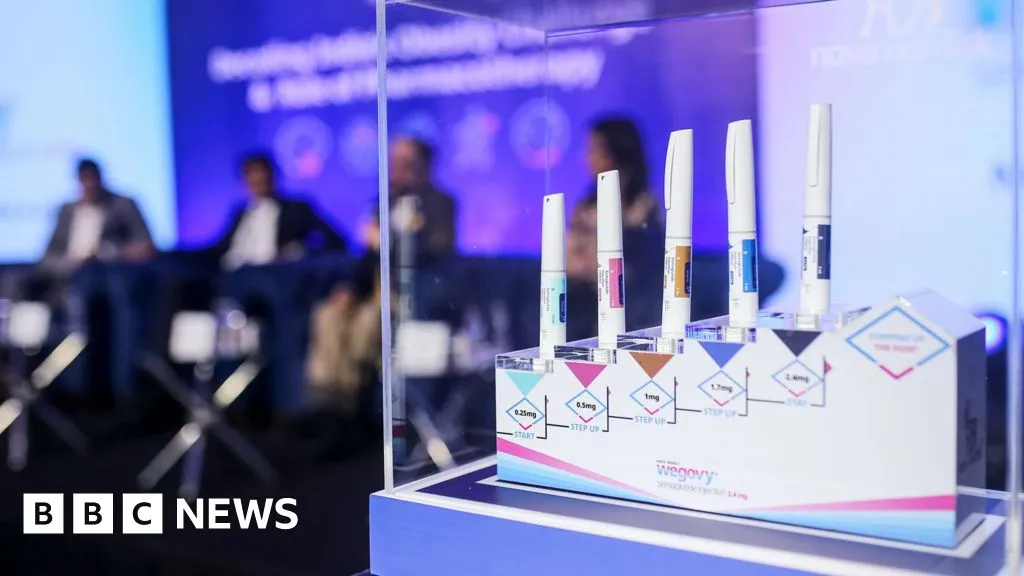
3 hours agoSoutik BiswasIndia correspondentBloomberg via Getty ImagesWegovy launched in India in 2025, but the patent on its core ingredient expires in the country this weekIndia could soon get a lot thinner - at least in theory.On Friday the patent on Semaglutide - the molecule behind Danish drugmaker Novo Nordisk's blockbuster weight-loss drugs Wegovy and Ozempic - expires in the country.This will allow domestic pharmaceutical companies to release cheaper copies or generics, triggering a rush of competition that could slash prices by more than half and rapidly expand access for people in India, and eventually in other countries too.Investment bank Jefferies has called it a potential "magic-pill moment" for India, predicting the Semaglutide market could eventually reach $1bn domestically with the right pricing and uptake.Analysts expect around 50 branded Semaglutide generics to enter the market within months - a familiar pattern in India's fiercely competitive pharmaceutical industry. When the diabetes drug sitagliptin went off patent in 2022, about 30 branded versions appeared within a month and nearly 100 within a year.Affluent Indians drive boom in weight-loss drugsIndia's pharmaceutical industry, currently worth about $60bn, is expected to double by 2030. Much of it is built on generics - a manufacturing muscle that now sets the stage for fierce competition over Semaglutide. What has until now been an expensive injection largely confined to affluent patients could soon become far more common.Originally developed to treat diabetes, these drugs are now being hailed as game changers for weight loss, offering results that few previous treatments could match. Semaglutide belongs to a class of medicines known as GLP-1 receptor agonists, which mimic a hormone that regulates appetite and blood sugar.By boosting insulin release and slowing the emptying of the stomach, the drugs make people feel full sooner and stay full longer. Originally developed for diabetes, they have become some of the most sought-after weight-loss treatments in the world.Getty ImagesThe new generation of weight-loss drugs is typically delivered through easy-to-use injectable pensSeveral Indian drugmakers are already preparing to make the move. According to Sheetal Sapale, vice-president at research firm Pharmarack, major firms including Cipla, Sun Pharma, Dr Reddy's Laboratories, Biocon, Natco, Zydus and Mankind Pharma are readying branded generics, with many more likely to follow. Prices are expected to fall sharply.Current monthly treatment costs are steep: Ozempic typically sells for 8,800 - 11,000 rupees ($95-$119; £71-£89), while Wegovy can cost 10,000-16,000 rupees ($108-$173). Sapale expects generic competition to push that down to roughly 3,000-5,000 rupees ($36-54) per month.Lower prices could transform the market.India's anti-obesity drug sector - covering both injectables and oral medicines - has already grown rapidly, from roughly $16m in 2021 to close to $100m, according to Pharmarack. Demand accelerated after the launch of Rybelsus in 2022, the first oral version of Semaglutide.The surge reflects a broader health shift.Indian pot belly: From status symbol to silent killerIndia already has more than 77 million people with type-2 diabetes and one of the world's largest populations of overweight adults. Urban lifestyles, carbohydrate-heavy diets and sedentary habits have helped drive both conditions.For doctors, cheaper GLP-1 drugs could soon add a powerful new tool to treat them.Weight-loss drugs are also moving beyond endocrinology clinics. Cardiologists use them to help patients shed weight before procedures such as angioplasty, orthopaedic surgeons to ease stress on joints before knee surgery, and chest physicians to treat conditions such as obstructive sleep apnoea.Muffazal Lakdawala, a Mumbai-based bariatric surgeon, says these drugs could dramatically expand treatment for India's large population of patients with diabetes and obesity.Until recently, he notes, access was limited: injectable GLP-1 drugs were expensive and difficult to obtain, while the oral drug Rybelsus was the only widely available option."It is great that these will become cheaper so that more of the diabetic and obese Indian population can access them," he says.But he adds a warning: "The quality of the drugs being made here must be very tightly regulated."ReutersIndia has one of the world's largest populations of overweight adultsThat caution reflects a broader reality about India's pharmaceutical industry - the global powerhouse behind low-cost generic medicines.The country is the world's largest supplier of generic medicines, producing roughly 60,000 brands across more than 60 therapeutic categories and accounting for around 20% of global generic supply.Its reputation as the "pharmacy of the world" rests largely on its ability to turn expensive medicines into affordable mass-market products.The most celebrated example came two decades ago, when Indian firms helped slash the price of HIV antiretroviral drugs, dramatically expanding treatment across Africa and the developing world.Today India supplies medicines to over 200 countries, meeting more than half of Africa's generic drug demand, about 40% of generics used in the US, and roughly a quarter of medicines in the UK."The export potential of Indian generic weight-loss drugs is humongous," says Namit Joshi, chairman of the government's Pharmaceuticals Export Promotion Council of India. "The US market alone could scale to $10bn within a few years as obesity rates drive demand."That would be a sizeable addition to India's pharmaceutical trade: the country's generic drug exports currently total $30.46bn, with the US already its largest market.Yet enthusiasm among doctors remains tempered by caution. Prashanth Vishwanathan/Bloomberg via Getty ImagesThere are more than 77 million people with Type 2 diabetes in IndiaGLP-1 drugs are powerful but not risk-free. Side-effects can include nausea, vomiting and digestive problems; rarer complications include gallstones or pancreatitis. Rapid weight loss without adequate protein intake or exercise can also lead to muscle loss.Doctors say many patients misunderstand the role of the drugs. Some expect dramatic weight loss within weeks, influenced by social-media hype and celebrity endorsements.Mumbai-based diabetologist Rahul Baxi says success depends not just on the drug but on "right patient selection".Doctors look beyond Body Mass Index (BMI) - a basic measure of weight relative to height - to related conditions such as diabetes or high cholesterol. Lifestyle matters too: if a patient's diet remains unhealthy, the drug alone may not be enough.Patients often arrive seeking a quick fix. "People come asking to lose 10kg in three months," Baxi says.Rapid weight loss can have downsides. Too fast, and patients may lose fat from the face, neck, arms and thighs, leaving them looking frail."Gradual weight loss, slow dose escalation, and a focus on protein intake, exercise and strength training are key to healthier outcomes," says Baxi.Another challenge is that weight loss often reverses once the drugs stop. Appetite can rebound strongly as the body resists losing fat."If you stop the drugs, the appetite comes back voraciously," Baxi says.Getty ImagesFried foods - often rich in carbohydrates and fats - are widely consumed in IndiaThere are also concerns about misuse as prices fall.Physicians report patients being prescribed high doses by gym trainers, beauty clinics or dieticians with no authority to do so. Online pharmacies sometimes dispense the drugs after cursory consultations. Beauticians already advertise rapid slimming "packages" for weddings or social events.Such practices could spread as cheaper generics become more widely available."More access to cheap drugs means a higher chance of abuse," says Bhaumik Kamdar, a Mumbai-based chest physician. "Access calls for more responsibility - and stricter regulation. I am cautiously optimistic about these drugs."That warning echoes Lakdawala's concerns about manufacturing standards."These are very beneficial drugs," he says. "We don't want side effects arising from poor-quality medicines and giving the molecule itself a bad name."The government is also trying to temper the hype. In an advisory last week, India's drug regulator warned pharmaceutical companies against promoting prescription weight-loss medicines such as GLP-1 drugs directly to consumers.Advertising that promises dramatic results or downplays the need for diet and exercise could be deemed misleading, officials said, stressing that such medicines should only be used under medical supervision.For regulators and doctors alike, the coming months may therefore test whether India can balance affordability with oversight.Baxi says he asks patients to improve their lifestyle and diet before prescribing weight-loss drugs.Even then, they are first put on a higher-protein diet with a dietician's help, he says. Current evidence suggests the drugs may need to be taken over a long term. But many patients arrive asking for a "quick fix after seeing Instagram reels", putting pressure on doctors.Yet, the rewards could be significant. A medicine that once cost tens of thousands of rupees a month could become accessible to millions - and perhaps eventually to patients far beyond India."I am actually writing on prescriptions to many patients: Come to me after 20 March when the prices come down," says Baxi.
SRCBBC News - World
LANGEN
LEANCenter
WORDS1 402
ENT11
WED · 2026-03-18 · 00:30 GMTBRIEF NSR-2026-0318-25533
NSR-2026-0318-25533News Report·EN·Economic Impact
India's cheap weight-loss drugs could reshape global obesity fight
The patent for semaglutide, the active ingredient in weight-loss drugs Wegovy and Ozempic, expires in India this week, paving the way for domestic pharmaceutical companies to produce cheaper generic versions. Analysts predict a surge of competition, with potentially 50 branded generics entering the market within months, significantly reducing prices and expanding access to the drug.
BBC News - WorldFiled 2026-03-18 · 00:30 GMTLean · CenterRead · 6 min
BBC News - WorldFIG 01
Reading time
6min
Word count
1 402words
Sources cited
1cited
Entities identified
11entities
Quality score
100%
§ 01
Briefing Summary
AI-generatedNEWSAR · AI
The patent for semaglutide, the active ingredient in weight-loss drugs Wegovy and Ozempic, expires in India this week, paving the way for domestic pharmaceutical companies to produce cheaper generic versions. Analysts predict a surge of competition, with potentially 50 branded generics entering the market within months, significantly reducing prices and expanding access to the drug. This development could reshape the obesity treatment landscape in India, with the semaglutide market potentially reaching $1 billion. Major Indian firms like Cipla, Sun Pharma, and Dr Reddy's Laboratories are preparing to launch their own versions. The availability of affordable semaglutide in India could eventually impact other countries as well.
Confidence 0.90Sources 1Claims 5Entities 11
§ 02
Article analysis
Model · rule-basedFraming
Economic Impact
Public Health
Tone
Measured
AI-assessed
CalmNeutralAlarmist
Factuality
0.80 / 1.00
Factual
LowHigh
Sources cited
1
Limited
FewMany
§ 03
Key claims
5 extracted01
Investment bank Jefferies has called it a potential 'magic-pill moment' for India.
quoteJefferies
Confidence
1.00
02
The patent on semaglutide expires in India this week.
factual
Confidence
1.00
03
Generic competition could push monthly treatment costs down to roughly 3,000-5,000 rupees ($36-54).
predictionSheetal Sapale, Pharmarack
Confidence
0.90
04
Analysts expect around 50 branded semaglutide generics to enter the market within months.
prediction
Confidence
0.80
05
India's pharmaceutical industry is expected to double by 2030.
prediction
Confidence
0.70
§ 04
Full report
6 min read · 1 402 words§ 05
Entities
11 identifiedKey playerOppositionContextPositiveNeutralNegative
Organizations9
Locations1
§ 06
Keywords & salience
9 termsweight-loss drugs
1.00
semaglutide
0.90
generics
0.80
patent expiration
0.70
india
0.70
pharmaceutical industry
0.60
drug prices
0.50
obesity
0.50
glp-1 receptor agonists
0.40
§ 07
Topic connections
Interactive graph Network visualization showing 51 related topics
View Full Graph Person Organization Location Event|Click node to navigate|Edge numbers = shared articles