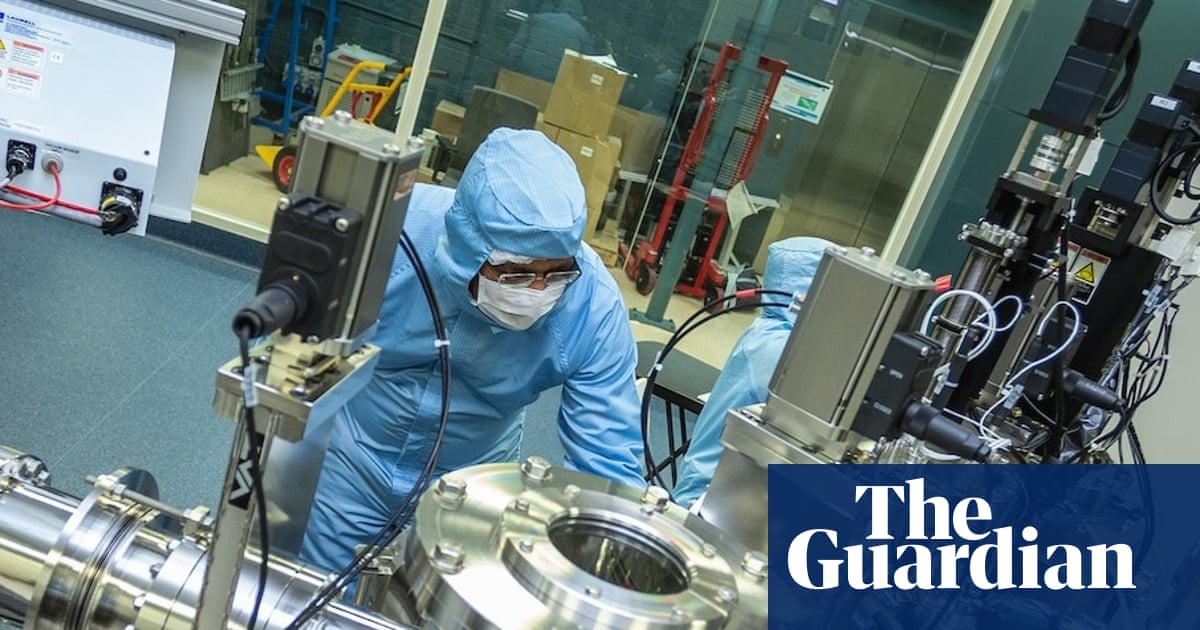
Australian scientists have developed what they say is the world’s first proof-of-concept quantum battery.Quantum batteries, first proposed as a theoretical concept in 2013, use the principles of quantum mechanics to store energy, and have the potential to be more efficient than conventional batteries.Researchers have now created a prototype – charged wirelessly with a laser – that they believe is a major step towards fully functioning quantum batteries with rapid charging times.Lead researcher Dr James Quach of the CSIRO, Australia’s national science agency, said: “It’s the first prototype which does a full cycle of a battery: in other words, you charge it, you store energy, and you can discharge it.”In conventional batteries, charge time increases with size. “That’s why your mobile phone takes about 30 minutes to charge and your electric car takes overnight to charge,” Quach said.In contrast, “quantum batteries have this really peculiar property where the larger they are, the less time they take to charge”, he said. That’s due to a feature known as “collective effects”, in which quantum cells charge faster when there are more cells involved.Quach and his colleagues first demonstrated this property in 2022, but there was no way to extract energy from that prototype battery.A researcher holds the tiny prototype quantum battery. Photograph: CSIROThe new prototype, detailed in the journal Light: Science & Applications, took femtoseconds (quadrillionths of a second) to charge, and stored the energy for nanoseconds – about six orders of magnitudes longer.To put that into perspective, Quach said, for a battery that took one minute to charge, six orders of magnitude would mean it would stay charged for “a couple of years”.The current prototype has a capacity of only a few billion electron volts, “which is very small and not enough to power anything useful”, he said.“What we need to do next is … to increase the storage time,” Quach added. “You want your battery to hold charge longer than a few nanoseconds if you want to be able to talk to someone on a mobile phone.”Fully functioning quantum batteries that charge almost instantaneously could eventually be used to power quantum computers or small conventional electronic devices.Quantum batteries are charged wirelessly with lasers, so another potential application is in remote charging.“You could put a quantum battery, for example, on a drone … and you could charge it while it’s in flight,” Quach said. “Once the technology matures … you would no longer need to stop your car at a petrol station to charge it up; you could charge it on the go.”Prof Andrew White, who leads the quantum technology laboratory at the University of Queensland and was not involved in the research, described it as “a really nice piece of work showing that the quantum battery is more than an idea, it’s now a working prototype”.White noted that the batteries were “not going to turn up in any electric vehicles anytime soon”, but “probably the first place that it’ll have an impact is actually for quantum computers”.Quantum batteries could provide energy “coherently … with the minimum energy cost to these computers”, White said.
SRCThe Guardian - World News
LANGEN
LEANCenter-Left
WORDS512
ENT3
WED · 2026-03-18 · 07:29 GMTBRIEF NSR-2026-0318-25598
NSR-2026-0318-25598News Report·EN·Technology
Is this the world’s first quantum battery? Australian scientists say so
Australian scientists at the CSIRO have developed a prototype quantum battery, claiming it's the first to complete a full charge-store-discharge cycle. Quantum batteries, theoretically proposed in 2013, utilize quantum mechanics for potentially more efficient energy storage and faster charging.
Donna LuThe Guardian - World NewsFiled 2026-03-18 · 07:29 GMTLean · Center-LeftRead · 3 min
The Guardian - World NewsFIG 01
Reading time
3min
Word count
512words
Sources cited
2cited
Entities identified
3entities
Quality score
75%
§ 01
Briefing Summary
AI-generatedNEWSAR · AI
Australian scientists at the CSIRO have developed a prototype quantum battery, claiming it's the first to complete a full charge-store-discharge cycle. Quantum batteries, theoretically proposed in 2013, utilize quantum mechanics for potentially more efficient energy storage and faster charging. This prototype, charged wirelessly with a laser, demonstrates the "collective effects" property where larger batteries charge faster. While the current prototype charges in femtoseconds and stores energy for nanoseconds, it holds a very small charge. Future research will focus on increasing storage time and capacity, with potential applications including powering quantum computers, small electronics, and remote charging of devices like drones. The research was published in the journal Light: Science & Applications.
Confidence 0.90Sources 2Claims 5Entities 3
§ 02
Article analysis
Model · rule-basedFraming
Technology
Economic Impact
Tone
Measured
AI-assessed
CalmNeutralAlarmist
Factuality
0.80 / 1.00
Factual
LowHigh
Sources cited
2
Limited
FewMany
§ 03
Key claims
5 extracted01
The new prototype took femtoseconds to charge and stored energy for nanoseconds.
factualArticle
Confidence
1.00
02
The prototype quantum battery charges wirelessly with a laser.
factualArticle
Confidence
1.00
03
Quantum batteries have a property where the larger they are, the less time they take to charge.
quoteDr James Quach
Confidence
0.90
04
Australian scientists have developed a proof-of-concept quantum battery.
factualArticle
Confidence
0.90
05
Quantum batteries use quantum mechanics to store energy and could be more efficient than conventional batteries.
factualArticle
Confidence
0.80
§ 04
Full report
3 min read · 512 words§ 05
Entities
3 identifiedKey playerOppositionContext