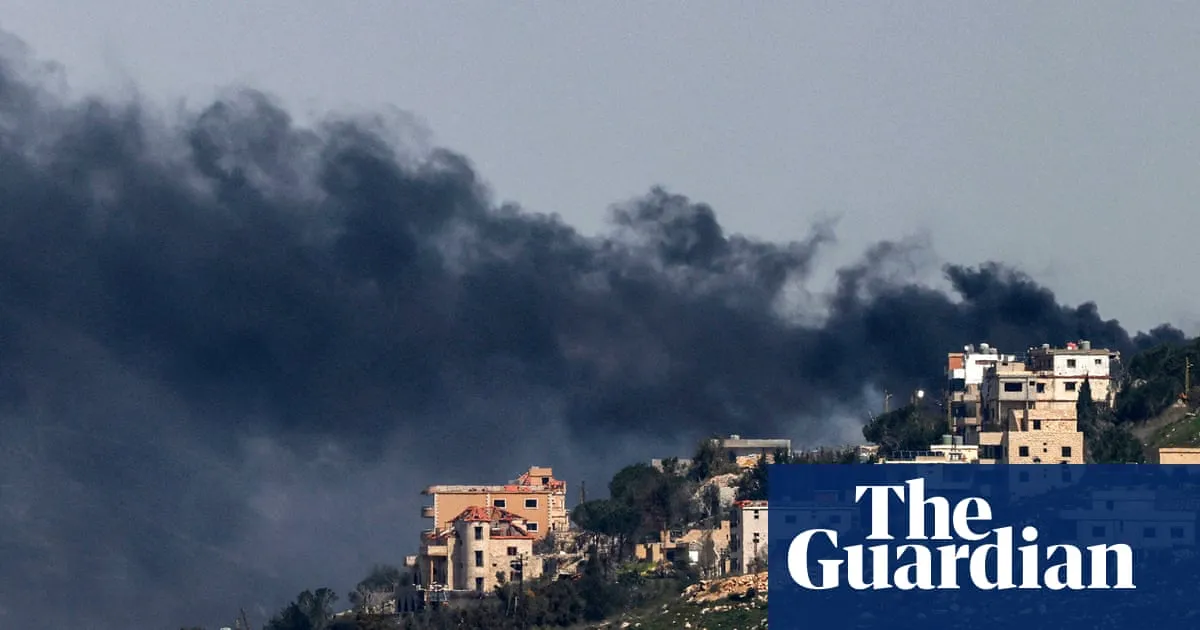
Israel and Hezbollah are engaged in intense ground clashes in at least three strategic areas in south Lebanon as Israel pushes on with its ground invasion of its neighbour, according to a Lebanese security source and residents of the affected towns.Much of the fighting was concentrated around the strategic hilltop city of Khiam, with the Israel-defense-forces" class="entity-link entity-organization" data-entity-id="391" data-entity-type="organization">Israel Defense Forces carrying out an air and artillery campaign against Hezbollah fighters dug into the city. Fighting escalated there after days of clashes, with a Hezbollah spokesperson acknowledging there were “heightened clashes” on the eastern and northern outskirts of the city.As fighting continued in Khiam, Israeli troops attempted to push into border towns in the central and western sectors of south Lebanon. A resident of the Aita al-Chaab border village said fighting was intense between Israeli soldiers and Hezbollah fighters there.A Lebanese security source said that the village was one of a number of border towns that had become the site of heavy fighting, as Israel tried to infiltrate southern Lebanon through various points along the shared border. There, they had been met with resistance by members of Hezbollah.The fighting came as Israel amassed troops along the border, bringing four brigades and columns of tanks ahead of an expanded ground invasion of south Lebanon. The Israeli military said that it had started a “limited ground operation”, as the political echelon discussed expanding the campaign.The war was triggered when Hezbollah launched rockets at Israel on 2 March. Israel quickly launched a military operation on Lebanon with the goal of completely eliminating Hezbollah. Hezbollah styled the war as one of survival for Lebanon, saying it was defending the country from the near-daily Israeli airstrikes on the country since the November 2024 ceasefire between the two parties. Outside Hezbollah’s constituency, the move to drag Lebanon into a war was deeply unpopular.The latest hostilities are a contest between Israel’s airpower and Hezbollah’s guerrilla fighters. Experts said the ground fighting in Lebanon was now centred on strategic axes, in particular Khiam, which could determine Hezbollah’s ability to fight off Israel’s invasion.“Khiam sits on a high plateau overlooking the Hula Valley and along key routes leading west towards the Israeli border,” said Ahmad Beydoun, a researcher at TU Delft specialising in open-source investigations of armed conflicts.Israel says it aims to create a buffer zone between Hezbollah’s operations in Lebanon and the border, to keep northern Israeli towns from the firing line. Photograph: Jalaa Marey/AFP/Getty ImagesIsraeli control of the hilltop would cut off Hezbollah’s supply lines to its fighters in south Lebanon. “Control of Khiam divides the central and eastern sectors south of the Litani [River], disrupting connectivity with the Bekaa valley,” Beydoun said.The Israeli military has targeted civilian infrastructure in south Lebanon to further cut off supply lines, hitting bridges crossing the Litani and major roads leading south. It has also struck medical centres and emergency workers, attacks that were designed to degrade the conditions of life in south Lebanon, rights groups said.The question of how Hezbollah has managed to preserve its presence south of the Litani, despite more than a year of the Lebanese army trying to disarm them, as well as near-daily strikes on fighters and weapons caches from Israel, has yet to be answered. Despite the intense pressure, Hezbollah has managed to put up a strong fight on the very frontlines of south Lebanon, using a mixture of anti-tank guided munitions, drones and artillery.To residents of south Lebanon, the question of disarmament seemed to be one debated only in thinktanks. On the ground, Hezbollah was still present, but kept a lower profile. Many of the residents of the villages themselves were members of the group. Now that Israel has invaded, many of them have started to fight.While Israel does have soldiers on the ground fighting Hezbollah, much of its operation is being conducted from the air. Photograph: Jalaa Marey/AFP/Getty Images“Hezbollah is now fighting on the ground. Every town in the south has at least a couple hundred fighters armed with anti-tank missiles. This won’t be an easy walk for Israel,” said Imad Salameh, the mayor of Khiam. He added that support for Hezbollah was widespread in the south and that weapons caches were distributed throughout the region.As Hezbollah clashed with Israel in Khiam, the IDF was pushing at the edges of the border. The Lebanese security source said it was exploiting the hilltops it occupied on its side of the border to bombard the Lebanese side as the soldiers tried to circle fighters.Moment building in central Beirut collapses after Israeli strike – videoIsrael was also creating “safe zones” along the Lebanese borders, where residents could stay as long as they self-policed to prevent Hezbollah infiltrating the village. A resident of Kafr Shouba, whose house was just a few meters from the border, said that on Monday night, Israeli forces raided his home and three others. He was pushed up against the wall by IDF soldiers as they searched for weapons in his house. When they left, they took one resident with them for interrogation, he said.The immediate goal of the Israeli campaign, according to former IDF officers, was to create a buffer zone in southern Lebanon which would push Hezbollah away from the border. While official objectives remain vague, military activity suggests a two-tier approach: the occupation of territory south of the Litani River, coupled with the creation of a surveillance-dominated zone to its north.Soldiers of the Lebanese army inspect the site of an Israeli attack on the village of Marjayoun. Photograph: AFP/Getty Images“The buffer zone is to make sure that the Israeli communities up north are out of the direct line of fire of anti-tank missiles and anti-tank guided missiles … to push the physical line that they can fire from further north,” said Miri Eisin, a former senior officer in the IDF combat intelligence corps and senior fellow at the International Institute for Counter-Terrorism.If Israel manages to push Hezbollah back from the Litani, it would then focus on the group’s presence north of the river. The armed group is firing most of its rockets and drones towards Israel from north of the river, while its members on the south side are concentrating their efforts on fighting Israeli soldiers.Israeli military experts warned that the idea of a buffer zone in south Lebanon would require a long-term occupation, which could in turn revive popular support for Hezbollah. At present, the group is domestically isolated and under pressure after dragging Lebanon into another war with Israel.“What is now unfolding is the renewed occupation of parts of southern Lebanon,” said Prof Yagil Levy, the head of the Open University Institute for the Study of Civil-Military Relations in Israel. “But this time, [Israel] seizes territory and removes the population, thereby ensuring full freedom of action and reducing the risk of guerrilla operations emerging from villages.”
SRCThe Guardian - World News
LANGEN
LEANCenter-Left
WORDS1 135
ENT9
WED · 2026-03-18 · 15:25 GMTBRIEF NSR-2026-0318-25726
NSR-2026-0318-25726News Report·EN·Conflict
Fighting intensifies between Israel and Hezbollah in southern Lebanon
Intense ground clashes have erupted between Israel and Hezbollah in southern Lebanon, particularly around the strategic city of Khiam and border towns like Aita al-Chaab. The fighting escalated as Israel advanced its ground invasion, deploying troops and tanks after Hezbollah initiated rocket attacks on March 2nd.
William Christou in Tyre, and Lorenzo Tondo in JerusalemThe Guardian - World NewsFiled 2026-03-18 · 15:25 GMTLean · Center-LeftRead · 5 min
The Guardian - World NewsFIG 01
Reading time
5min
Word count
1 135words
Sources cited
3cited
Entities identified
9entities
Quality score
100%
§ 01
Briefing Summary
AI-generatedNEWSAR · AI
Intense ground clashes have erupted between Israel and Hezbollah in southern Lebanon, particularly around the strategic city of Khiam and border towns like Aita al-Chaab. The fighting escalated as Israel advanced its ground invasion, deploying troops and tanks after Hezbollah initiated rocket attacks on March 2nd. Israel's military operation aims to eliminate Hezbollah, while Hezbollah claims it is defending Lebanon from Israeli airstrikes following the November 2024 ceasefire. The conflict is focused on strategic locations like Khiam, which controls key routes and could impact Hezbollah's ability to resist the Israeli invasion. The fighting involves Israel's airpower against Hezbollah's guerrilla tactics.
Confidence 0.90Sources 3Claims 5Entities 9
§ 02
Article analysis
Model · rule-basedFraming
Conflict
National Security
Tone
Measured
AI-assessed
CalmNeutralAlarmist
Factuality
0.70 / 1.00
Factual
LowHigh
Sources cited
3
Well sourced
FewMany
§ 03
Key claims
5 extracted01
Khiam sits on a high plateau overlooking the Hula Valley and along key routes leading west towards the Israeli border.
quoteAhmad Beydoun, researcher at TU Delft
Confidence
1.00
02
Hezbollah launched rockets at Israel on 2 March.
factual
Confidence
1.00
03
Fighting was concentrated around the strategic hilltop city of Khiam.
factual
Confidence
0.90
04
Israel and Hezbollah are engaged in intense ground clashes in at least three strategic areas in south Lebanon.
factualLebanese security source and residents
Confidence
0.90
05
Israel quickly launched a military operation on Lebanon with the goal of completely eliminating Hezbollah.
factual
Confidence
0.80
§ 04
Full report
5 min read · 1 135 words§ 05
Entities
9 identifiedKey playerOppositionContextPositiveNeutralNegative
People1
Organizations3
§ 06
Keywords & salience
10 termshezbollah
1.00
israel
1.00
ground clashes
0.90
southern lebanon
0.90
ground invasion
0.80
khiam
0.70
border towns
0.60
air strikes
0.60
military operation
0.50
strategic areas
0.40
§ 07
Topic connections
Interactive graph Network visualization showing 51 related topics
View Full Graph Person Organization Location Event|Click node to navigate|Edge numbers = shared articles