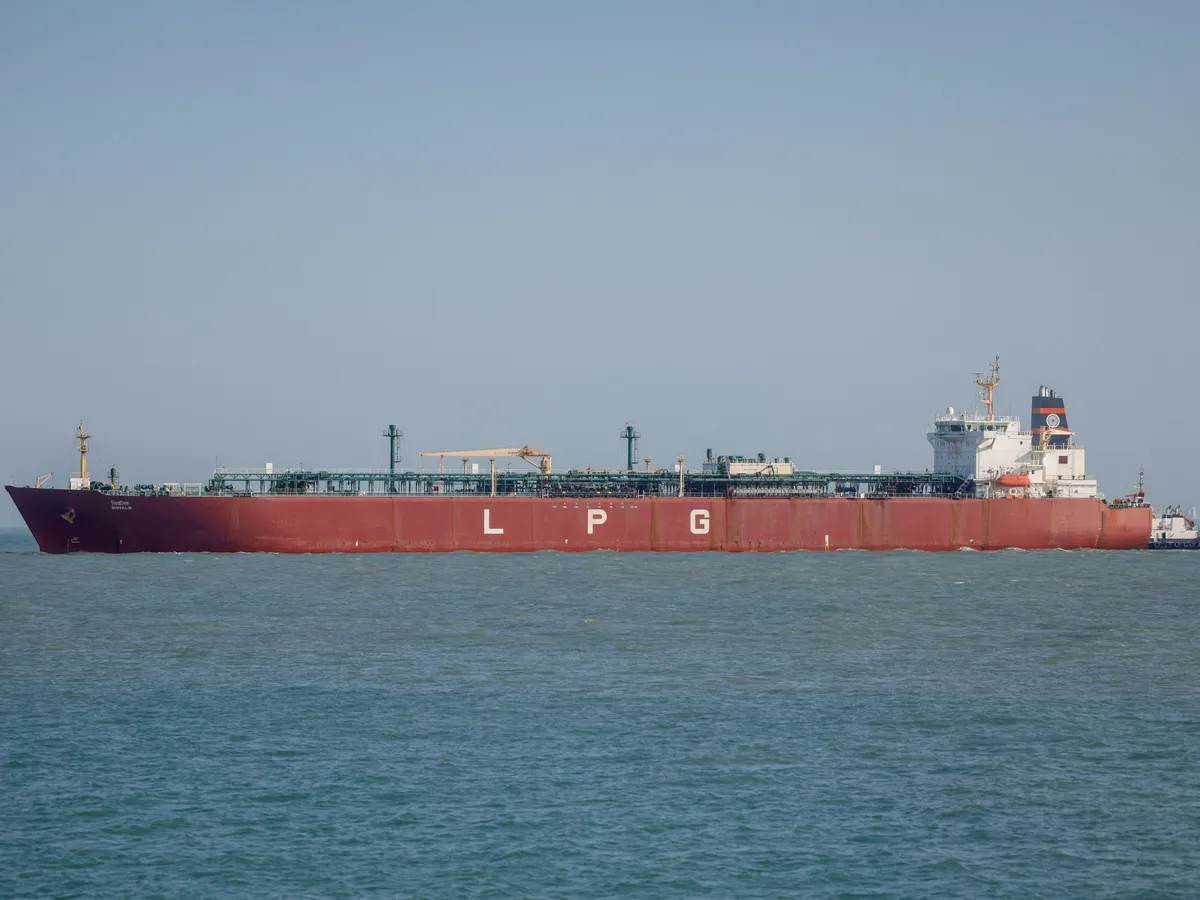
Lifting the Jones Act temporarily allows foreign ships to transport cargo across the US, but critics question the move’s efficacy.An Indian tanker, the Shivalik, arrives at Gujarat, India, via the Strait of Hormuz on March 16 [File: Amit Dave/Reuters]Published On 18 Mar 2026United States President Donald Trump has waived a more than century-old maritime shipping law in an effort to quell rising fuel costs amid the ongoing US and Israeli war against Iran.On Wednesday, the White House issued a 60-day waiver to lift the Jones Act, which would allow foreign-flagged vessels to transport cargo to US ports.Recommended Stories list of 4 itemslist 1 of 4Cuba restores power after 29-hour blackout amid US oil blockadelist 2 of 4Qatar can keep goods flowing amid tensions, customs chief sayslist 3 of 4Not just energy: How the Iran war could trigger a global food crisislist 4 of 4Amid ruins, Palestinians struggle to preserve Gaza’s historic marketsend of listNormally, under the Jones Act, goods shipped between US ports must be carried on vessels that are US-built, US-flagged and mostly US-owned. The requirement sharply limits the number of tankers available for domestic shipments but is supported by maritime industry unions.Those industry groups questioned whether Wednesday’s waiver would be effective in lowering fuel costs.“Waiving the Jones Act would do nothing to reduce gasoline [petrol] prices. In fact, the primary driver of gasoline prices is the cost of crude oil, not domestic shipping costs,” leaders from American Maritime Officers, a maritime labour union, said in a letter to President Trump earlier this month.“A Jones Act waiver would instead create opportunities for foreign-flag operators that avoid paying US taxes, rely heavily on low-wage labor, and operate under regulatory regimes that circumvent international labor and vessel safety standards.”But the Trump administration defended the waiver as a temporary measure that could reduce shipping costs and speed up deliveries.“This action will allow vital resources like oil, natural gas, fertilizer, and coal to flow freely to US ports for sixty days, and the Administration remains committed to continuing to strengthen our critical supply chains,” White House press secretary Karoline Leavitt told Al Jazeera in a statement.The move comes less than three weeks into the US-and-Israeli-led war against Iran.As part of its counteroffensive, Iran has largely blocked shipping through the Strait of Hormuz, a narrow waterway that connects the Gulf to the Indian Ocean.Roughly a fifth of the world’s oil and liquefied natural gas supply passes through that trade route.But since the war began on February 28, the number of tankers in the strait has dropped. Only about 90 ships have passed through the passage since the war began, and 20 ships have been attacked in the area.More than 400 vessels are still stranded near the passage, according to Kpler, a global market intelligence platform. That blockage has, in turn, caused the price of fuel to spike worldwide.To bring prices down domestically, Trump has already indicated he would release 172 million barrels of oil from the US government’s Strategic Petroleum Reserve, a supply kept for emergencies.Rachel Ziemba, a senior fellow at the think tank Center for a New American Security, said the Jones Act waiver is designed to support that move — but it will have limited impact on global price fluctuations.“The waiver of the Jones Act helps to make the Strategic Petroleum Reserve release more effective and reduces the costs of getting fuel from the Gulf Coast to other parts of the US,” Ziemba said.“It won’t add supplies on its own, though — just mitigates some friction of getting supplies to the Northeast and, to an extent, the Pacific coasts and US territories.”Costs jumpThe cost of shipping has also increased since the war began. Maritime insurance costs have surged across the board, in some cases by more than 1,000 percent, according to a Reuters analysis.That comes in addition to the surge in fuel prices, as global oil supply is strained. The average price for a gallon of petrol in the US is $3.84, up from $2.92 ($1.01 per litre from $0.77 per litre) this time last month, according to the American Automobile Association (AAA).But changes at the petrol pump as a result of the Jones Act waiver will likely be negligible, according to experts.“The waiver will simplify logistics, making it slightly cheaper and easier for products to flow, mainly from the Gulf to the US Northeast,” said Patrick De Haan, the head of petroleum analysis at GasBuddy, an app that tracks fuel costs.But De Haan warned not to expect steep price drops from the waiver.“It won’t have a ‘visible’ impact in reducing prices at the pump as of now; it will merely offset rising retail prices. I estimate it may offset 3 to 10 cents per gallon ($0.007 to $0.02 per litre) of price increases,” he said.That assessment was echoed by 2022 analysis, which found that a Jones Act waiver would only save drivers on the US East Coast about 10 cents per gallon.Others believe that there will not be an impact for consumers at all.David St Amand, the president of the maritime consulting firm Navigistics Consulting, explained the cost breakdown in a statement to Al Jazeera.“A Jones Act waiver is unlikely to reduce the price of gasoline at the pump, and any claims of a material – eg, $0.05 – benefit to US consumers is not possible. Any benefit would almost certainly flow to new entrants to the market – eg, commodity traders,” St Amand said.US markets are trending downward following news of the Jones Act waiver. The Nasdaq and the S&P 500 are both down 0.5 percent, while the Dow Jones Industrial Average is down 0.8 percent in midday trading.Meanwhile, shipping giants are seeing a surge in their stocks on the heels of the news.Shares for the logistics company Maersk, which previously suspended shipments through the Strait of Hormuz following the strikes, are up 2.5 percent. Hapag-Lloyd AG, a container company that also suspended shipments, is up 2.6 percent.
SRCAl Jazeera
LANGEN
LEANCenter
WORDS988
ENT11
WED · 2026-03-18 · 17:56 GMTBRIEF NSR-2026-0318-25741
NSR-2026-0318-25741News Report·EN·Economic Impact
Trump temporarily waives century-old shipping law amid rising fuel costs
Amid the ongoing US and Israeli war against Iran, President Trump temporarily waived the Jones Act for 60 days. The Jones Act requires goods shipped between US ports to be carried on US-built, US-flagged, and US-owned vessels.
Al Jazeera StaffAl JazeeraFiled 2026-03-18 · 17:56 GMTLean · CenterRead · 4 min
Al JazeeraFIG 01
Reading time
4min
Word count
988words
Sources cited
4cited
Entities identified
11entities
Quality score
100%
§ 01
Briefing Summary
AI-generatedNEWSAR · AI
Amid the ongoing US and Israeli war against Iran, President Trump temporarily waived the Jones Act for 60 days. The Jones Act requires goods shipped between US ports to be carried on US-built, US-flagged, and US-owned vessels. This waiver, issued on March 18, 2026, allows foreign-flagged ships to transport cargo to US ports in an effort to lower rising fuel costs. The administration defends the move as a way to ensure vital resources flow freely, while maritime industry groups question its effectiveness, arguing that crude oil prices, not domestic shipping costs, are the primary driver of gasoline prices. Iran's counteroffensive has largely blocked shipping through the Strait of Hormuz.
Confidence 0.90Sources 4Claims 5Entities 11
§ 02
Article analysis
Model · rule-basedFraming
Economic Impact
Political Strategy
Tone
Mixed Tone
AI-assessed
CalmNeutralAlarmist
Factuality
0.70 / 1.00
Factual
LowHigh
Sources cited
4
Well sourced
FewMany
§ 03
Key claims
5 extracted01
Roughly a fifth of the world’s oil and liquefied natural gas supply passes through the Strait of Hormuz.
statisticnull
Confidence
1.00
02
Trump waived the Jones Act for 60 days to quell rising fuel costs amid the US and Israeli war against Iran.
factualnull
Confidence
1.00
03
The primary driver of gasoline prices is the cost of crude oil, not domestic shipping costs.
quoteleaders from American Maritime Officers
Confidence
0.90
04
Waiving the Jones Act would do nothing to reduce gasoline prices.
quoteleaders from American Maritime Officers
Confidence
0.90
05
This action will allow vital resources like oil, natural gas, fertilizer, and coal to flow freely to US ports.
quoteWhite House press secretary Karoline Leavitt
Confidence
0.80
§ 04
Full report
4 min read · 988 words§ 05
Entities
11 identifiedKey playerOppositionContextPositiveNeutralNegative
§ 06
Keywords & salience
9 termsjones act
1.00
fuel costs
0.80
maritime shipping
0.70
us ports
0.60
foreign-flagged vessels
0.60
us-iran war
0.50
shipping law
0.50
strait of hormuz
0.50
supply chains
0.40
§ 07
Topic connections
Interactive graph Network visualization showing 51 related topics
View Full Graph Person Organization Location Event|Click node to navigate|Edge numbers = shared articles