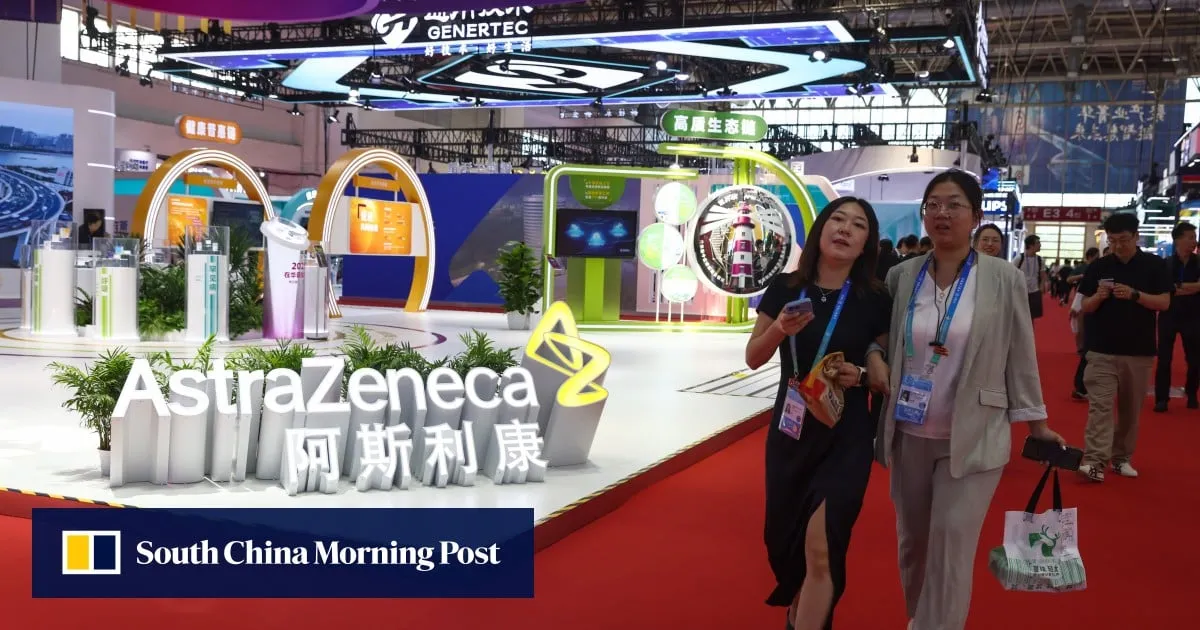
AstraZeneca said it would establish drug manufacturing facilities in Guangzhou and Shanghai as well as a separate innovation centre in Shanghai, joining a group of foreign players building new plants in China amid geopolitical tensions.The moves are part of a US$15 billion commitment the British firm pledged to make in the world’s second-largest drug market through 2030, unveiled during UK Prime Minister Keir Starmer’s visit to Beijing in January.China’s manufacturing capabilities, integrated supply chain and cost advantages were drawing multinationals to produce locally, said Zhang Jialin, head of China healthcare research at Nomura. “Beyond their long-term commitment to the China market, technical know-how and quality advantages are key considerations driving these companies to build here.”On Thursday, AstraZeneca signed a memorandum of understanding with Guangzhou authorities to build a radioconjugate drug manufacturing site, which would produce next-generation cancer drugs for patients in China and the broader Asia-Pacific region, according to a statement on its website.The new facility will be in the Guangzhou Economic and Technological Development Zone, a state-designated industrial district spanning 17.67 sq km in Huangpu district, east of the city centre. It will specialise in producing an actinium-225-based radioconjugate for prostate cancer treatment.A view of the AstraZeneca building in Macclesfield, central England on May 11, 2021. Photo: AFPSeparately, AstraZeneca said it planned to build a cell therapy production base in Shanghai’s Lingang Special Area, a government-designated free-trade zone designed to attract advanced manufacturing and hi-tech industries, as well as an innovation centre at Zhangjiang Hi-Tech Park, a life sciences and tech hub in the Pudong district that is home to hundreds of pharmaceutical and biotech companies.
SRCSouth China Morning Post
LANGEN
LEANCenter-Right
WORDS267
ENT10
FRI · 2026-03-20 · 06:30 GMTBRIEF NSR-2026-0320-26232
NSR-2026-0320-26232News Report·EN·Economic Impact
Global drug giants double down on China amid trend to build self-reliant supply chains
AstraZeneca is investing $15 billion in China by 2030, establishing new drug manufacturing facilities in Guangzhou and Shanghai, and an innovation center in Shanghai. This move, announced during UK Prime Minister Keir Starmer's visit, reflects a trend of foreign pharmaceutical companies increasing local production in China.
Julie ZhangSouth China Morning PostFiled 2026-03-20 · 06:30 GMTLean · Center-RightRead · 2 min
South China Morning PostFIG 01
Reading time
2min
Word count
267words
Sources cited
1cited
Entities identified
10entities
Quality score
100%
§ 01
Briefing Summary
AI-generatedNEWSAR · AI
AstraZeneca is investing $15 billion in China by 2030, establishing new drug manufacturing facilities in Guangzhou and Shanghai, and an innovation center in Shanghai. This move, announced during UK Prime Minister Keir Starmer's visit, reflects a trend of foreign pharmaceutical companies increasing local production in China. The Guangzhou facility will produce radioconjugate cancer drugs for China and the Asia-Pacific region, while the Shanghai plant will focus on cell therapy. The innovation center will be located in the Zhangjiang Hi-Tech Park. These investments are driven by China's manufacturing capabilities, integrated supply chain, cost advantages, and the companies' long-term commitment to the Chinese market.
Confidence 0.90Sources 1Claims 5Entities 10
§ 02
Article analysis
Model · rule-basedFraming
Economic Impact
Political Strategy
Tone
Measured
AI-assessed
CalmNeutralAlarmist
Factuality
0.80 / 1.00
Factual
LowHigh
Sources cited
1
Limited
FewMany
§ 03
Key claims
5 extracted01
AstraZeneca plans to build a cell therapy production base in Shanghai’s Lingang Special Area.
factualnull
Confidence
1.00
02
AstraZeneca signed a memorandum of understanding with Guangzhou authorities to build a radioconjugate drug manufacturing site.
factualnull
Confidence
1.00
03
The moves are part of a US$15 billion commitment AstraZeneca pledged to make in China through 2030.
factualnull
Confidence
1.00
04
AstraZeneca will establish drug manufacturing facilities in Guangzhou and Shanghai and an innovation centre in Shanghai.
factualnull
Confidence
1.00
05
China’s manufacturing capabilities, integrated supply chain and cost advantages were drawing multinationals to produce locally.
quoteZhang Jialin, head of China healthcare research at Nomura
Confidence
0.90
§ 04
Full report
2 min read · 267 words§ 05
Entities
10 identifiedKey playerOppositionContextPositiveNeutralNegative
Organizations2
§ 06
Keywords & salience
10 termschina
0.90
drug manufacturing
0.90
astrazeneca
0.80
supply chains
0.70
pharmaceutical
0.60
innovation center
0.60
foreign investment
0.50
cancer drugs
0.50
radioconjugate
0.40
cell therapy
0.40
§ 07
Topic connections
Interactive graph Network visualization showing 15 related topics
View Full Graph Person Organization Location Event|Click node to navigate|Edge numbers = shared articles