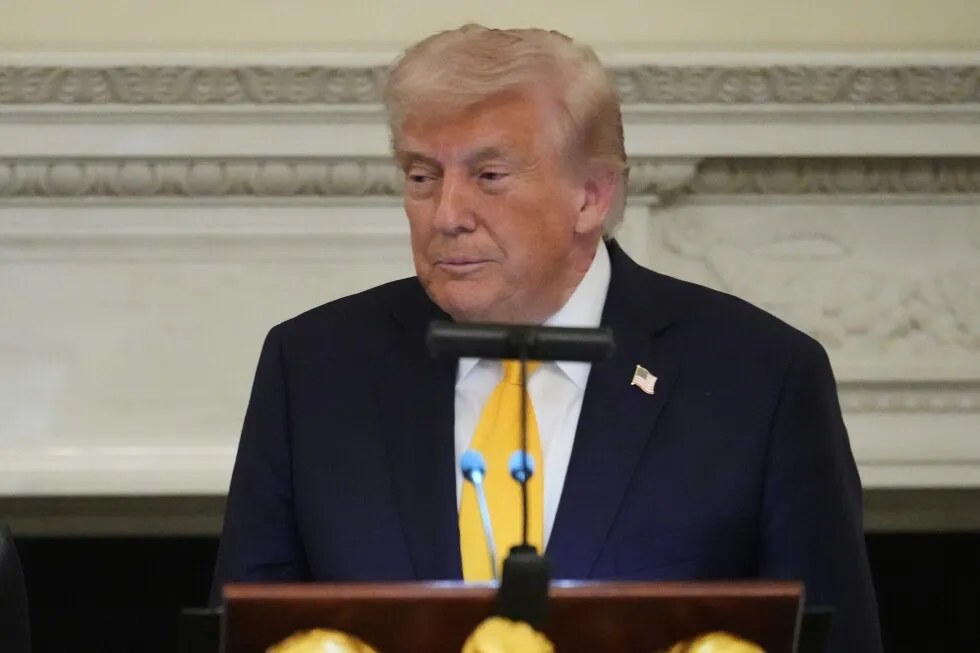
President Donald Trump speaks at a dinner with Japan’s Prime Minister Sanae Takaichi in the State Dining Room of the White House, Thursday, March 19, 2026, in Washington. (AP Photo/Julia Demaree Nikhinson) Updated [hour]:[minute] [AMPM] [timezone], [monthFull] [day], [year] WASHINGTON (AP) — The White House said on Friday that Congress should “preempt state AI laws” that it views as too burdensome, laying out a broad framework for how it wants Congress to address concerns about artificial intelligence without curbing growth or innovation in the sector. The legislative blueprint outlines a half-dozen guiding principles for lawmakers, focusing on protecting children, preventing electricity costs from surging, respecting intellectual property rights, preventing censorship and educating Americans on using the technology.The announcement comes as state governments have forged ahead on their own regulations for AI while civil liberties and consumer rights groups lobby for more regulations on the powerful technology. But the industry and the White House have pushed back, arguing that a patchwork of rules would hurt growth. Trump signed an executive order in December to block states from crafting their own regulations. “This was in response to a growing patchwork of 50 different state regulatory regimes that threaten to stifle innovation and jeopardize America’s lead in the AI race,” said White House AI czar David Sacks in a social media post Wednesday. Sacks said the next step is to work with Congress to turn the administration’s principles into federal legislation. Four states — Colorado, California, Utah and Texas — have already passed laws that set some rules for AI across the private sector, but the White House is calling for “strong federal leadership” to make sure the public can trust how artificial intelligence is being used in their lives. The state-level laws include limiting collection of certain personal information and requiring more transparency from companies. As backlash against data centers has increased along with rising power prices, the White House had previously stepped up pressure on AI companies and the power sector to do more to address the issue -- including having AI companies sign voluntary pledges earlier this month to build their own power generation plants. The Trump administration says it doesn’t think Congress should preempt all state regulatory powers over AI, including enforcement of general laws against AI developers, “to protect children, prevent fraud, and protect consumers.” It also says Congress shouldn’t interfere with local authorities in deciding where to place data centers and other AI infrastructure, or how states procure their own AI tools for law enforcement or education. However, it says states “should not be permitted to regulate AI development,” shouldn’t penalize AI developers for a third party’s unlawful conduct using their product, and “should not unduly burden Americans’ use of AI for activity that would be lawful if performed without AI.”The framework recommends against wading into the legal fights between artists and creators and the technology companies that have ingested huge amounts of copyrighted works to build AI systems that can generate new text, images and sound.The Trump administration “believes that training of AI models on copyrighted material does not violate copyright laws,” according to the document, but acknowledges “arguments to the contrary exist and therefore supports allowing the Courts to resolve this issue.” There are dozens of lawsuits pending from writers and publishers, visual artists, music record labels and others. Judges have largely sided with AI developers in allowing for the “fair use” of copyrighted works to create something new, but some have questioned how the materials were obtained. A federal judge in September approved a $1.5 billion settlement between artificial intelligence company Anthropic and authors who allege nearly half a million books had been illegally pirated to train its chatbot.O’Brien reported from Providence, Rhode Island. Kim covers the White House for The Associated Press. She joined the AP in 2022 and is based in Washington. Kim is also a political analyst for CNN. O’Brien covers the business of technology and artificial intelligence for The Associated Press.
SRCAssociated Press (AP)
LANGEN
LEANCenter
WORDS661
ENT10
FRI · 2026-03-20 · 13:53 GMTBRIEF NSR-2026-0320-26389
NSR-2026-0320-26389News Report·EN·Economic Impact
White House urges Congress to take a light touch on AI regulations in new legislative blueprint
The White House is urging Congress to take a "light touch" on AI regulations, releasing a legislative blueprint that prioritizes federal oversight to preempt potentially burdensome state laws. The administration, under President Trump, argues that a patchwork of state regulations would stifle innovation and hinder America's leadership in AI.
By
SEUNG MIN KIM and MATT O’BRIENAssociated Press (AP)Filed 2026-03-20 · 13:53 GMTLean · CenterRead · 3 min
Associated Press (AP)FIG 01
Reading time
3min
Word count
661words
Sources cited
2cited
Entities identified
10entities
Quality score
100%
§ 01
Briefing Summary
AI-generatedNEWSAR · AI
The White House is urging Congress to take a "light touch" on AI regulations, releasing a legislative blueprint that prioritizes federal oversight to preempt potentially burdensome state laws. The administration, under President Trump, argues that a patchwork of state regulations would stifle innovation and hinder America's leadership in AI. The blueprint outlines principles for Congress, including protecting children, preventing electricity cost surges, respecting intellectual property, preventing censorship, and educating the public. While some states like Colorado, California, Utah, and Texas have already enacted AI regulations, the White House advocates for strong federal leadership to ensure public trust in AI. The administration's move follows an executive order blocking states from crafting their own regulations and voluntary pledges from AI companies to address rising power prices.
Confidence 0.90Sources 2Claims 5Entities 10
§ 02
Article analysis
Model · rule-basedFraming
Economic Impact
Political Strategy
Tone
Measured
AI-assessed
CalmNeutralAlarmist
Factuality
0.70 / 1.00
Factual
LowHigh
Sources cited
2
Limited
FewMany
§ 03
Key claims
5 extracted01
The Trump administration says Congress shouldn’t preempt all state regulatory powers over AI.
factualArticle
Confidence
1.00
02
Four states — Colorado, California, Utah and Texas — have already passed laws that set some rules for AI.
factualArticle
Confidence
1.00
03
Trump signed an executive order in December to block states from crafting their own regulations.
factualArticle
Confidence
1.00
04
The White House wants Congress to preempt state AI laws viewed as too burdensome.
factualArticle
Confidence
1.00
05
This was in response to a growing patchwork of 50 different state regulatory regimes that threaten to stifle innovation.
quoteDavid Sacks
Confidence
0.90
§ 04
Full report
3 min read · 661 words§ 05
Entities
10 identifiedKey playerOppositionContextPositiveNeutralNegative
People3
Locations6
§ 06
Keywords & salience
9 termsai regulations
1.00
artificial intelligence
0.90
state ai laws
0.80
federal legislation
0.70
white house
0.70
innovation
0.60
data centers
0.50
intellectual property
0.50
power sector
0.40
§ 07
Topic connections
Interactive graph No topic relationship data available yet. This graph will appear once topic relationships have been computed.