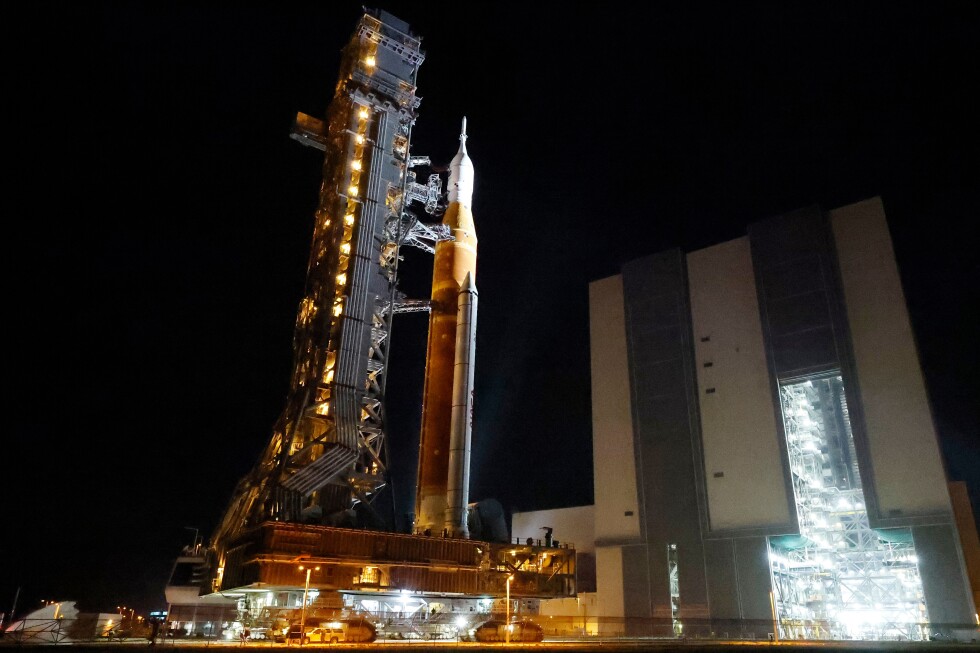
NASA hauls its repaired moon rocket from the hangar back to the pad for an early April launch 1 of 5 | The NASA Artemis II rocket with the Orion spacecraft aboard leaves the Vehicle Assembly Building moving slowly to pad 39B at the Kennedy Space Center in Cape Canaveral, Fla., Friday, March 20, 2026. (AP Photo/Terry Renna) 2 of 5 | The NASA Artemis II rocket with the Orion spacecraft aboard leaves the Vehicle Assembly Building moving slowly to pad 39B at the Kennedy Space Center in Cape Canaveral, Fla., Friday, March 20, 2026. (AP Photo/Terry Renna) 3 of 5 | The NASA Artemis II rocket with the Orion spacecraft aboard leaves the Vehicle Assembly Building moving slowly to pad 39B at the Kennedy Space Center in Cape Canaveral, Fla., Friday, March 20, 2026. (AP Photo/Terry Renna) 4 of 5 | The NASA Artemis II rocket with the Orion spacecraft aboard leaves the Vehicle Assembly Building moving slowly to pad 39B at the Kennedy Space Center in Cape Canaveral, Fla., Friday, March 20, 2026. (AP Photo/Terry Renna) 5 of 5 | The Orion spacecraft sits on top of the NASA Artemis II rocket in the Vehicle Assembly Building before rollout to pad 39B at the Kennedy Space Center in Cape Canaveral, Fla., Thursday, March 19, 2026. (AP Photo/Terry Renna) 1 of 5 The NASA Artemis II rocket with the Orion spacecraft aboard leaves the Vehicle Assembly Building moving slowly to pad 39B at the Kennedy Space Center in Cape Canaveral, Fla., Friday, March 20, 2026. (AP Photo/Terry Renna) Add AP News on Google Add AP News as your preferred source to see more of our stories on Google. 2 of 5 The NASA Artemis II rocket with the Orion spacecraft aboard leaves the Vehicle Assembly Building moving slowly to pad 39B at the Kennedy Space Center in Cape Canaveral, Fla., Friday, March 20, 2026. (AP Photo/Terry Renna) Add AP News on Google Add AP News as your preferred source to see more of our stories on Google. 3 of 5 The NASA Artemis II rocket with the Orion spacecraft aboard leaves the Vehicle Assembly Building moving slowly to pad 39B at the Kennedy Space Center in Cape Canaveral, Fla., Friday, March 20, 2026. (AP Photo/Terry Renna) Add AP News on Google Add AP News as your preferred source to see more of our stories on Google. 4 of 5 The NASA Artemis II rocket with the Orion spacecraft aboard leaves the Vehicle Assembly Building moving slowly to pad 39B at the Kennedy Space Center in Cape Canaveral, Fla., Friday, March 20, 2026. (AP Photo/Terry Renna) Add AP News on Google Add AP News as your preferred source to see more of our stories on Google. 5 of 5 The Orion spacecraft sits on top of the NASA Artemis II rocket in the Vehicle Assembly Building before rollout to pad 39B at the Kennedy Space Center in Cape Canaveral, Fla., Thursday, March 19, 2026. (AP Photo/Terry Renna) Add AP News on Google Add AP News as your preferred source to see more of our stories on Google. Updated [hour]:[minute] [AMPM] [timezone], [monthFull] [day], [year] Cape Canaveral, Fla. (AP) — For the second time this year, NASA moved its moon rocket from the hangar out toward the pad Friday in hopes of launching four astronauts on a lunar fly-around next month. If the latest repairs work and everything else goes NASA’s way, the Space Launch System could blast off as early as April 1 from Florida’s Kennedy Space Center. The Artemis II crew went into quarantine this week in Houston.The 322-foot (98-meter) rocket began the slow 4-mile (6.4-kilometer) trek in the middle of the night, transported atop a massive crawler used since the 1960s Apollo era. It was expected to take 12 hours. The trip was held up for several hours by high wind.The three Americans and one Canadian will zip around the moon in their capsule and then come straight home without stopping. Their mission should have been completed by now, but hydrogen fuel leaks and clogged helium lines forced two months of delay. While technicians plugged the leaks at the pad, the helium issue could only be fixed in the Vehicle Assembly Building, forcing NASA to roll the rocket back at the end of February. The last time NASA sent astronauts to the moon was during Apollo 17 in 1972. The new Artemis program aims for a two-person landing in 2028.___The Associated Press Health and Science Department receives support from the Howard Hughes Medical Institute’s Department of Science Education and the Robert Wood Johnson Foundation. The AP is solely responsible for all content.
SRCAssociated Press (AP)
LANGEN
LEANCenter
WORDS774
ENT10
FRI · 2026-03-20 · 12:53 GMTBRIEF NSR-2026-0320-26390
NSR-2026-0320-26390News Report·EN·Technology
NASA hauls its repaired moon rocket from the hangar back to the pad for an early April launch
NASA's repaired Artemis II rocket, with the Orion spacecraft, was transported from the Vehicle Assembly Building to pad 39B at the Kennedy Space Center in Cape Canaveral, Florida, on Friday, March 20, 2026. This move prepares the rocket for a planned launch in early April.
By
MARCIA DUNNAssociated Press (AP)Filed 2026-03-20 · 12:53 GMTLean · CenterRead · 4 min
Associated Press (AP)FIG 01
Reading time
4min
Word count
774words
Sources cited
0cited
Entities identified
10entities
Quality score
100%
§ 01
Briefing Summary
AI-generatedNEWSAR · AI
NASA's repaired Artemis II rocket, with the Orion spacecraft, was transported from the Vehicle Assembly Building to pad 39B at the Kennedy Space Center in Cape Canaveral, Florida, on Friday, March 20, 2026. This move prepares the rocket for a planned launch in early April. The Artemis II mission is part of NASA's broader program to return humans to the moon. The rocket's relocation to the launchpad follows repairs and maintenance conducted in the hangar. The launch aims to further test the Orion spacecraft and pave the way for future lunar missions.
Confidence 0.90Claims 5Entities 10
§ 02
Article analysis
Model · rule-basedFraming
Technology
Tone
Measured
AI-assessed
CalmNeutralAlarmist
Factuality
0.90 / 1.00
Factual
LowHigh
Sources cited
0
No named sources
FewMany
§ 03
Key claims
5 extracted01
The Orion spacecraft sits on top of the NASA Artemis II rocket in the Vehicle Assembly Building on Thursday, March 19, 2026.
factualnull
Confidence
1.00
02
The Orion spacecraft sits on top of the NASA Artemis II rocket in the Vehicle Assembly Building before rollout to pad 39B
factualnull
Confidence
1.00
03
This event occurred at the Kennedy Space Center in Cape Canaveral, Fla., Friday, March 20, 2026.
factualnull
Confidence
1.00
04
The NASA Artemis II rocket with the Orion spacecraft aboard leaves the Vehicle Assembly Building moving slowly to pad 39B
factualnull
Confidence
1.00
05
NASA hauls its repaired moon rocket from the hangar back to the pad for an early April launch
factualnull
Confidence
1.00
§ 04
Full report
4 min read · 774 words§ 05
Entities
10 identifiedKey playerOppositionContextPositiveNeutralNegative
Organizations3
Locations5
§ 06
Keywords & salience
10 termsmoon rocket
0.90
nasa
0.80
artemis ii
0.80
launch
0.70
spacecraft
0.60
orion spacecraft
0.60
pad 39b
0.50
vehicle assembly building
0.50
kennedy space center
0.50
cape canaveral
0.40
§ 07
Topic connections
Interactive graph Network visualization showing 38 related topics
View Full Graph Person Organization Location Event|Click node to navigate|Edge numbers = shared articles