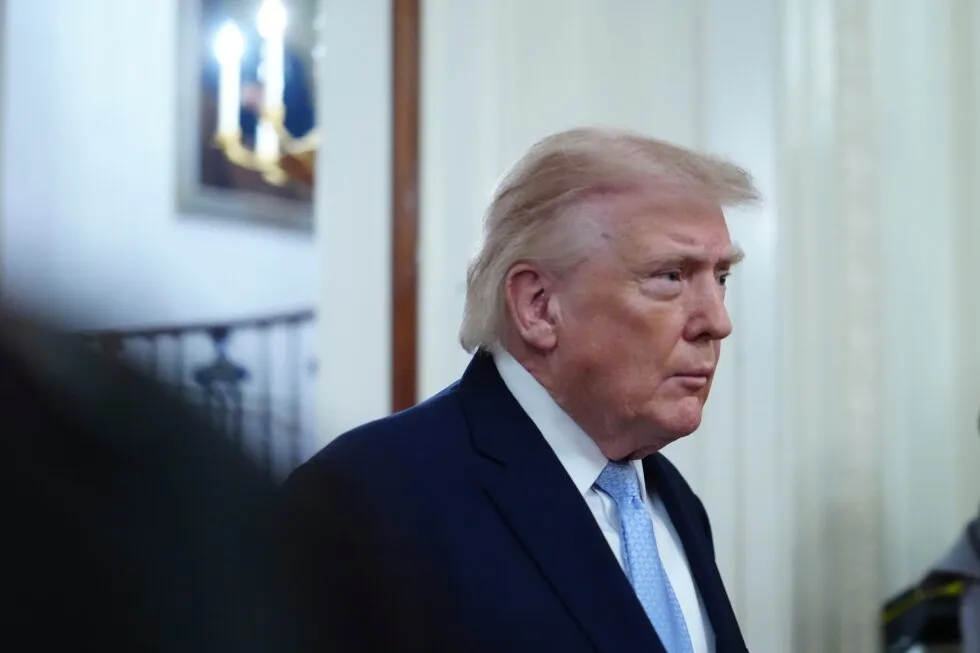
Trump administration sues Harvard, saying it violated civil rights law and seeking to recover funds 1 of 2 | President Donald Trump arriving to speak at the Commander-in-Chief’s Trophy presentation with the Navy Midshipmen football team in the East Room of the White House, Friday, March 20, 2026, in Washington. (AP Photo/Julia Demaree Nikhinson) 2 of 2 | El presidente Donald Trump en la Casa Blanca en Washington el 19 de marzo del 2026. (AP foto/Julia Demaree Nikhinson) 1 of 2 President Donald Trump arriving to speak at the Commander-in-Chief’s Trophy presentation with the Navy Midshipmen football team in the East Room of the White House, Friday, March 20, 2026, in Washington. (AP Photo/Julia Demaree Nikhinson) Add AP News on Google Add AP News as your preferred source to see more of our stories on Google. 2 of 2 El presidente Donald Trump en la Casa Blanca en Washington el 19 de marzo del 2026. (AP foto/Julia Demaree Nikhinson) Add AP News on Google Add AP News as your preferred source to see more of our stories on Google. Updated [hour]:[minute] [AMPM] [timezone], [monthFull] [day], [year] WASHINGTON (AP) — The Justice Department filed a new lawsuit Friday against Harvard University, saying its leadership failed to address antisemitism on campus, creating grounds for the government to freeze existing grants and seek repayment for grants already paid.The lawsuit, filed in federal court in Massachusetts, is another missive in a protracted battle between the administration of President Donald Trump and the elite university.“The United States cannot and will not tolerate these failures and brings this action to compel Harvard to comply” with federal civil rights law, the Justice Department wrote in the lawsuit, “and to recover billions of dollars of taxpayer subsidies awarded to a discriminatory institution.”Harvard did not immediately respond to a request for comment. The lawsuit comes after negotiations appear to have bogged down in the months-long battle with the Trump administration that has tested the boundaries of the government’s authority over America’s universities. What began as an investigation into campus antisemitism escalated into an all-out feud as the Trump administration slashed more than $2.6 billion in research funding, ended federal contracts and attempted to block Harvard from hosting international students. In a pair of lawsuits filed by the university, Harvard has said it’s being unfairly penalized for refusing to adopt the administration’s views. A federal judge agreed in December, reversing the funding cuts and calling the antisemitism argument a “smokescreen.” Even so, Harvard and the Trump administration have held some negotiations, and the two sides have reportedly been close to reaching an agreement on multiple occasions. Last year, the administration and the university were reportedly approaching a deal that would have required Harvard to pay $500 million to regain access to federal funding and to end the investigations. Almost a year later, Trump upped that figure to $1 billion, saying that Harvard has been “behaving very badly.” At the same time, the administration was taking steps in a civil rights investigation that had the potential to jeopardize all of Harvard’s federal funding, including federal student aid. In June, the Trump administration said a civil rights investigation had led to a formal finding that Harvard tolerated antisemitism. In a letter sent to Harvard, a federal task force said its investigation had found the university was a “willful participant” in antisemitic harassment of Jewish students and faculty. The task force threatened to refer the case to the Justice Department to file a civil rights lawsuit “as soon as possible,” unless Harvard came into compliance.Harvard responded that it strongly disagreed with the government’s findings and was committed to fighting bias.“Antisemitism is a serious problem and no matter the context, it is unacceptable,” the university said in a statement. “Harvard has taken substantive, proactive steps to address the root causes of antisemitism in its community.”
SRCAssociated Press (AP)
LANGEN
LEANCenter
WORDS641
ENT6
FRI · 2026-03-20 · 15:23 GMTBRIEF NSR-2026-0320-26419
NSR-2026-0320-26419News Report·EN·Legal & Judicial
Trump administration sues Harvard, saying it violated civil rights law and seeking to recover funds
In March 2026, the Trump administration's Justice Department filed a lawsuit against Harvard University, alleging the university failed to address antisemitism on campus, violating federal civil rights law. The lawsuit, filed in federal court in Massachusetts, seeks to freeze existing grants and recover billions of dollars in taxpayer subsidies already awarded to the institution.
By
MORIAH BALINGIT and MICHAEL CASEYAssociated Press (AP)Filed 2026-03-20 · 15:23 GMTLean · CenterRead · 3 min
Associated Press (AP)FIG 01
Reading time
3min
Word count
641words
Sources cited
0cited
Entities identified
6entities
Quality score
100%
§ 01
Briefing Summary
AI-generatedNEWSAR · AI
In March 2026, the Trump administration's Justice Department filed a lawsuit against Harvard University, alleging the university failed to address antisemitism on campus, violating federal civil rights law. The lawsuit, filed in federal court in Massachusetts, seeks to freeze existing grants and recover billions of dollars in taxpayer subsidies already awarded to the institution. The Justice Department claims the U.S. cannot tolerate Harvard's failures to comply with civil rights law. This action follows a protracted battle between the Trump administration and Harvard, escalating from an investigation into campus antisemitism to disputes over research funding, federal contracts, and international students. Harvard has previously filed lawsuits claiming unfair penalization for refusing to adopt the administration's definition of antisemitism.
Confidence 0.90Claims 5Entities 6
§ 02
Article analysis
Model · rule-basedFraming
Legal & Judicial
Political Strategy
Tone
Measured
AI-assessed
CalmNeutralAlarmist
Factuality
0.80 / 1.00
Factual
LowHigh
Sources cited
0
No named sources
FewMany
§ 03
Key claims
5 extracted01
A federal judge reversed funding cuts and called the antisemitism argument a “smokescreen.”
factualAP
Confidence
1.00
02
The Trump administration slashed more than $2.6 billion in research funding.
factualAP
Confidence
1.00
03
The Justice Department wrote in the lawsuit to recover billions of dollars of taxpayer subsidies awarded to a discriminatory institution.
quoteJustice Department
Confidence
1.00
04
The lawsuit seeks to freeze existing grants and recover grants already paid to Harvard.
factualAP
Confidence
1.00
05
The Justice Department filed a lawsuit against Harvard University alleging failure to address antisemitism on campus.
factualAP
Confidence
1.00
§ 04
Full report
3 min read · 641 words§ 05
Entities
6 identifiedKey playerOppositionContextPositiveNeutralNegative
Organizations2
§ 06
Keywords & salience
9 termsharvard university
1.00
civil rights law
0.90
lawsuit
0.90
trump administration
0.80
federal funding
0.70
antisemitism
0.70
grants
0.60
justice department
0.60
discrimination
0.50
§ 07
Topic connections
Interactive graph Network visualization showing 10 related topics
View Full Graph Person Organization Location Event|Click node to navigate|Edge numbers = shared articles