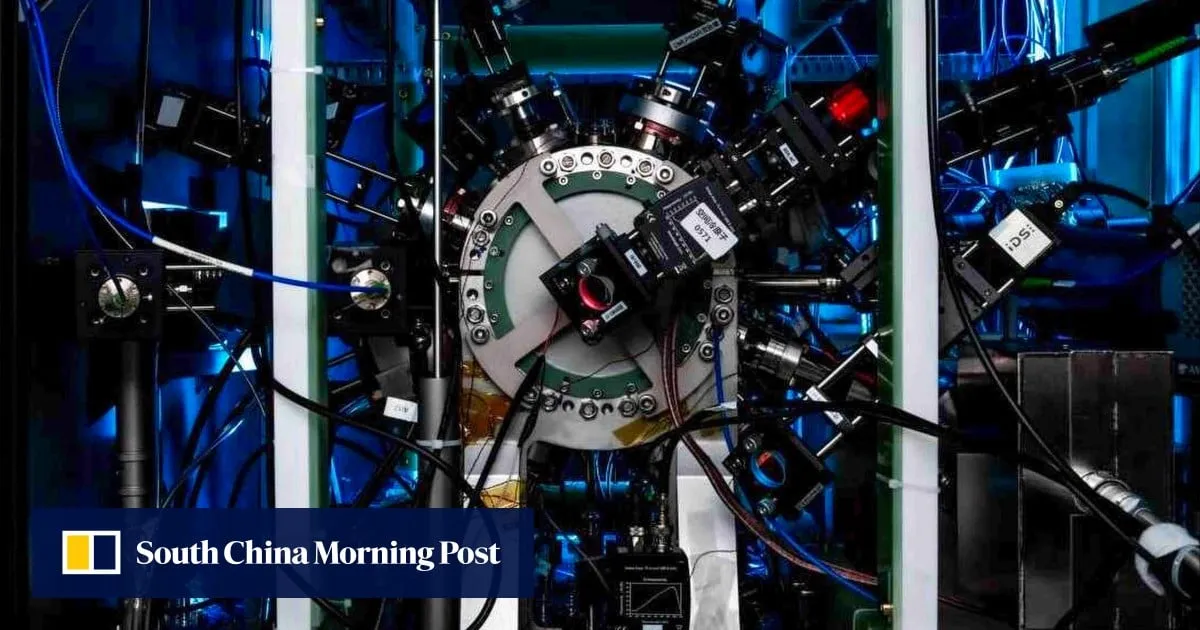
China has joined the global top-tier timekeeping club with a new optical clock that could help it play a leading role in redefining the second.A team, led by Pan Jianwei at the China" class="entity-link entity-location" data-entity-id="23976" data-entity-type="location">University of Science and Technology of China in Hefei, has built a strontium optical clock that would lose or gain less than one second over about 30 billion years – more than twice the age of the universe.The clock’s key parameters, known as stability and uncertainty, both surpassed the level of 10 to the power of minus 19, a feat achieved by only a handful of labs worldwide, including the National Institute of Standards and Technology in the United States and Germany’s national standards laboratory, the team wrote in the journal Metrologia this month.Its precision exceeds the threshold required for redefining the second, potentially “allowing China to play a leading role in the effort”, according to state broadcaster CCTV.The work also provided a practical path for China to develop more stable and portable optical clocks, as well as space-based versions, said Dai Hanning, a co-author from Pan’s team.“It lays a solid foundation for using optical clocks to test fundamental physics, improve next-generation satellite navigation and build a unified ultra-precise global time standard,” Dai told CCTV on March 7.Optical clocks are the most precise timekeeping devices available. They use lasers to trap atoms such as strontium and rubidium at very low temperatures, and measure time from the frequency of light emitted as their electrons jump between energy levels.
SRCSouth China Morning Post
LANGEN
LEANCenter-Right
WORDS249
ENT10
SAT · 2026-03-21 · 06:00 GMTBRIEF NSR-2026-0321-26561
NSR-2026-0321-26561News Report·EN·Technology
Made-in-China clock loses a second in twice the age of the universe
A team at the University of Science and Technology of China, led by Pan Jianwei, has developed a highly precise strontium optical clock. This clock is so accurate that it would only lose or gain one second in 30 billion years, exceeding the precision threshold needed to redefine the second.
Ling XinSouth China Morning PostFiled 2026-03-21 · 06:00 GMTLean · Center-RightRead · 1 min
South China Morning PostFIG 01
Reading time
1min
Word count
249words
Sources cited
3cited
Entities identified
10entities
Quality score
100%
§ 01
Briefing Summary
AI-generatedNEWSAR · AI
A team at the University of Science and Technology of China, led by Pan Jianwei, has developed a highly precise strontium optical clock. This clock is so accurate that it would only lose or gain one second in 30 billion years, exceeding the precision threshold needed to redefine the second. The clock's stability and uncertainty parameters place it among the top timekeeping devices globally, alongside those in the US and Germany. Published in Metrologia this month, this achievement positions China to potentially lead in redefining the second and developing more advanced optical clocks. The technology paves the way for advancements in fundamental physics research, satellite navigation, and the creation of a unified global time standard.
Confidence 0.90Sources 3Claims 5Entities 10
§ 02
Article analysis
Model · rule-basedFraming
Technology
Economic Impact
Tone
Measured
AI-assessed
CalmNeutralAlarmist
Factuality
0.80 / 1.00
Factual
LowHigh
Sources cited
3
Well sourced
FewMany
§ 03
Key claims
5 extracted01
The clock's stability and uncertainty both surpassed the level of 10 to the power of minus 19.
factualthe team
Confidence
1.00
02
China has built a strontium optical clock that would lose or gain less than one second over about 30 billion years.
factualUniversity of Science and Technology of China
Confidence
1.00
03
Its precision exceeds the threshold required for redefining the second.
quoteCCTV
Confidence
0.90
04
The work provided a practical path for China to develop more stable and portable optical clocks.
quoteDai Hanning
Confidence
0.80
05
It lays a solid foundation for using optical clocks to test fundamental physics.
quoteDai Hanning
Confidence
0.70
§ 04
Full report
1 min read · 249 words§ 05
Entities
10 identifiedKey playerOppositionContextPositiveNeutralNegative
Organizations3
§ 06
Keywords & salience
9 termsoptical clock
1.00
timekeeping
0.80
precision
0.70
china
0.70
strontium
0.60
second redefinition
0.60
time standard
0.50
university of science and technology of china
0.40
satellite navigation
0.40
§ 07
Topic connections
Interactive graph Network visualization showing 51 related topics
View Full Graph Person Organization Location Event|Click node to navigate|Edge numbers = shared articles