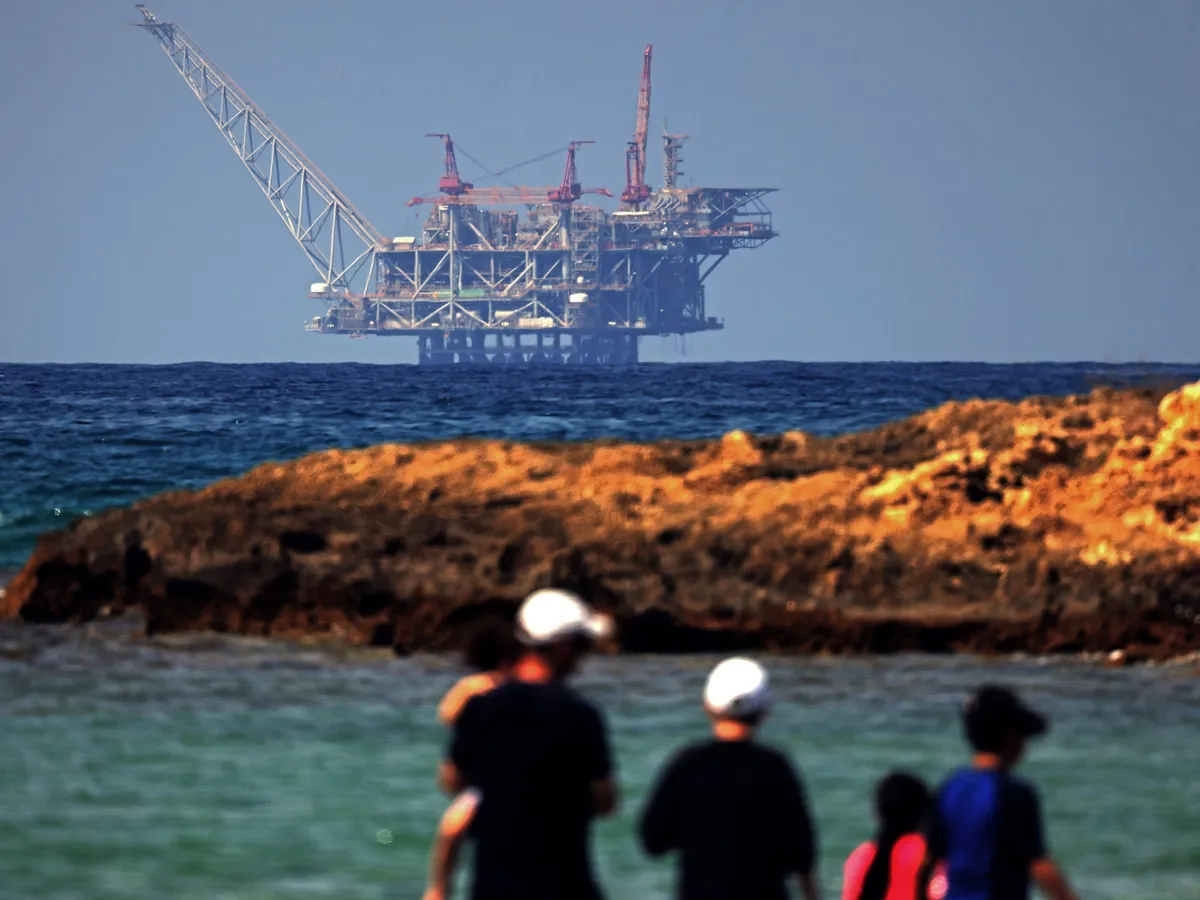
The war on Iran revealed how dependent Israel’s Arab neighbours are on its gas exports, a dependency that could extend to Syria and Lebanon.Researcher at the Centre for International Studies at Sciences Po.Published On 21 Mar 2026A view of the platform of the Leviathan natural gasfield in the Mediterranean Sea on August 29, 2022 [File: Jack Guez/AFP]At the start of the US-Israeli war on Iran, reports emerged that Jordan and Egypt have cut off gas supplies to Syria. These reports appeared as minor details amid the shock of the latest episode of US-Israeli aggression in the Middle East – part of an ongoing effort to reshape the region.Yet such seemingly inconsequential reports conceal the longer-term, nonmilitary processes through which that reshaping is materially enacted. What was made clear by this news was that Israel has a growing energy control over the region – one that could help propel its colonialist agenda.Where does the gas come from?In January, Egypt began supplying 2.8 million cubic metres (98.9 million cubic feet) of gas per day to Syria through the Arab Gas Pipeline, which runs from Egypt’s El Arish through Taba to Jordan’s Aqaba and then north to Amman, then Syria’s Damascus and Homs and from there to Lebanon’s Tripoli. A memorandum of understanding was also signed with Lebanon for the import of gas from Egypt, but according to reports, the gas has not yet started flowing due to technical challenges.Also in January, Jordan’s state-owned National Electric Power Company signed a deal with the Syrian Petroleum Company for the supply of 4 million cubic metres (141.2 million cubic feet) of gas daily.From the moment news of the agreements surfaced, a central question emerged: where would Egypt and Jordan obtain gas for export?Egypt is a gas producer, but its local production has declined over the past years, hitting a six-year low of 49.3 billion cubic metres (1.7 trillion cubic feet) in 2024. The same year, its imports reached a record high of 14.6bcm (515.6 billion cubic feet), of which about 10bcm (353 billion cubic feet) came from Israel. Last year, Cairo signed a $35bn deal to import Israeli gas from Israel until 2040, boosting its previous supplies by another 2bcm (70.6 billion cubic feet) per year.Although Egypt is a gas importer, it still exports gas. However, reports on what gas it is selling to Syria are conflicting. Some say it is of Israeli origin, while others claim it comes from liquified gas intended for Egypt, received in the Jordanian port of Aqaba, where it is regasified and pumped north through the Arab Gas Pipeline.Unlike Egypt, Jordan is not a major gas-producing country. Local production accounts for less than 5 percent of gas (PDF) needs. It imports the rest, about 3.6bcm (127 billion cubic feet) per year, mostly from Israel, but also Egypt and some LNG sources.When questions arose regarding the source of Jordanian gas sales to Syria, a Syrian official responded that the imported gas was “not of Jordanian origin”, but was rather liquefied natural gas bought from global markets and regasified at Aqaba.A regional gas energy system centred on IsraelThe Arab Gas Pipeline—once a symbol of joint Arab development projects—has become the primary conduit for exporting Israeli gas to both Jordan and Egypt. Pipelines carrying gas from the Leviathan field off the coast of Haifa connect to the pipeline network in northern Jordan’s Mafraq governorate, from which gas flows southward towards the Egyptian border.Any independent LNG shipment arriving by tanker at the Aqaba terminal must enter the Arab Gas Pipeline system, where it inevitably mixes with Israeli gas already flowing through the network. Once inside the system, it becomes part of a shared “gas blend” distributed among the interconnected states. Crucially, Israeli gas constitutes the backbone of the long-term supply through the pipeline.As a result, LNG shipments are likely handled through a regional clearing mechanism. Gas imported as LNG through Aqaba, for instance, may be routed to Egypt – the nearest point in the network – while an equivalent quantity of Israeli gas entering the system in northern Jordan is redirected towards Syria. This arrangement avoids the logistical and financial costs associated with reversing pipeline flows or transporting gas across long distances.When Israeli gas stops, the entire network stopsWhen Israel shut down gas production in the Leviathan field, gas flows to Jordan and Egypt immediately stopped, plunging both countries into crisis and forcing them to activate emergency plans to confront the sudden shortage.This was the second such disruption in less than a year. The same field had been shut down for 13 days the previous June during the 12-day Israeli attack on Iran, again cutting supplies to Jordan and Egypt.When it happened this time, Amman announced reductions – and partial suspension – of the gas it had been supplying to Syria. Cairo was also forced to suspend exports to Syria.The material reality, therefore, appears to contradict official narratives: the gas reaching Syria and, in the future, Lebanon, is, in practical terms, Israeli gas.Even when Israel is not the immediate supplier in a given transaction, the system itself depends structurally on Israeli gas. Once Israeli exports stop, the entire network falters.Jordan’s own emergency plan following the interruption of Israeli gas involves importing LNG through Aqaba from global markets. The option clearly exists even under the current conditions. If that route remains available, why were supplies to Syria reduced or halted?Whatever the explanation, the facts confirm that Israel sits at the heart of the emerging regional gas system. This centrality grants it considerable political leverage. Energy supply has already been deployed as a political instrument — for example, in threats to reconsider gas agreements with Egypt under the pretext of alleged peace treaty violations.More starkly, Israel has demonstrated its willingness to weaponise essential infrastructure and utilities. During the genocide in Gaza, electricity, energy and water – along with the infrastructure that sustains them – were systematically targeted and cut off, deployed as instruments of collective punishment and destruction.The cage of dependencyLebanon and Syria desperately need electricity. That urgency is being used to justify integration into a regional energy network centred on Israel. Under such conditions, questions regarding the origin of gas are likely to be set aside, and Israel’s structural centrality to the regional energy order quietly ignored.The result would be a system that places both countries – along with Egypt and Jordan – within an infrastructure where supply disruptions remain possible at any moment and where the decisive lever ultimately lies in Israeli hands.This is a clear example of how the Zionist settler-colonial project is expanding not only through military aggression but also through economic power and energy networks.It advances through an infrastructure that appears mundane and technical, yet ultimately grips societies by the throat. Once embedded, disengaging from such systems becomes extraordinarily difficult, because they govern the essentials of everyday life: electricity, water and energy.Syria and Lebanon do have an alternative – developing their own energy reserves. Syrian onshore gas reserves amount to 280bcm (9,888 trillion cubic feet) and offshore – possibly 250bcm (8,829 trillion cubic feet); Lebanon could have as much as 700bcm (24,720 trillion cubic feet) in offshore reserves. Developing these energy resources would take not just time and substantial financing, but also strong political will to resist political pressure, especially from Israel and the US, to opt for dependency on Israeli gas.Today, Syrian and Lebanese political leaders may be lured by the promise of quick and easy economic security and reliable living conditions. But such security would be illusory. Ultimate control would rest in the hands of a state whose capacity to cut supply – and to use that interruption as a tool of destruction, political coercion and colonial expansion – is already visible for all to see.The views expressed in this article are the author’s own and do not necessarily reflect Al Jazeera’s editorial stance.
SRCAl Jazeera
LANGEN
LEANCenter
WORDS1 305
ENT12
SAT · 2026-03-21 · 16:01 GMTBRIEF NSR-2026-0321-27925
NSR-2026-0321-27925Analysis·EN·Political Strategy
Arab states should beware of Israel’s hegemonic energy expansion
Published in March 2026, the article discusses Israel's growing energy influence in the Middle East. Following the US-Israeli war on Iran, reports indicated that Jordan and Egypt halted gas supplies to Syria.
Hisham BustaniAl JazeeraFiled 2026-03-21 · 16:01 GMTLean · CenterRead · 6 min
Al JazeeraFIG 01
Reading time
6min
Word count
1 305words
Sources cited
1cited
Entities identified
12entities
Quality score
100%
§ 01
Briefing Summary
AI-generatedNEWSAR · AI
Published in March 2026, the article discusses Israel's growing energy influence in the Middle East. Following the US-Israeli war on Iran, reports indicated that Jordan and Egypt halted gas supplies to Syria. Egypt and Jordan had agreements to supply gas to Syria and Lebanon via the Arab Gas Pipeline. However, both countries rely on gas imports from Israel to meet their own needs and export commitments. Egypt, despite being a gas producer, has seen declining production and increased imports, including a significant amount from Israel. The article highlights concerns that this dependence on Israeli gas could advance Israel's regional agenda.
Confidence 0.90Sources 1Claims 5Entities 12
§ 02
Article analysis
Model · rule-basedFraming
Political Strategy
Economic Impact
Tone
Mixed Tone
AI-assessed
CalmNeutralAlarmist
Factuality
0.60 / 1.00
Mixed
LowHigh
Sources cited
1
Limited
FewMany
§ 03
Key claims
5 extracted01
Cairo signed a $35bn deal to import Israeli gas from Israel until 2040.
factualArticle's own claim
Confidence
0.90
02
Egypt's local gas production hit a six-year low of 49.3 billion cubic metres in 2024.
statisticArticle's own claim
Confidence
0.90
03
Jordan’s state-owned National Electric Power Company signed a deal with the Syrian Petroleum Company for the supply of 4 million cubic metres of gas daily.
factualArticle's own claim
Confidence
0.90
04
Egypt began supplying 2.8 million cubic metres of gas per day to Syria in January.
factualArticle's own claim
Confidence
0.90
05
Israel has a growing energy control over the region.
factualArticle's own claim
Confidence
0.70
§ 04
Full report
6 min read · 1 305 words§ 05
Entities
12 identifiedKey playerOppositionContextPositiveNeutralNegative
Organizations4
§ 06
Keywords & salience
10 termsisraeli gas
0.90
energy control
0.80
gas exports
0.70
gas supply
0.70
arab states
0.60
egypt
0.60
jordan
0.50
middle east
0.50
syria
0.50
hegemonic expansion
0.40
§ 07
Topic connections
Interactive graph Network visualization showing 51 related topics
View Full Graph Person Organization Location Event|Click node to navigate|Edge numbers = shared articles