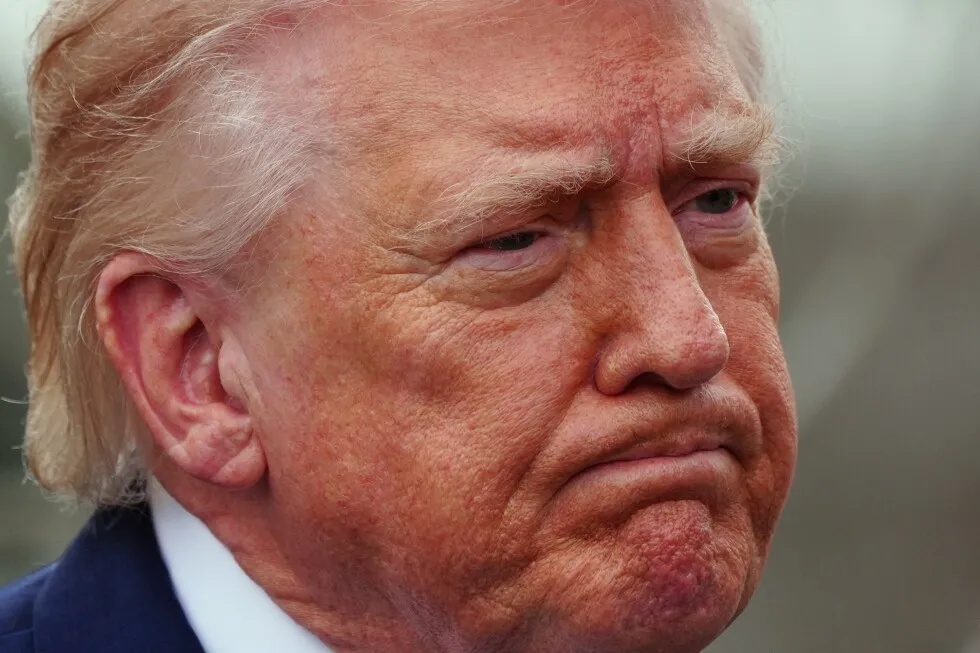
Trump’s mixed messages on Iran: ‘Winding down’ the war and easing sanctions but adding more troops 1 of 3 | President Donald Trump speaks with reporters before departing on Marine One from the South Lawn of the White House, Friday, March 20, 2026, in Washington. (AP Photo/Alex Brandon) 2 of 3 | President Donald Trump, accompanied by Secretary of State Marco Rubio, speaks with reporters while departing the White House, Friday, March 20, 2026, in Washington. (AP Photo/Julia Demaree Nikhinson) 3 of 3 | President Donald Trump steps off Air Force One, Friday, March 20, 2026, at Palm Beach International Airport in West Palm Beach, Fla. (AP Photo/Mark Schiefelbein) 1 of 3 President Donald Trump speaks with reporters before departing on Marine One from the South Lawn of the White House, Friday, March 20, 2026, in Washington. (AP Photo/Alex Brandon) Add AP News on Google Add AP News as your preferred source to see more of our stories on Google. 2 of 3 President Donald Trump, accompanied by Secretary of State Marco Rubio, speaks with reporters while departing the White House, Friday, March 20, 2026, in Washington. (AP Photo/Julia Demaree Nikhinson) Add AP News on Google Add AP News as your preferred source to see more of our stories on Google. 3 of 3 President Donald Trump steps off Air Force One, Friday, March 20, 2026, at Palm Beach International Airport in West Palm Beach, Fla. (AP Photo/Mark Schiefelbein) Add AP News on Google Add AP News as your preferred source to see more of our stories on Google. Updated [hour]:[minute] [AMPM] [timezone], [monthFull] [day], [year] President Donald Trump frequently contradicts himself, sometimes in the same speech, social media post or even sentence. Within the space of a few hours Friday, he sent a torrent of mixed signals about the Iran war that raise more questions about the direction of the conflict and his administration’s strategy.During this time, Trump said he was considering winding down the war, his administration confirmed it was sending more troops to the Middle East and, in an effort to lessen the economic impact on global energy markets, the United States lifted sanctions on some Iranian oil for the first time in decades — relieving some of the pressure that Washington traditionally has used as leverage. The confusing combination of actions deepens a sense among Trump’s critics that there is no clear, long-term strategy for the war the U.S. and Israel launched against Iran. Now in its fourth week, the war remains on an unpredictable path and a credible endgame is unclear even as the global economy is being roiled. Just 24 hours after saying the U.S. was thinking of walking away from the conflict, Trump issued another contradictory statement Saturday evening, threatening to escalate the conflict by targeting Iran’s power plants unless the country lets oil shipments pass through the Persian Gulf. ‘Winding down’ the warAfter another rough day in the financial markets, Trump said Friday afternoon on his social media network: “We are getting very close to meeting our objectives as we consider winding down our great Military efforts in the Middle East.”Trump contended the U.S. has adequately degraded Iranian naval, missile and industrial capacity and prevented Tehran from acquiring a nuclear weapon. The Republican president then suggested the U.S. could pull out of the conflict without stabilizing the Strait of Hormuz, the channel through which about one-fifth of the world’s oil supply travels. The strait has been ravaged by Iranian missile, drone and mine attacks during the war. “The Hormuz Strait will have to be guarded and policed, as necessary, by other Nations who use it — The United States does not!” Trump wrote. But, in another contradiction, he said the U.S. would help if asked, “but it shouldn’t be necessary once Iran’s threat is eradicated.” While oil that traverses the strait is usually bound for Asia and other places rather than North America, the chaos still affects the United States. Oil is bought and sold globally, so a shortage in oil for Asian countries leads to bidding up prices on oil sold to companies in America, too. That fact, coupled with an Israeli strike on Iran’s gas fields and an Iranian retaliation that crippled a major terminal to ship liquefied natural gas from Qatar, helped tank U.S. equity markets Friday, with the S&P 500 dropping 1.5%. There also was a sharp increase in U.S. fuel prices.Trump’s concern about the persistent blockage of the strait erupted Saturday night when the president posted on social media that he’d “hit and obliterate” Iran’s power plants unless the country opens the strait within 48 hours. The threat against Iran’s civilian infrastructure was yet another escalation. More US military might to the Middle EastEven as Trump said the U.S. was close to winding down the war, the administration announced it was sending three more warships to the Middle East with about 2,500 additional Marines. It was the second time in the week that the administration said it was deploying more forces to the conflict. The military says some 50,000 are supporting the war effort.Trump has been coy about sending in ground troops, while his administration has hinted at a possible deployment of special forces or similar units. The Marines being sent to the region are an expeditionary unit designed for quick amphibious landings, but their deployment does not mean a ground invasion is certain. Analysts have suggested it may require the presence of U.S. forces on the ground to ultimately secure the strait.The surge in troops came just a day after news emerged that the Pentagon was seeking an additional $200 billion from Congress to fund the war. That extraordinarily high number does not suggest that the war was being wound down. Sanctions on Iranian oil salesThe administration said it would lift sanctions on the sale of Iranian oil, provided it was already at sea as of Friday. The move was an attempt to help lower skyrocketing energy prices by allowing freer sale of oil that Iran has let pass through the strait. It also extends a financial lifeline to the Iranian government that Trump is targeting.His administration has tried other methods to lower oil prices. It has tapped the U.S. strategic petroleum reserve and lifted sanctions on some Russian oil. Yet Brent crude remained at $112 per barrel Friday, and analysts say oil prices are likely to remain high for months regardless of the next steps in the war.The Iranian oil eventually would have reached another country, but now the United States and its allies can bid on it as well, Treasury Secretary Scott Bessent wrote on X. “At present, sanctioned Iranian oil is being hoarded by China on the cheap,” Bessent wrote. “By temporarily unlocking this existing supply for the world, the United States will quickly bring approximately 140 million barrels of oil to global markets, expanding the amount of worldwide energy and helping to relieve the temporary pressures on supply caused by Iran.”While 140 million barrels may seem like a lot, that is only a couple of days worth of oil on the global market. Patrick De Haan, the head of petroleum analysis at GasBuddy, a U.S. fuel-tracking service, said he does not expect the temporary suspension to have a major impact on gas prices. The de facto closure of the strait has a much greater effect, he said. “Prices will likely still continue to rise so long as the Strait remains silent,” De Haan said.And the contradictions in the position were obvious in Bessent’s post announcing the move, which labeled Iran “the head of the snake for global terrorism.” He said the administration would take steps to prevent Tehran from cashing in on the sales, but it was unclear how that would be done.Even among some Republicans, the contradictions triggered rare public skepticism.“Bombing Iran with one hand and buying Iran oil with the other,” Rep. Nancy Mace of South Carolina posted on X Saturday.___AP Business Writer Dee-Ann Durbin in Ann Arbor, Michigan, contributed to this report.
SRCAssociated Press (AP)
LANGEN
LEANCenter
WORDS1 333
ENT9
SAT · 2026-03-21 · 17:23 GMTBRIEF NSR-2026-0321-27938
NSR-2026-0321-27938News Report·EN·Political Strategy
Trump’s mixed messages on Iran: ‘Winding down’ the war and easing sanctions but adding more troops
In March 2026, President Trump sent mixed signals regarding the ongoing U.S. and Israeli war against Iran.
By
NICHOLAS RICCARDIAssociated Press (AP)Filed 2026-03-21 · 17:23 GMTLean · CenterRead · 6 min
Associated Press (AP)FIG 01
Reading time
6min
Word count
1 333words
Sources cited
0cited
Entities identified
9entities
Quality score
100%
§ 01
Briefing Summary
AI-generatedNEWSAR · AI
In March 2026, President Trump sent mixed signals regarding the ongoing U.S. and Israeli war against Iran. While suggesting he was considering winding down the conflict, his administration confirmed the deployment of additional troops to the Middle East. Simultaneously, the U.S. eased sanctions on some Iranian oil exports, a move intended to lessen the economic impact on global energy markets. These actions, taken within a few hours, created confusion about the administration's strategy and long-term goals for the war, which was in its fourth week. Critics suggest the contradictory messages highlight a lack of clear direction in the conflict.
Confidence 0.90Claims 5Entities 9
§ 02
Article analysis
Model · rule-basedFraming
Political Strategy
Conflict
Tone
Mixed Tone
AI-assessed
CalmNeutralAlarmist
Factuality
0.60 / 1.00
Mixed
LowHigh
Sources cited
0
No named sources
FewMany
§ 03
Key claims
5 extracted01
The war is in its fourth week.
factualnull
Confidence
1.00
02
The US is sending more troops to the Middle East.
factualnull
Confidence
1.00
03
The US lifted sanctions on some Iranian oil.
factualnull
Confidence
1.00
04
Trump threatened to escalate the conflict by targeting Iran’s power plants.
factualnull
Confidence
0.90
05
Trump sent mixed signals about the Iran war.
factualnull
Confidence
0.90
§ 04
Full report
6 min read · 1 333 words§ 05
Entities
9 identifiedKey playerOppositionContextPositiveNeutralNegative
§ 06
Keywords & salience
8 termsiran war
1.00
mixed messages
0.90
easing sanctions
0.80
adding troops
0.70
winding down
0.60
middle east
0.50
economic impact
0.40
global energy markets
0.40
§ 07
Topic connections
Interactive graph Network visualization showing 51 related topics
View Full Graph Person Organization Location Event|Click node to navigate|Edge numbers = shared articles