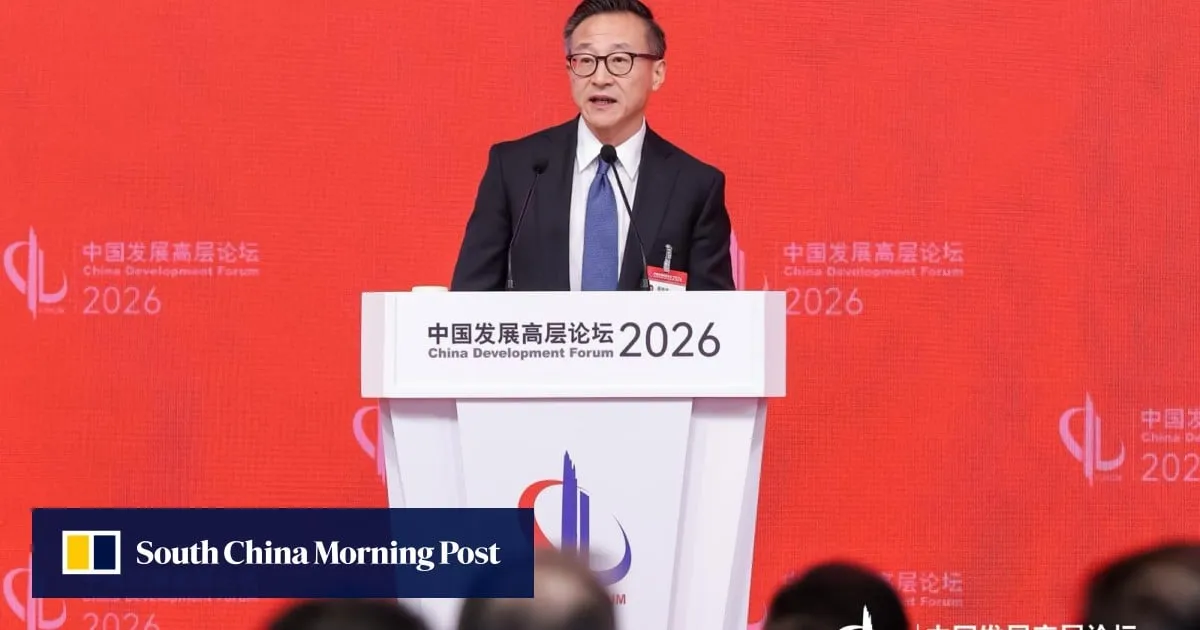
China’s artificial intelligence breakthroughs in recent years stemmed from the country’s strategic strengthening of its power grid, commitment to open-source models and complete manufacturing supply chain, according to Joe Tsai, chairman of Alibaba Group Holding.“Currently, geopolitical complexities are deeply affecting supply chain security and the sharing of technological achievements,” Tsai said in a speech on Sunday at the China-development-forum-2026" class="entity-link entity-event" data-entity-id="51541" data-entity-type="event">China Development Forum 2026 in Beijing. “In this era and environment of uncertainty, China’s technology sector is both willing and capable of providing certainty.”Over the past decade, China had continuously increased investment in power transmission, with annual spending in recent years averaging US$90 billion – the highest in the world – leading to newly installed power generation capacity last year that was 10 times that of the US, he said.“In the AI industry, which is extremely energy-intensive, such massive investment has directly translated into advantages in ample supply and [low] cost, forming a solid foundation for us,” Tsai said.The ultimate goal of developing AI was not to build the most cutting-edge models but to proliferate its application to benefit society, he said.Participants attend the China Development Forum in Beijing on March 22. Photo: XinhuaTsai said open-source models had enabled China’s AI sector to break down barriers, “ensuring that AI is no longer the privilege of a few giants”. He added that widespread adoption would “drive shared global economic growth and improvements in living standards, achieving a win-win outcome”.
SRCSouth China Morning Post
LANGEN
LEANCenter-Right
WORDS236
ENT7
SUN · 2026-03-22 · 11:46 GMTBRIEF NSR-2026-0322-28813
NSR-2026-0322-28813News Report·EN·Technology
Alibaba chairman Joe Tsai credits China’s AI edge to power grid, open-source models
Alibaba chairman Joe Tsai attributed China's AI advancements to its robust power grid, commitment to open-source models, and comprehensive manufacturing supply chain. Speaking at the China Development Forum 2026 in Beijing, Tsai highlighted China's significant investment in power transmission over the past decade, exceeding the US by a large margin.
Ji SiqiSouth China Morning PostFiled 2026-03-22 · 11:46 GMTLean · Center-RightRead · 1 min
South China Morning PostFIG 01
Reading time
1min
Word count
236words
Sources cited
1cited
Entities identified
7entities
Quality score
100%
§ 01
Briefing Summary
AI-generatedNEWSAR · AI
Alibaba chairman Joe Tsai attributed China's AI advancements to its robust power grid, commitment to open-source models, and comprehensive manufacturing supply chain. Speaking at the China Development Forum 2026 in Beijing, Tsai highlighted China's significant investment in power transmission over the past decade, exceeding the US by a large margin. He argued this energy infrastructure provides a crucial advantage for the energy-intensive AI industry. Tsai emphasized that open-source models have democratized AI development in China, preventing it from being controlled by a few large companies. He believes this widespread adoption will foster global economic growth and improve living standards.
Confidence 0.90Sources 1Claims 5Entities 7
§ 02
Article analysis
Model · rule-basedFraming
Technology
Economic Impact
Tone
Measured
AI-assessed
CalmNeutralAlarmist
Factuality
0.70 / 1.00
Factual
LowHigh
Sources cited
1
Limited
FewMany
§ 03
Key claims
5 extracted01
Open-source models enabled China’s AI sector to break down barriers.
quoteJoe Tsai
Confidence
0.90
02
Geopolitical complexities are deeply affecting supply chain security and the sharing of technological achievements.
quoteJoe Tsai
Confidence
0.90
03
China’s AI breakthroughs stemmed from strengthening its power grid, open-source models, and complete manufacturing supply chain.
quoteJoe Tsai
Confidence
0.90
04
China's newly installed power generation capacity last year was 10 times that of the US.
statisticJoe Tsai
Confidence
0.80
05
China's annual spending on power transmission averaged US$90 billion in recent years.
statisticJoe Tsai
Confidence
0.80
§ 04
Full report
1 min read · 236 words§ 05
Entities
7 identifiedKey playerOppositionContextPositiveNeutralNegative
§ 06
Keywords & salience
9 termsartificial intelligence
1.00
china
0.90
power grid
0.80
open-source models
0.80
supply chain
0.70
technology sector
0.60
economic growth
0.50
joe tsai
0.50
investment
0.40
§ 07
Topic connections
Interactive graph Network visualization showing 51 related topics
View Full Graph Person Organization Location Event|Click node to navigate|Edge numbers = shared articles