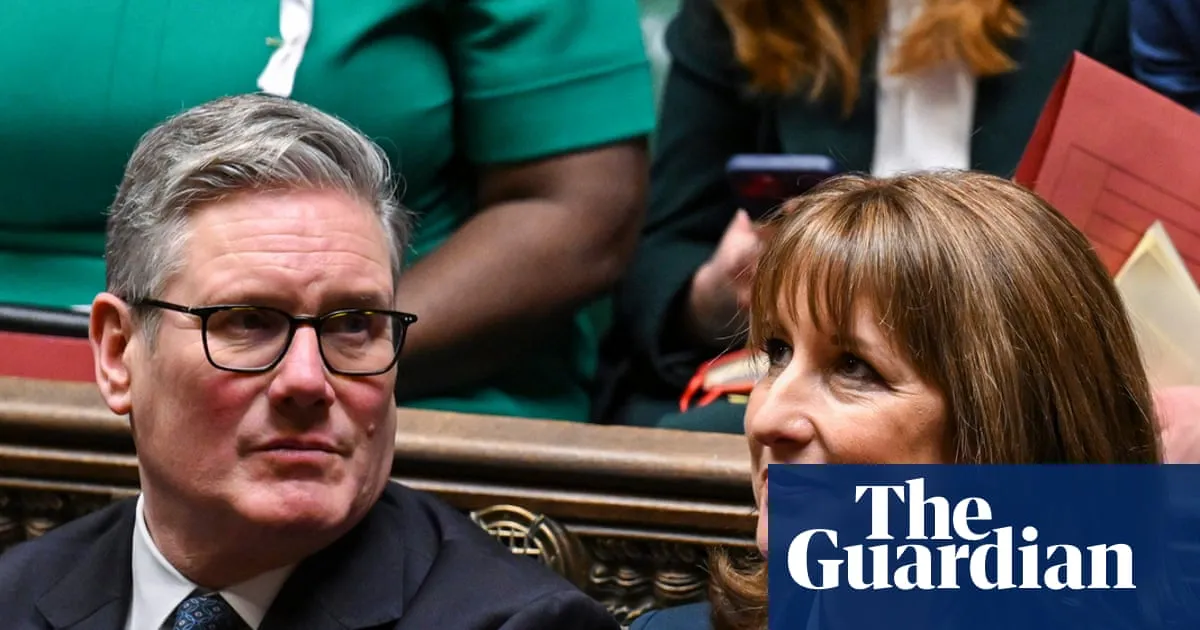
The political fates of Keir Starmer and Rachel Reeves are intertwined. Allies say that if one goes, the other is likely to follow.This is why, in the wake of the budget, the Conservatives have attempted to focus their response on the chancellor’s personal ethics, accusing Reeves of lying about the rationale behind her record-breaking tax rises.And it is also why, in response, Starmer has chosen to fight back personally. In a speech on Monday, he will seek to draw a line under the row and refocus attention on the government’s wider economic plan.Writing for the Guardian before that speech, the prime minister argues: “At the budget last week, we made the right choices for Britain, cutting the cost of energy with £150 off bills, protecting the NHS and tackling the scourge of child poverty by removing the two-child limit.”Seeking to buy himself and his chancellor political breathing space, he will argue on Monday that his programme – which includes welfare reform and deregulation – is a “big, bold long-term plan” and not a “set of quick fixes”.The prime minister has reason to shift the focus on to his long-term economic goals and away from the immediate aftermath of the budget, given the row that has engulfed the chancellor over whether she lied about why she was raising taxes.The Conservatives have accused Reeves of using reduced productivity forecasts from the Office for Budget Responsibility (OBR) as a smokescreen for tax rises.Rachel Reeves and Kemi Badenoch discuss the budget on BBC One’s Sunday with Laura Kuenssberg. Photograph: Jeff Overs/BBC/PAWhile the OBR did downgrade its productivity predictions, it also upgraded its forecasts for wages and tax receipts, which ended up leaving the chancellor with a surplus rather than a hole.Kemi Badenoch, the Conservative leader, has also accused the chancellor’s allies of trying to manipulate financial markets by briefing on 14 November that Reeves had decided to drop a plan to increase income tax rates because of better-than-expected news from the OBR.In fact, Reeves and her team had known for some time about the OBR’s more rosy outlook – even when she gave a rare pre-budget speech on 4 November warning that a lower productivity outlook would have consequences for wages and tax receipts.That timeline was spelled out clearly last week in a letter from Richard Hughes, the head of the OBR, to the Treasury select committee.The letter was meant as a corrective to the Treasury briefing on 14 November, when officials attempted to calm investors spooked by news overnight that the chancellor had ditched her plans to raise income tax rates.skip past newsletter promotionafter newsletter promotionComing after weeks of stories about the OBR – including Reeves publicly questioning the timing of its productivity review and criticising it for not “scoring” pro-growth government policies – this flurry of briefings appears to have particularly irked the independent forecaster.Reeves argued on Sunday that she needed to put up taxes to increase her buffer against unexpected costs to protect her fiscal rules and keep government borrowing costs down. Her allies point out that without the productivity downgradeshe would have been in a far more comfortable position.But Reeves and Starmer know that the more challenging long-term problem is that the public appears to have made its mind up on how the government is managing the economy. Polling for More in Common after the budget shows just 16% of voters think the chancellor is doing a good job – almost exactly the same as thought so beforehand.The prime minister hopes that voters will eventually feel the impact of higher public spending and business deregulation. On Monday, he will argue that his plan should only be judged at the end of the parliament.But with voters restless for their daily lives to improve, he may find that time is a luxury he does not have.
SRCThe Guardian - World News
LANGEN
LEANCenter-Left
WORDS634
ENT4
SUN · 2025-11-30 · 22:30 GMTBRIEF NSR-2025-1130-319
NSR-2025-1130-319News Report·EN·Political Strategy
Starmer leads fightback as budget row rumbles on for Reeves
Following the recent budget, a political dispute has emerged, with Conservatives accusing Labour's Chancellor Rachel Reeves of misrepresenting the rationale behind tax increases. They allege Reeves used downgraded productivity forecasts from the Office for Budget Responsibility (OBR) as a justification, despite the OBR also upgrading wage and tax receipt forecasts.
Kiran Stacey and Heather StewartThe Guardian - World NewsFiled 2025-11-30 · 22:30 GMTLean · Center-LeftRead · 3 min
The Guardian - World NewsFIG 01
Reading time
3min
Word count
634words
Sources cited
4cited
Entities identified
4entities
Quality score
100%
§ 01
Briefing Summary
AI-generatedNEWSAR · AI
Following the recent budget, a political dispute has emerged, with Conservatives accusing Labour's Chancellor Rachel Reeves of misrepresenting the rationale behind tax increases. They allege Reeves used downgraded productivity forecasts from the Office for Budget Responsibility (OBR) as a justification, despite the OBR also upgrading wage and tax receipt forecasts. Conservative leader Kemi Badenoch further accused Reeves' team of manipulating markets by selectively briefing positive OBR news. In response, Labour leader Keir Starmer is attempting to shift focus back to the government's broader economic plan, arguing it's a long-term strategy, not just short-term fixes. The Prime Minister is also seeking to defend the budget and refocus attention on his long-term economic goals.
Confidence 0.90Sources 4Claims 5Entities 4
§ 02
Article analysis
Model · rule-basedFraming
Political Strategy
Economic Impact
Tone
Measured
AI-assessed
CalmNeutralAlarmist
Factuality
0.70 / 1.00
Factual
LowHigh
Sources cited
4
Well sourced
FewMany
§ 03
Key claims
5 extracted01
Reeves argued on Sunday that she needed to plan for a lower productivity outlook.
quoteReeves
Confidence
1.00
02
The OBR did downgrade its productivity predictions, but also upgraded its forecasts for wages and tax receipts.
factualnull
Confidence
1.00
03
Kemi Badenoch accused the chancellor’s allies of trying to manipulate financial markets.
quoteKemi Badenoch
Confidence
0.90
04
Conservatives have accused Reeves of lying about the rationale behind her record-breaking tax rises.
quoteConservatives
Confidence
0.90
05
Starmer will seek to draw a line under the row and refocus attention on the government’s wider economic plan.
predictionnull
Confidence
0.80
§ 04
Full report
3 min read · 634 words§ 05
Entities
4 identifiedKey playerOppositionContextPositiveNeutralNegative
§ 06
Keywords & salience
10 termsbudget
1.00
tax rises
0.80
rachel reeves
0.70
economic plan
0.70
keir starmer
0.70
productivity forecasts
0.60
office for budget responsibility
0.60
deregulation
0.50
welfare reform
0.50
political ethics
0.40
§ 07
Topic connections
Interactive graph Network visualization showing 51 related topics
View Full Graph Person Organization Location Event|Click node to navigate|Edge numbers = shared articles