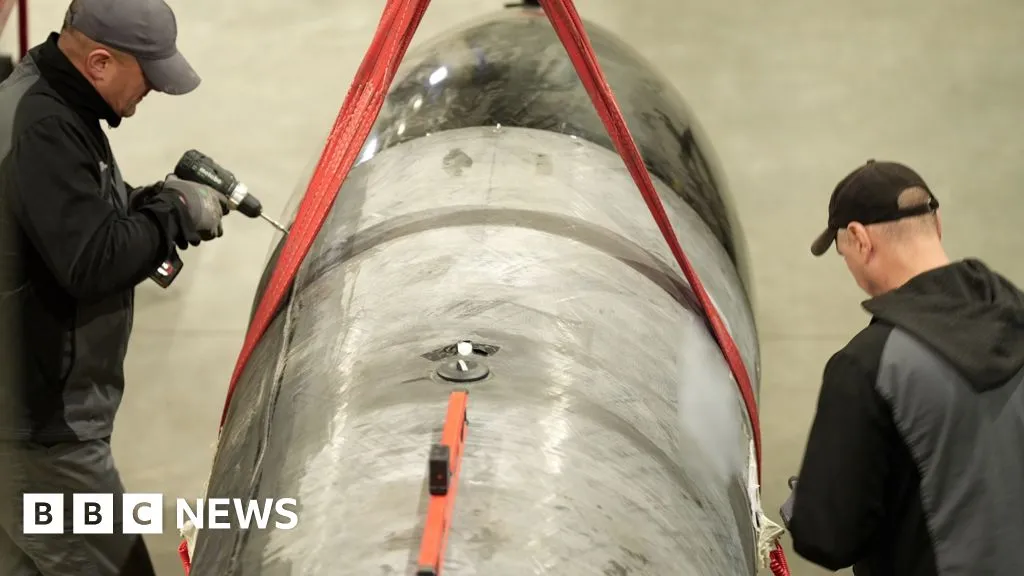
5 hours agoMoose Campbell/BBCThe Flamingo missile is a new, long-range Ukrainian cruise missile, designed for deep strikes against Russia with a range of up to 3,000km Jonathan BealeDefence correspondent in KyivWe're driven blindfolded to a secret location where Ukraine is making one of its latest weapons. We're told to turn off our phones - such is the secrecy around the production of Ukraine's Flamingo cruise missile.For Ukraine, dispersing and hiding the production of weapons like this is key to survival. Two factories belonging to the company that make it - Fire Point - have already been hit.Inside the one we're visiting we're told not to film any features such as pillars, windows or ceilings. We're also asked not to show the faces of workers on the assembly line - where Flamingo missiles are at various stages of completion.Even under fire, Ukraine is ramping up its arms industry. President Volodymyr Zelensky says the country now produces more than 50% of the weapons it uses on the front line. Almost its entire inventory of long-range weapons is domestically made.At the start of the war Ukraine mostly relied on its old Soviet-era arsenal. Western military support helped modernise the country's armed forces, but it now leads much of the world in developing unmanned systems – like robots and drones.Now, domestically produced cruise missiles are adding to Ukraine's long-range capability.Moose Campbell/BBCUkraine builds the missiles in secret factories - the BBC team were blindfolded before they were taken thereIryna Terekh is the chief technical officer of Fire Point – one of Ukraine's largest drone and missile manufacturers whose Latin motto translates to "if not us, then who".The 33-year-old once studied architecture, but she is now trying to help dismantle the Russian war machine.She cuts a tiny figure in front of the giant Flamingo missile, which she tells me is painted black not pink (unlike early prototypes) "because it eats Russian oil".The end product looks similar to the German V1 rocket from World War Two. It consists of a large jet engine placed on top of a tube the length of a London bus. They've already been used in combat, though the company won't confirm specific targets.Moose Campbell/BBCIrena Terekh from Fire Point says the Flamingo missile is black because it "eats Russian oil"The Flamingo is the kind of deep-strike weapon that Western nations have been reluctant to supply. The cruise missile is said to have a range of 3,000km (1,900 miles). That's similar to a US-made Tomahawk – the more sophisticated and expensive weapon that US President Donald Trump refused to give Ukraine.But deep strikes are seen as a critical part of the war, for which Ukraine mainly uses long-range drones. It is still losing ground to Russia on a front line that stretches for more than a thousand kilometres. So Ukraine is increasingly trying to target Russia's war economy, to slow those advances. The head of Ukraine's Armed Forces, General Oleksandr Syrskyi, says Ukraine's long-range strikes have already cost the Russian economy more than $21.5bn this year.Moose Campbell/BBCThe name Flamingo is a reference to early prototypes of the missiles, which were painted pinkRuslan, an officer in Ukraine's Special Operations Forces, says the strategy is simple: "To reduce the enemy's military capabilities and their economic potential." He says Ukraine's Special Operations Forces have carried out hundreds of strikes on oil refineries, weapons factories and ammunition dumps - deep inside enemy territory. Of course Russia has been doing the same, and on a greater scale. On average it has been launching around 200 Shahed drones a day; Ukraine's response has been about half that number.Nor is Russia limiting its strikes to military targets. Its long-range missile and drone attacks have led to massive power cuts right across the country – making life harder for millions of civilians. "I'd like to launch as many drones as Russia does," Ruslan says. "But we're scaling up very quickly".Ms Tarekh, of Fire Point, says Ukraine may not be able to match Russia's resources, but, she says, "we are trying to fight with brains and tactics". Denys Shtilerman, the chief designer and co-founder of the company, admits there is no "Wunderwaffe" – or wonder weapon. "The game changer is our will to win," he says.Kevin McGregor/BBCRuslan, in Ukraine Special Operations Forces, says they're quickly scaling up domestic weapons manufacturingFire Point didn't even exist before Russia's full-scale invasion. But the start-up is now producing 200 drones a day. Its FP1 and FP2 drones, each the size of a small aeroplane, have carried out 60% of Ukraine's long-range strikes. Each drone costs around $50,000 – three times cheaper than a Russian Shahed drone. Russia is still producing nearly 3,000 of those a month.Ukraine still needs outside help, not least with intelligence, targeting and money. But it is trying to be more self-sufficient. Ms Terekh says they've made a deliberate decision to source as many of their components as possible from within Ukraine. "We are following the principle that no one can influence the weapons we build," she says. They avoid parts from two specific countries – China and the United States. Asked why there should be no American components, she says "we're on an emotional roller coaster [with the US]. Tomorrow somebody may want to shut it down, and we would not be able to use our own weapons."Until the end of last year, under President Biden, the United States supplied nearly $70bn-worth of military support to Ukraine. That was soon stopped under President Trump – instead he has set up a scheme to allow European Nato to purchase US weapons. The US is no longer Ukraine's biggest military backer, and Europe has struggled to fill the gap left by America or to match its previous support.Concerns about future US support spills over into talk of future US security guarantees – a key issue of the current peace talks. Ms Terekh dismisses the ongoing negotiations as "capitulation talks", and says that Ukraine making its own weapons "is the only way to really provide security guarantees".The former architecture student also hopes that the rest of Europe will be watching, and learning lessons. "We are a bloody example," she says, "in terms of being prepared for war."Ms Terekh says she wants to shock them into action, and believes that if any other country had faced the same onslaught as Ukraine "then they'd already have been conquered."
SRCBBC News - World
LANGEN
LeanCenter
WORDS1,060
ENT4
THU · 2025-12-18 · 00:00 GMTBRIEF NSR-2025-1218-3196
NSR-2025-1218-3196News Report·EN·National Security
In this secret missile factory, Ukraine is ramping up its domestic arms industry
Ukraine is secretly increasing its domestic arms production, including the new Flamingo cruise missile with a range of up to 3,000km, designed for deep strikes against Russia. The BBC was granted access to a hidden Fire Point factory, where the missiles are assembled, highlighting the importance of dispersed production due to previous Russian strikes.
BBC News - WorldFiled 2025-12-18 · 00:00 GMTLean · CenterRead · 5 min
BBC News - WorldFIG 01
Reading time
5min
Word count
1,060words
Sources cited
2cited
Entities identified
4entities
NEWSAR · AI
Ukraine is secretly increasing its domestic arms production, including the new Flamingo cruise missile with a range of up to 3,000km, designed for deep strikes against Russia. The BBC was granted access to a hidden Fire Point factory, where the missiles are assembled, highlighting the importance of dispersed production due to previous Russian strikes. President Zelensky states that Ukraine now produces over 50% of its weapons, with almost its entire long-range arsenal being domestically made. The Flamingo missile, already used in combat, provides Ukraine with a deep-strike capability that Western nations have been hesitant to supply. Fire Point's chief technical officer, Iryna Terekh, leads the effort to manufacture these weapons, despite the ongoing conflict.
Confidence 0.90Sources 2Claims 5Entities 4
Framing
National Security
Economic Impact
Tone
Measured
AI-assessed
CalmNeutralAlarmist
Factuality
0.80 / 1.00
Factual
LowHigh
Sources cited
2
Limited
FewMany
01
The Flamingo missile is black because it 'eats Russian oil'.
quoteIrena Terekh, Fire Point
Confidence
1.00
02
Two factories belonging to Fire Point have already been hit.
factualBBC
Confidence
1.00
03
President Volodymyr Zelensky says the country now produces more than 50% of the weapons it uses on the front line.
quoteVolodymyr Zelensky
Confidence
1.00
04
Ukraine is making one of its latest weapons at a secret location.
factualJonathan Beale, BBC
Confidence
1.00
05
The Flamingo cruise missile is said to have a range of 3,000km (1,900 miles).
factualBBC
Confidence
0.90
§ 04
Full report
5 min read · 1,060 wordsKey playerOppositionContextPositiveNeutralNegative
flamingo missile
1.00
domestic arms industry
0.90
cruise missile
0.80
long-range weapons
0.70
weapon production
0.70
arms industry
0.60
deep strike
0.60
fire point
0.60
ukrainian military
0.50
§ 07
Connections
Who appears together in the newsIn this articleWider coverageLine weight = articles in common
Laying out network…
Strongest ties articles in common
- 3,926
- 1,519
- 1,390
- 932
- 889
- 507
Recurring context not named in this article
- PDonald Trumplinks 4
- LUnited Stateslinks 4
- LChinalinks 4
- PVladimir Putinlinks 4
- LMoscowlinks 4
- LIranlinks 4
- OEuropean Unionlinks 4
- ONATOlinks 4