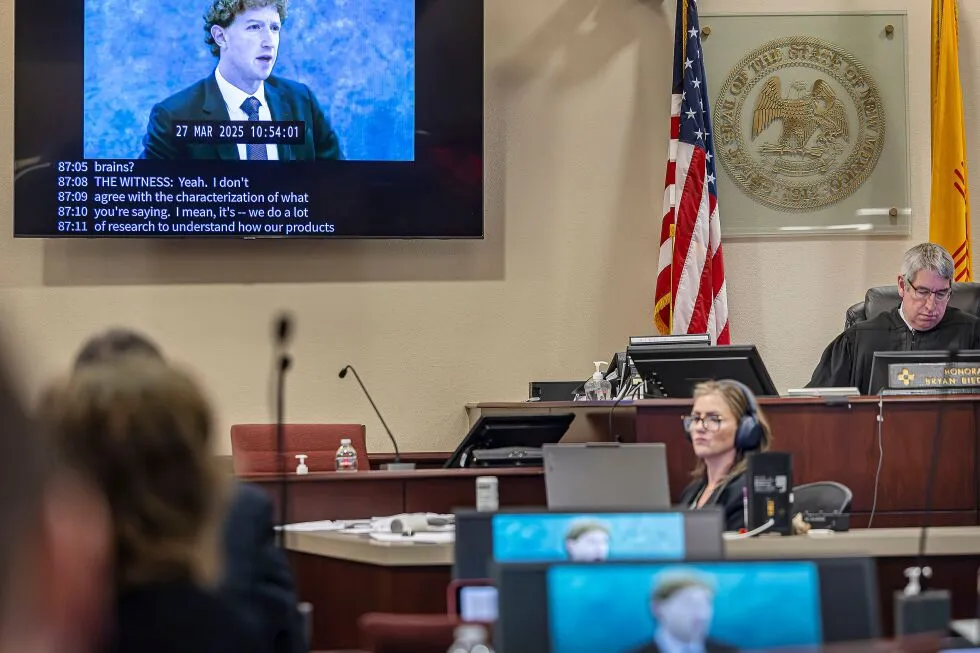
Jury begins deliberations in landmark New Mexico trial over children’s safety risks on Meta 1 of 6 | A jury began deliberations Monday in a landmark trial in New Mexico where social media conglomerate Meta is accused of misleading its users about how safe its platforms are for children. 2 of 6 | A recording of Meta Founder and CEO Mark Zuckerberg’s deposition is played for the jurors on Wednesday, March 4, 2026, in Santa Fe, N.M. (Jim Weber/Santa Fe New Mexican via AP, Pool) 3 of 6 | Lawyers for the plaintiff watch on a laptop as a recording of Meta Founder and CEO Mark Zuckerberg’s deposition is played for the jurors on Wednesday, March 4, 2026, in Santa Fe, N.M. (Jim Weber/Santa Fe New Mexican via AP, Pool) 4 of 6 | Meta attorney Kevin Huff makes closing arguments, Monday, March 23, 2026, in state court, in Santa Fe, N.M., in a trial where the social media conglomerate is accused of misleading its users about how safe its platforms are for children. (Eddie Moore/The Albuquerque Journal via AP, Pool) 5 of 6 | Linda Singer, an attorney representing the plaintiff, makes closing arguments, Monday, March 23, 2026, in state court, in Santa Fe, N.M., in a trial where the social media conglomerate is accused of misleading its users about how safe its platforms are for children. (Eddie Moore/The Albuquerque Journal via AP, Pool) 6 of 6 | Linda Singer, an attorney representing the plaintiff, left, shakes hands with attorney Kevin Huff, representing Meta, after they made closing arguments, Monday, March 23, 2026, in state court, in Santa Fe, N.M., in a trial where the social media conglomerate is accused of misleading its users about how safe its platforms are for children. (Eddie Moore/The Albuquerque Journal via AP, Pool) 1 of 6 A jury began deliberations Monday in a landmark trial in New Mexico where social media conglomerate Meta is accused of misleading its users about how safe its platforms are for children. Add AP News on Google Add AP News as your preferred source to see more of our stories on Google. 2 of 6 A recording of Meta Founder and CEO Mark Zuckerberg’s deposition is played for the jurors on Wednesday, March 4, 2026, in Santa Fe, N.M. (Jim Weber/Santa Fe New Mexican via AP, Pool) Add AP News on Google Add AP News as your preferred source to see more of our stories on Google. 3 of 6 Lawyers for the plaintiff watch on a laptop as a recording of Meta Founder and CEO Mark Zuckerberg’s deposition is played for the jurors on Wednesday, March 4, 2026, in Santa Fe, N.M. (Jim Weber/Santa Fe New Mexican via AP, Pool) Add AP News on Google Add AP News as your preferred source to see more of our stories on Google. 4 of 6 Meta attorney Kevin Huff makes closing arguments, Monday, March 23, 2026, in state court, in Santa Fe, N.M., in a trial where the social media conglomerate is accused of misleading its users about how safe its platforms are for children. (Eddie Moore/The Albuquerque Journal via AP, Pool) Add AP News on Google Add AP News as your preferred source to see more of our stories on Google. 5 of 6 Linda Singer, an attorney representing the plaintiff, makes closing arguments, Monday, March 23, 2026, in state court, in Santa Fe, N.M., in a trial where the social media conglomerate is accused of misleading its users about how safe its platforms are for children. (Eddie Moore/The Albuquerque Journal via AP, Pool) Add AP News on Google Add AP News as your preferred source to see more of our stories on Google. 6 of 6 Linda Singer, an attorney representing the plaintiff, left, shakes hands with attorney Kevin Huff, representing Meta, after they made closing arguments, Monday, March 23, 2026, in state court, in Santa Fe, N.M., in a trial where the social media conglomerate is accused of misleading its users about how safe its platforms are for children. (Eddie Moore/The Albuquerque Journal via AP, Pool) Add AP News on Google Add AP News as your preferred source to see more of our stories on Google. Updated [hour]:[minute] [AMPM] [timezone], [monthFull] [day], [year] SANTA FE, N.M. (AP) — A jury began deliberations Monday in a landmark trial in New Mexico where social media conglomerate Meta is accused of misleading its users about how safe its platforms are for children.Meta’s attorneys dispute the claims and say the company provides built-in protections for teenagers and weeds out harmful content but that some potentially harmful gets past its safety nets for some users.Jurors heard closing arguments after six weeks of testimony from scores of witnesses that included local teachers, psychiatric experts, state investigators, top Meta officials and whistleblowers who left the company.The case in New Mexico state court is among the first to reach trial in a wave of litigation involving social media platforms and their impacts on children.New Mexico prosecutors have accused Meta — which owns Instagram, Facebook and WhatsApp — of prioritizing profits over safety in violation of state consumer protection laws. They have raised concerns about the safety of complex algorithms, and a variety of messaging features and settings.“It’s clear that young people are spending too much time on Meta’s products, they’ve lost control,” prosecution attorney Linda Singer told the jury in closing statements. “Meta knew that and it didn’t disclose it.” Prosecutor says trial evidence shows Meta failed to enforce its minimum user ageSinger said testimony and evidence at trial showed Meta’s algorithms had been recommending sensational and harmful content to teenagers, while alleging that the company failed to truly enforce its minimum user age of 13.“The safety issues that you’ve heard about in this case, weren’t mistakes. .... They were a product of a corporate philosophy that chose growth and engagement over children’s safety,” Singer said. “And young people in this state and around the country have borne the cost.”Meta attorney Kevin Huff on Monday highlighted witness testimony about Meta’s investments in the safety on its platforms, describing automated features and roles dedicated to safety. “Meta has built innovative, automated tools to protect people,” he said. “Meta has 40,000 people working to make its apps as safe as possible.” But he added that Meta’s systems aren’t perfect: “No one can, with billions of pieces of content every day, even the best system, cannot catch all of it.”He said the company’s enforcement of minimum age limits are hamstrung by U.S. government restrictions on collecting young children’s data. Meta attorney insists the company has disclosed risks of its platformsHuff told the jury that the company “disclosed to the world that its safeguards are not perfect, and that some bad content and bad actors get onto its service.”“Common sense also says that parents and teens know that there is bad content on the internet, and on Facebook and Instagram specifically,” he added. But Huff noted the social media company has disclosed risks of its platforms in its user agreements, website, ads and on television.“Wherever it could get its message out, Meta was disclosing risk to the public,” Huff said.Singer urged jurors to impose a civil penalty that could exceed $2 billion against Meta, based on the maximum $5,000 penalty per violation on two counts of consumer protection violations, and an estimated 208,700 monthly users of Meta platforms under the age of 18 in New Mexico. The violations include “unconscionable” trade practices. “Over the course of a decade Meta has failed over and over again to act honestly and transparently, failed to act to protect young people in this state,” Singer said. “It is up to you to finish this job.”Huff called the state’s request for penalties “a shocking number” and said prosecutors failed to provide any examples of teenagers who chose to use Instagram because of a false understanding of its risks.“Even though teens are aware of the risks, they continue to use Instagram because they enjoy Instagram,” Huff said.A second phase of the trial will follow with a judge deciding whether Meta created a public nuisance and should be on the hook financially to fund programs to address alleged harms to children. Company’s attorneys say the state has cherry-picked evidence to support its caseAttorney General Raúl Torrez filed suit in 2023, accusing Meta of creating a marketplace and “breeding ground” for predators who target children for sexual exploitation and failing to disclose what it knew about those harmful effects. State investigators created social media accounts posing as children to document online sexual solicitations and the response from Meta.Meta attorneys accuse prosecutors of cherry-picking evidence and conducting a shoddy investigation.Meta executives emphasized at trial that the company continuously improves safety and addresses compulsive social media use without infringing on free speech or censoring users.But the prosecution on Monday said that public assurances about safety disclosures from Meta executives including founder Mark Zuckerberg and Instagram head Adam Mosseri often didn’t square with internal studies and communications at the company. “It was included in Meta’s internal research -- again this was research that didn’t get disclosed by Meta -- one-in-three teens experienced problematic use,” Singer said. “They knew these kids were struggling with problematic use — again, addiction.”The jury is assembled from residents of Santa Fe County, including the politically progressive state capital city.Limits on liability for tech companiesTech companies have been protected from liability for material posted on their social media platforms under Section 230, a 30-year-old provision of the U.S. Communications Decency Act, as well as a First Amendment shield.Prosecutors say New Mexico is not seeking to hold Meta accountable for content on its platforms, but rather its role in pushing out that content through complex algorithms that proliferate material that can be addictive and harmful to children.In California, a jury already is sequestered in deliberations on whether Meta and YouTube should be liable for harms caused to children using their platforms. The bellwether case could impact how thousands of similar lawsuits against social media companies are likely to play out.
SRCAssociated Press (AP)
LANGEN
LEANCenter
WORDS1 674
ENT6
TUE · 2026-03-24 · 07:23 GMTBRIEF NSR-2026-0324-32052
NSR-2026-0324-32052News Report·EN·Legal & Judicial
Jury begins deliberations in landmark New Mexico trial over children’s safety risks on Meta
In Santa Fe, New Mexico, a jury has begun deliberations in a landmark trial against Meta, the parent company of social media platforms like Facebook and Instagram. The trial centers on accusations that Meta misled users regarding the safety of its platforms for children.
By
MORGAN LEEAssociated Press (AP)Filed 2026-03-24 · 07:23 GMTLean · CenterRead · 7 min
Associated Press (AP)FIG 01
Reading time
7min
Word count
1 674words
Sources cited
4cited
Entities identified
6entities
Quality score
100%
§ 01
Briefing Summary
AI-generatedNEWSAR · AI
In Santa Fe, New Mexico, a jury has begun deliberations in a landmark trial against Meta, the parent company of social media platforms like Facebook and Instagram. The trial centers on accusations that Meta misled users regarding the safety of its platforms for children. The plaintiffs argue that Meta failed to adequately protect young users from harmful content and interactions. Evidence presented included a recorded deposition of Meta CEO Mark Zuckerberg. Closing arguments were delivered on Monday, March 23, 2026, after which the jury began considering the evidence to determine if Meta is liable for the alleged harm. The outcome of this trial could have significant implications for social media regulation and child safety online.
Confidence 0.90Sources 4Claims 5Entities 6
§ 02
Article analysis
Model · rule-basedFraming
Legal & Judicial
Human Interest
Tone
Measured
AI-assessed
CalmNeutralAlarmist
Factuality
0.90 / 1.00
Factual
LowHigh
Sources cited
4
Well sourced
FewMany
§ 03
Key claims
5 extracted01
Linda Singer is an attorney representing the plaintiff.
factual
Confidence
1.00
02
Kevin Huff is an attorney representing Meta.
factual
Confidence
1.00
03
Mark Zuckerberg's deposition was played for the jurors.
factual
Confidence
1.00
04
Meta is accused of misleading its users about how safe its platforms are for children.
factual
Confidence
1.00
05
A jury began deliberations in a trial in New Mexico.
factual
Confidence
1.00
§ 04
Full report
7 min read · 1 674 words§ 05
Entities
6 identifiedKey playerOppositionContextPositiveNeutralNegative
Organizations1
§ 06
Keywords & salience
8 termschildren's safety
0.90
meta
0.80
trial
0.70
social media
0.70
jury deliberations
0.60
misleading users
0.60
deposition
0.50
mark zuckerberg
0.50
§ 07
Topic connections
Interactive graph Network visualization showing 51 related topics
View Full Graph Person Organization Location Event|Click node to navigate|Edge numbers = shared articles