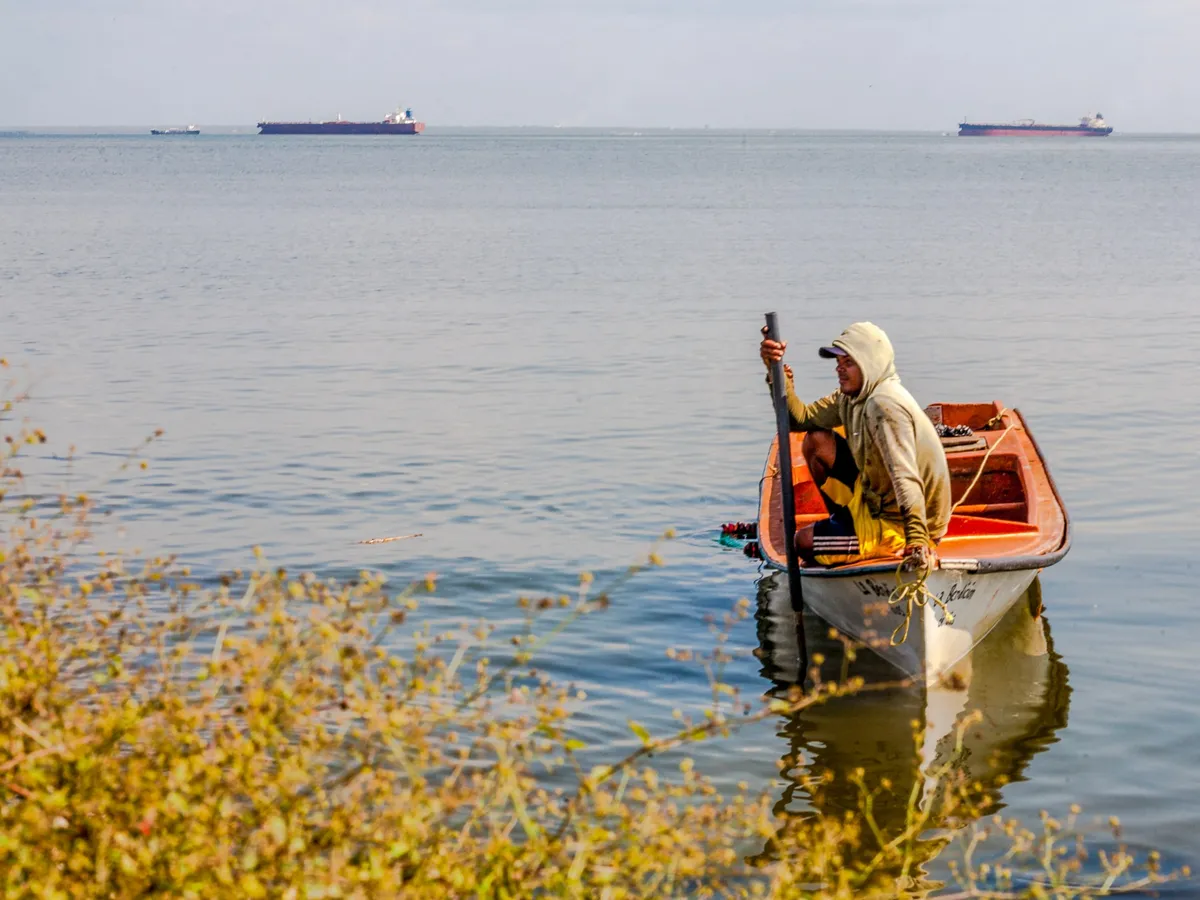
EXPLAINERUS companies developed Venezuelan oil fields until the country nationalised its oil reserves in the 1970s.A man sits in a boat with two crude oil tankers in the background on Lake Maracaibo, near Maracaibo, Zulia state, Venezuela on December 17, 2025 [AFP]Published On 18 Dec 2025United States Homeland Security Advisor and close Trump aide Stephen Miller suggested on Wednesday that Venezuela’s oil “belongs to Washington”.Miller’s comments came a day after US President Donald Trump posted on social media that he is imposing a “total and complete blockade” of sanctioned oil tankers entering and leaving Venezuela.The US has amassed the largest military force in the region in decades, just off the coast of Venezuela, and has carried out multiple strikes on boats it claims are trafficking drugs, killing about 90 people since September. However, the Trump administration has provided no evidence of drug trafficking, prompting claims that it is more interested in controlling oil in the region and forcing regime change in Venezuela.Here is a closer look at what Miller said and whether Washington could really lay claim to Venezuela’s oil.What did Miller say?In a post on X on Wednesday, Miller wrote: “American sweat, ingenuity and toil created the oil industry in Venezuela. Its tyrannical expropriation was the largest recorded theft of American wealth and property.”He added: “These pillaged assets were then used to fund terrorism and flood our streets with killers, mercenaries and drugs.”Miller also shared a screenshot of a Truth Social post from Trump on Tuesday, in which he accused Venezuela of “stealing” US oil, land and other assets, and using that oil to fund crime, terrorism and human trafficking.In the post, Trump declared Venezuela’s government a “foreign terrorist organisation” and ordered a total blockade of all sanctioned oil tankers going in or out of the country.Trump added that migrants sent by Venezuela are being deported quickly and demanded that all “stolen assets” be returned to the US immediately.Stephen Miller speaks to reporters outside the White House in Washington, DC, on October 24, 2025 [Kylie Cooper/Reuters]How much oil does Venezuela have?Today, Venezuela’s oil reserves are concentrated primarily in the Orinoco Belt, a vast region in the eastern part of the country stretching across roughly 55,000 square kilometres (21,235sq miles).While the country is home to the world’s largest proven oil reserves – at an estimated 303 billion barrels (Bbbl) as of 2023 – it earns only a fraction of the revenue it once did from exporting crude.According to data from the Observatory of Economic Complexity (OEC), Venezuela exported just $4.05bn worth of crude oil in 2023. This is far below other major exporters, including Saudi Arabia ($181bn), the US ($125bn), and Russia ($122bn).(Al Jazeera)Why does the US believe it has a claim to Venezuelan oil?US companies began drilling for oil in Venezuela in the early 1900s.In 1922, vast petroleum reserves were initially discovered by Royal Dutch Shell in Venezuela’s Lake Maracaibo, in Zulia state, northwestern Venezuela.At this point, the US ramped up its investment in the extraction and development of Venezuelan oil reserves. Companies such as Standard Oil led development under concession agreements, propelling Venezuela to a position as a key global supplier, especially for the US.Venezuela was a founding member of OPEC, joining at its creation on September 14, 1960. OPEC is a group of major oil-exporting countries that work together to manage supply and influence global oil prices.That began to wind up when Venezuela nationalised its oil industry in 1976 under then-President Carlos Andres Perez amid the oil boom. He established the state-owned Petroleos de Venezuela (PDVSA) to control all oil resources.Venezuela continued to be a major oil exporter to the US for some years, supplying 1.5 – 2 million barrels per day (bpd) in the late 1990s and early 2000s. But after Hugo Chavez took office in 1998, he nationalised all oil assets, seized foreign-owned assets, restructured PDVSA and prioritised political goals over exports, leading to declining production alongside mismanagement and underinvestment.When did the US impose sanctions on Venezuela?The US first imposed sanctions on Venezuelan oil in retaliation for nationalising oil assets in 2005.Under US sanctions, named individuals and companies are barred from accessing any property or financial assets held in the US. They cannot access US bank accounts, sell their property, or access their money if it passes through the US financial system.Any US companies or citizens doing business with any sanctioned individual or company will be penalised and risk becoming subject to enforcement actions.The sanctions extend beyond the individuals on the list. Any entity that is owned 50 percent or more, directly or indirectly, by one or more of the blocked people is also sanctioned as well, even if that company isn’t explicitly named.Under President Nicolas Maduro, the US imposed more sanctions in 2017 and tightened them again in 2019. This further restricted sales to the US and access for Venezuelan companies to global finance. As a result, oil exports to the US nearly stopped, and Venezuela shifted its trade mainly to China, with some sales to India and Cuba.Last week, the Trump administration imposed yet more sanctions – this time on Maduro family members and on Venezuelan tankers carrying sanctioned oil.Today, PDVSA controls the petroleum industry in Venezuela, and US involvement in Venezuelan oil drilling is limited. Houston-based Chevron is the only US company that still operates in Venezuela.Trump has repeatedly voiced his desire for the US to regain control of Venezuela’s oil.A commercial container ship sails on Lake Maracaibo, Venezuela, where oil was discovered in 1922 [Jose Bula Urrutia/UCG/Universal Images Group via Getty Images]Is there any legal basis to US claims on Venezuelan oil?No. International law is clear that sovereign states own the natural resources within their territories under the principle of Permanent Sovereignty over Natural Resources (PSNR).This means that sovereign states have the inherent right to control, use and dispose of their resources for their own development.The concept of PSNR emerged after 1945 during the decolonisation of former European colonies. It was solidified by the United Nations General Assembly in a resolution adopted in December 1962.Under this law, therefore, Venezuela owns its oil. It would be illegal under international law for the US to lay claim to it.Why does Chevron continue to operate there?Foreign oil companies are not permitted to own oil fields outright in Venezuela, so US oil group Chevron pays PDVSA a percentage of its output under a joint operation, which accounts for about one-fifth of Venezuela’s official oil production.This setup allows PDVSA to earn revenues from oil without directly selling to US buyers, which sanctions restrict, giving Venezuela an incentive to continue allowing Chevron to operate.To get around US restrictions, Chevron was granted a special licence by US President Joe Biden in 2022 to operate outside US sanctions. The Trump administration extended the firm another waiver this year.Chevron increased shipments of Venezuelan oil from 128,000bpd in October this year to 150,000bpd last month.Chevron has been operating in Venezuela for decades and has billions of dollars in assets there in the form of oil fields, facilities and infrastructure. If it were to withdraw from Venezuela, it would run a high risk of losing those assets forever, as Venezuela could seize them.
SRCAl Jazeera
LANGEN
LEANCenter
WORDS1 191
ENT8
THU · 2025-12-18 · 11:23 GMTBRIEF NSR-2025-1218-3264
NSR-2025-1218-3264News Report·EN·Political Strategy
Does the US have any real claim on Venezuelan oil as Stephen Miller says?
In December 2025, former Trump advisor Stephen Miller claimed Venezuela's oil "belongs to Washington," citing US companies' historical role in developing the country's oil industry before its nationalization in the 1970s. Miller alleged that Venezuela's "expropriation" was a theft of American wealth used to fund terrorism and drug trafficking.
Sarah ShamimAl JazeeraFiled 2025-12-18 · 11:23 GMTLean · CenterRead · 5 min
Al JazeeraFIG 01
Reading time
5min
Word count
1 191words
Sources cited
2cited
Entities identified
8entities
Quality score
100%
§ 01
Briefing Summary
AI-generatedNEWSAR · AI
In December 2025, former Trump advisor Stephen Miller claimed Venezuela's oil "belongs to Washington," citing US companies' historical role in developing the country's oil industry before its nationalization in the 1970s. Miller alleged that Venezuela's "expropriation" was a theft of American wealth used to fund terrorism and drug trafficking. This statement followed President Trump's announcement of a "total and complete blockade" of sanctioned oil tankers entering or leaving Venezuela. The US has amassed a significant military presence near Venezuela and conducted strikes on alleged drug trafficking boats. Venezuela possesses the world's largest proven oil reserves, primarily located in the Orinoco Belt.
Confidence 0.90Sources 2Claims 5Entities 8
§ 02
Article analysis
Model · rule-basedFraming
Political Strategy
Economic Impact
Tone
Mixed Tone
AI-assessed
CalmNeutralAlarmist
Factuality
0.70 / 1.00
Factual
LowHigh
Sources cited
2
Limited
FewMany
§ 03
Key claims
5 extracted01
American sweat, ingenuity and toil created the oil industry in Venezuela.
quoteStephen Miller
Confidence
1.00
02
Venezuela exported just $4.05bn worth of crude oil in 2023.
statisticObservatory of Economic Complexity (OEC)
Confidence
1.00
03
Venezuela is home to the world’s largest proven oil reserves – at an estimated 303 billion barrels as of 2023.
statisticAl Jazeera
Confidence
1.00
04
Trump is imposing a “total and complete blockade” of sanctioned oil tankers entering and leaving Venezuela.
quoteDonald Trump
Confidence
1.00
05
Stephen Miller suggested Venezuela’s oil “belongs to Washington”.
quoteStephen Miller
Confidence
1.00
§ 04
Full report
5 min read · 1 191 words§ 05
Entities
8 identifiedKey playerOppositionContextPositiveNeutralNegative
§ 06
Keywords & salience
9 termsvenezuelan oil
1.00
us claim
0.80
nationalization
0.70
stephen miller
0.70
trump administration
0.60
oil reserves
0.60
drug trafficking
0.50
blockade
0.50
stolen assets
0.40
§ 07
Topic connections
Interactive graph Network visualization showing 51 related topics
View Full Graph Person Organization Location Event|Click node to navigate|Edge numbers = shared articles